Living
Griffon or Weimaraner?
The Griffon for apartments and lower-energy households; the Weimaraner only with serious daily exercise and someone home often.

Quick answer
Griffon or Weimaraner?
The Griffon for apartments and lower-energy households; the Weimaraner only with serious daily exercise and someone home often.
Brussels Griffon or Weimaraner? On paper they differ most on apartment suitability, and on the scales Weimaraner is the heavier at 55–90 lbs. Here is how the two compare on everything that shapes an ordinary week.
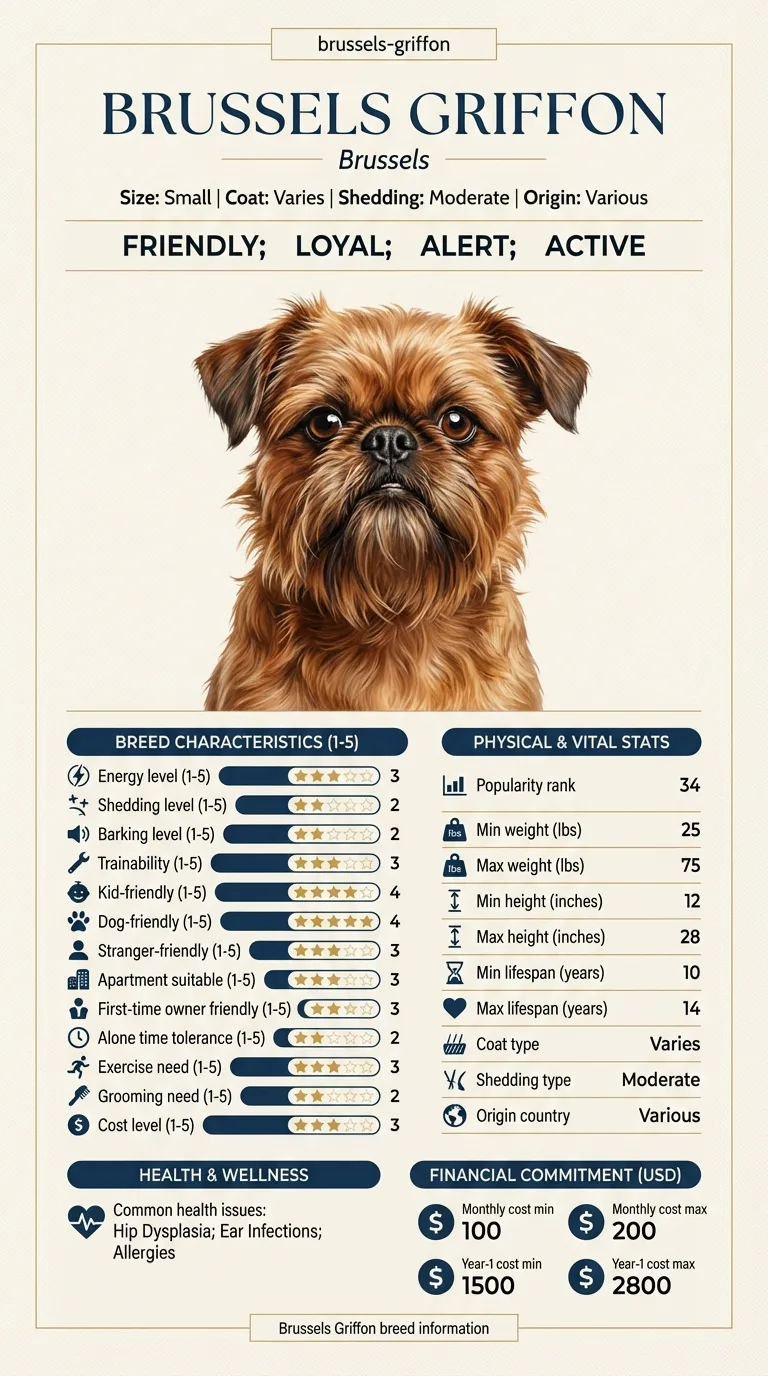
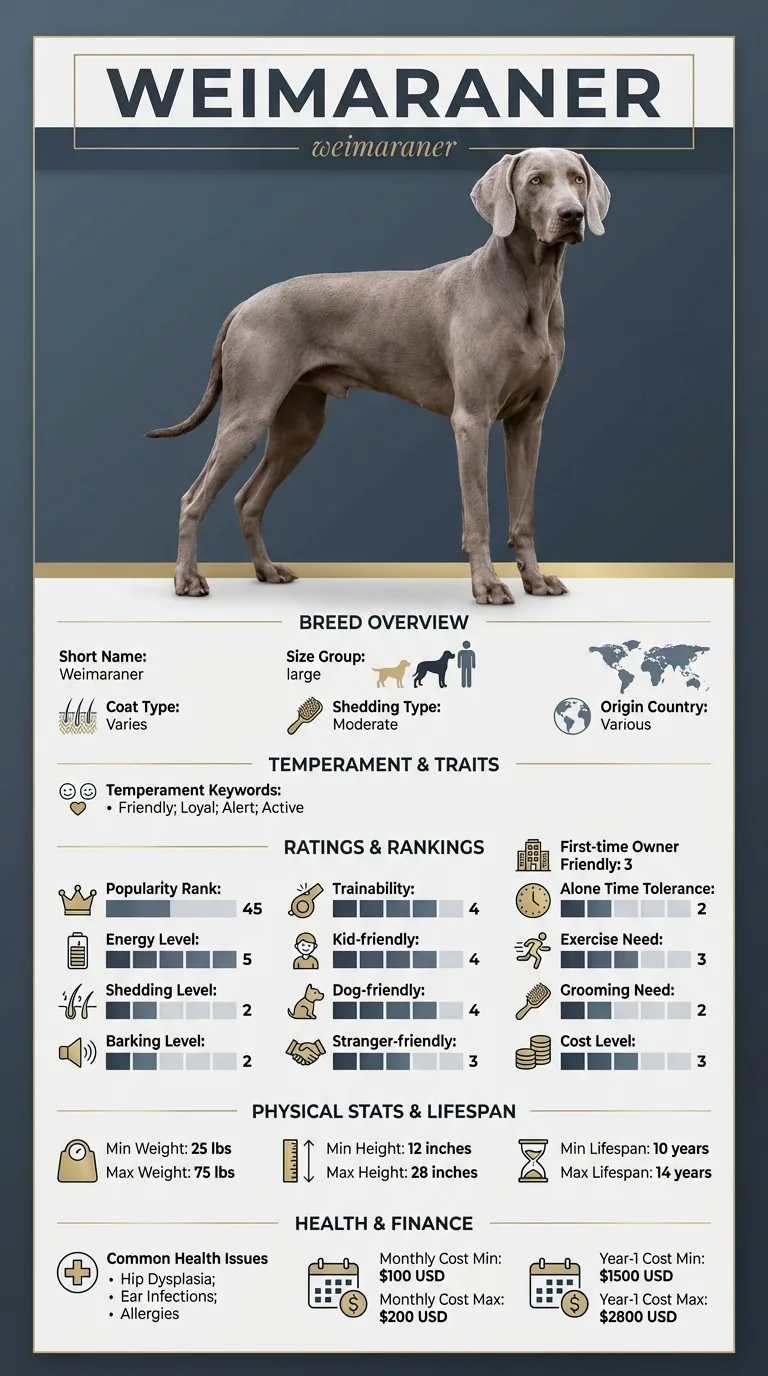
This is for someone already down to Brussels Griffon and Weimaraner and deciding between them. For this pair the decision usually turns on apartment suitability and exercise need, so those are covered first and in most detail. Anyone choosing from a flat has a clear answer here: Brussels Griffon rates 5/5 against 1/5. The focus throughout is on daily consequences rather than breed background.
Between Brussels Griffon and Weimaraner, apartment suitability is what separates them, and Brussels Griffon is the lower-effort dog of the two to keep.
Choose Brussels Griffon if you are in a flat or a smaller home, this is your first dog and your walking routine is modest.
Choose Weimaraner if you do not want a standing grooming appointment, there are young children at home and you want a dog that picks up training quickly.
| Feature | brussels griffon | weimaraner | Winner |
|---|---|---|---|
| Size class | small | large | Equal |
| Weight | 8–12 lbs | 55–90 lbs | Equal |
| Height | 7–10 in | 23–27 in | Equal |
| Lifespan | 12–15 years | 10–13 years | brussels griffon |
| Exercise need | Low (2/5) | Very high (5/5) | brussels griffon |
| Grooming need | Moderate (3/5) | Very low (1/5) | weimaraner |
| Shedding | Low (2/5) | Low (2/5) | Equal |
| Energy level | Moderate (3/5) | Very high (5/5) | Equal |
| Barking | Moderate (3/5) | Moderate (3/5) | Equal |
| Apartment suitability | Very high (5/5) | Very low (1/5) | brussels griffon |
| Good for first-time owners | Moderate (3/5) | Low (2/5) | brussels griffon |
| Tolerates being alone | Low (2/5) | Very low (1/5) | brussels griffon |
| Trainability | Moderate (3/5) | High (4/5) | weimaraner |
| Good with kids | Moderate (3/5) | High (4/5) | weimaraner |
| Good with other dogs | Moderate (3/5) | Moderate (3/5) | Equal |
| Friendly to strangers | Moderate (3/5) | Moderate (3/5) | Equal |
| Cost level | Moderate (3/5) | Moderate (3/5) | Equal |
| Coat | Rough or smooth | Short and sleek | Equal |
| Origin | Various | Various | Equal |
| Typical monthly cost | $80–$150 | $110–$240 | Equal |
| Typical first-year cost | $1,100–$2,300 | $1,700–$3,200 | Equal |
Few match-ups on this site span a bigger gap: the Griffon at 8–12 lbs and under 10 inches, the Weimaraner at 55–90 lbs and up to 27 inches. A large male Weimaraner can weigh more than seven Griffons combined. The sleek, silver-gray Weimaraner is built for endurance hunting; the Griffon is built to sit in your lap.
The Weimaraner needs a 5/5 amount of exercise against the Griffon's 2/5 — this is a breed developed to hunt large game across long distances and it needs real, sustained activity daily, not a walk around the block. The Griffon's needs are minimal by comparison. Under-exercise a Weimaraner and expect anxious, destructive behavior; the same neglect barely registers with a Griffon.
The Weimaraner's short, sleek coat needs almost no grooming (1/5) and sheds lightly (2/5, tied with the Griffon), making it one of the lowest-maintenance coats on the site despite the dog's size. The Griffon needs moderate grooming (3/5) for its rough or smooth coat. So while the Weimaraner dwarfs the Griffon in every other measurement, coat care is roughly a wash, maybe even easier with the big dog.
The contrast is severe: 5/5 apartment suitability for the Griffon, 1/5 for the Weimaraner. Barking ties at moderate (3/5), so noise isn't the issue — space and exercise are. Alone tolerance is a serious concern for the Weimaraner specifically, rated a rock-bottom 1/5, and its health list even names separation anxiety directly as a known risk, which the Griffon's low-but-milder 2/5 doesn't approach.
The Weimaraner trains well (4/5) but its first-time-owner score is only 2/5, reflecting how much structure and exercise it needs to channel that intelligence productively. The Griffon trains at a moderate 3/5 and suits a first-timer slightly better (3/5 overall). Neither is a bad choice for a beginner outright, but the Weimaraner asks more of an inexperienced owner's time and consistency.
The Weimaraner scores better with kids (4/5 versus the Griffon's 3/5), and the two tie on both friendliness to strangers and compatibility with other dogs, both landing at moderate (3/5). Weimaraners are loyal, alert family dogs once their exercise needs are met — the challenge isn't sociability, it's whether a household can supply the daily activity the breed's health profile suggests it needs.
The Griffon's lifespan advantage is real here — 12–15 years versus the Weimaraner's shorter 10–13 — and the two share no listed conditions in common. The Weimaraner's risks include bloat (GDV), hypertrophic osteodystrophy, Von Willebrand disease, and separation anxiety, a profile typical of large, deep-chested working breeds. The Griffon's concerns instead center on airway and skeletal issues tied to its small, flat-faced build.
Both rate a moderate 3/5 cost level, but the dollar ranges tell a fuller story: $80–$150 monthly and $1,100–$2,300 for year one with a Griffon, against $110–$240 and $1,700–$3,200 for a Weimaraner. Feeding a 55–90 lb dog costs meaningfully more than feeding a 10-lb one, and that gap compounds over a dog's lifetime.
Brussels Griffon weighs 8–12 lbs and lives 12–15 years; Weimaraner weighs 55–90 lbs and lives 10–13 years. The two diverge most on apartment suitability, exercise need and grooming need and 1 other rated axes. They are level on barking, cost level and good with other dogs, so those cannot decide it. The table below marks a winner only where one breed is genuinely easier for a typical owner; size and origin are facts rather than merits and stay level. Ratings come from one source applied to both breeds, so they are meaningful against each other rather than as absolute scores.

Enormously bigger — 55 to 90 lbs versus the Griffon's 8 to 12 lbs, one of the largest size gaps in any comparison on this site.
The Weimaraner, at the top of the scale (5/5), versus the Griffon's minimal 2/5.
They're tied at low (2/5) — the Weimaraner's short coat sheds surprisingly little for its size.
No — it rates 1/5 for apartment suitability, the lowest score, mainly due to its exercise needs and documented tendency toward separation anxiety.
The Weimaraner runs higher, $110-240 versus the Griffon's $80-150, reflecting the cost of feeding a much larger dog.
No overlapping conditions are listed. The Weimaraner's risks include bloat and separation anxiety; the Griffon's center on airway and joint issues.
The Griffon, by a couple of years on average — 12-15 years versus the Weimaraner's 10-13.
The Griffon for apartments and lower-energy households; the Weimaraner only with serious daily exercise and someone home often.
The Weimaraner costs more, $110-240 versus the Griffon's $80-150.
The Weimaraner needs intense daily exercise (5/5); the Griffon needs very little (2/5).
The Griffon lives longer on average, 12-15 years versus the Weimaraner's 10-13.
Secure checkout on Stripe. We never see your card.
7-day money-back guarantee. Instant access.

Health information here is general and is not veterinary advice. If your dog shows pain, sudden behaviour change, or worsening symptoms, consult a licensed veterinarian.
Some links on this site are affiliate links. We may earn a commission at no extra cost to you, and we only suggest products we believe are helpful for dog owners.
We research and check what we publish, but we do not warrant that any figure, date, price, or statement is accurate, complete, or current, and we accept no liability for any loss, cost, injury, or other harm arising from the use of this site. Use it as one reference among several. You remain responsible for your own decisions and for your dog's care - confirm anything that matters with a licensed veterinarian or another qualified professional before you act on it. Full disclaimer.
Match your lifestyle to the right dog.
Take quizNot sure which breed is right for you? Take our 2-minute quiz to find out.
Take the quiz