Living
Griffon or Shiba — which is the easier dog?
The Griffon, for most owners — it's more trainable, friendlier with other dogs, and better suited to a first-time owner.

Quick answer
Griffon or Shiba — which is the easier dog?
The Griffon, for most owners — it's more trainable, friendlier with other dogs, and better suited to a first-time owner.
Brussels Griffon or Shiba Inu? On paper they differ most on shedding, and on the scales Shiba Inu is the heavier at 17–23 lbs. Here is how the two compare on everything that shapes an ordinary week.
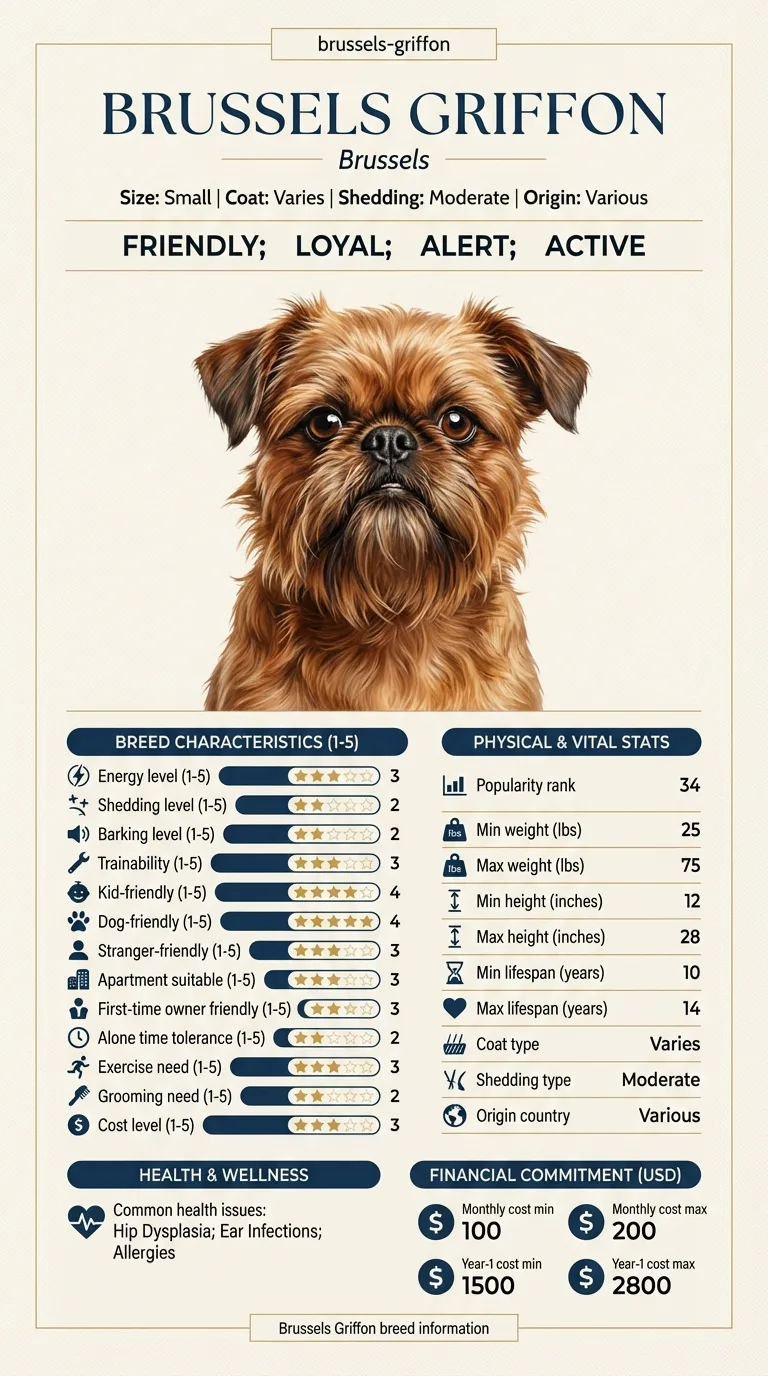
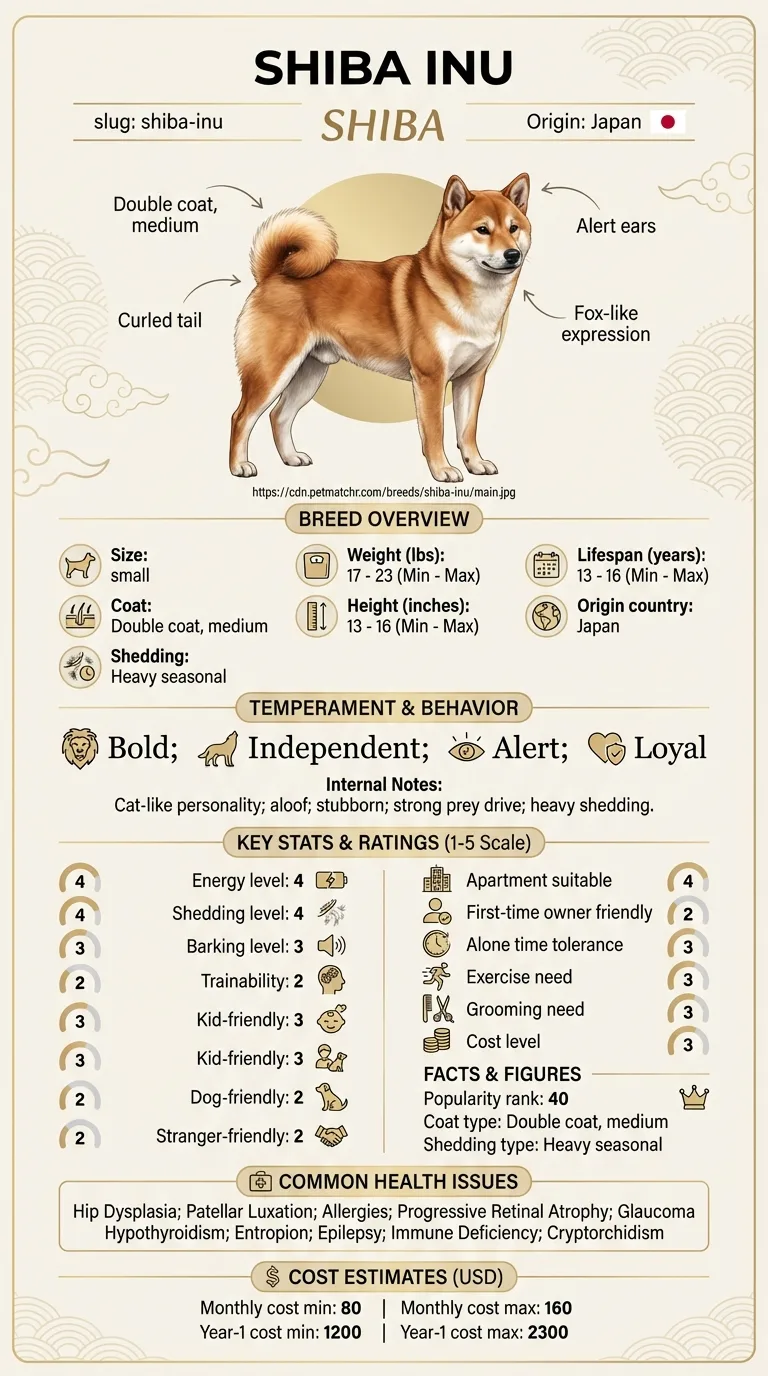
This is for someone already down to Brussels Griffon and Shiba Inu and deciding between them. For this pair the decision usually turns on shedding, so those are covered first and in most detail. Anyone choosing from a flat has a clear answer here: Brussels Griffon rates 5/5 against 4/5. Breed history is left out; what follows is what you will actually live with.
Between Brussels Griffon and Shiba Inu, shedding is what separates them, and Brussels Griffon is the lower-effort dog of the two to keep.
Choose Brussels Griffon if you are in a flat or a smaller home, this is your first dog and shedding is a problem in your house.
Choose Shiba Inu if the dog will be alone during the working day, you want a dog that can keep up with an active routine and you want a dog that is more watchful with visitors.
| Feature | brussels griffon | shiba inu | Winner |
|---|---|---|---|
| Size class | small | small | Equal |
| Weight | 8–12 lbs | 17–23 lbs | Equal |
| Height | 7–10 in | 13–16 in | Equal |
| Lifespan | 12–15 years | 13–16 years | shiba inu |
| Exercise need | Low (2/5) | Moderate (3/5) | brussels griffon |
| Grooming need | Moderate (3/5) | Moderate (3/5) | Equal |
| Shedding | Low (2/5) | High (4/5) | brussels griffon |
| Energy level | Moderate (3/5) | High (4/5) | Equal |
| Barking | Moderate (3/5) | Moderate (3/5) | Equal |
| Apartment suitability | Very high (5/5) | High (4/5) | brussels griffon |
| Good for first-time owners | Moderate (3/5) | Low (2/5) | brussels griffon |
| Tolerates being alone | Low (2/5) | Moderate (3/5) | shiba inu |
| Trainability | Moderate (3/5) | Low (2/5) | brussels griffon |
| Good with kids | Moderate (3/5) | Moderate (3/5) | Equal |
| Good with other dogs | Moderate (3/5) | Low (2/5) | brussels griffon |
| Friendly to strangers | Moderate (3/5) | Low (2/5) | brussels griffon |
| Cost level | Moderate (3/5) | Moderate (3/5) | Equal |
| Coat | Rough or smooth | Double coat, medium | Equal |
| Origin | Various | Japan | Equal |
| Typical monthly cost | $80–$150 | $80–$160 | Equal |
| Typical first-year cost | $1,100–$2,300 | $1,200–$2,300 | Equal |
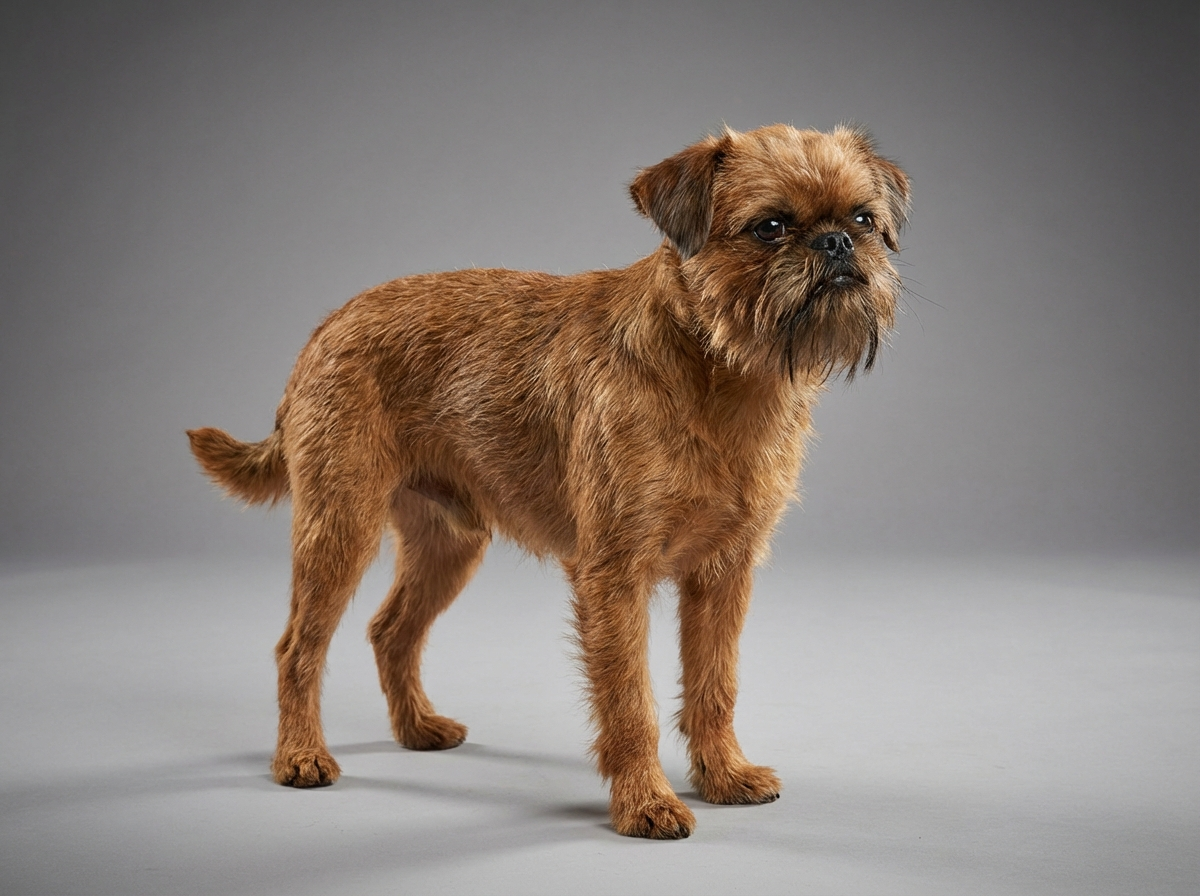
The Griffon weighs 8–12 lbs and stands under 10 inches; the Shiba runs 17–23 lbs and up to 16 inches — nearly double the Griffon's weight despite both counting as small breeds. The Shiba's fox-like, athletic build reads as a different animal entirely once you see them side by side, even though the height gap (7–10 in vs 13–16 in) is the bigger visual tell.
The Shiba needs more daily activity than the Griffon — 3/5 versus 2/5 — though neither is an endurance breed. What separates them in practice is temperament during exercise: the Shiba is bold and independent and will happily wander off-leash investigating on its own terms, while the Griffon is content pottering around at your heel. A fenced yard or a solid recall matters more with the Shiba.
Grooming effort ties at moderate (3/5) for both, but shedding does not — the Shiba's double coat rates a 4/5, the Griffon's a 2/5. Shiba owners deal with two seasonal blowouts a year that can carpet a room in undercoat within days. The Griffon sheds steadily but lightly, with nothing close to that seasonal dump.
Both handle small spaces reasonably well — Griffon 5/5, Shiba 4/5 — and neither is a particularly loud breed, tying at moderate (3/5) barking. The bigger apartment-living concern with the Shiba is less about noise and more about its low tolerance for boredom paired with a stubborn streak; left alone too often, that independence can turn into destructive habits rather than barking fits.
The numbers here favor the Griffon for new owners — 3/5 versus the Shiba's 2/5 for first-timer suitability, and 3/5 versus 2/5 for trainability. Shibas are famously cat-like: intelligent but unmotivated by pleasing you, which makes obedience work slower going even with an experienced trainer. The Griffon is also independent-minded but responds better to patient, consistent handling.
With other dogs and with strangers, the Griffon comes out ahead — 3/5 to the Shiba's 2/5 on both counts. Shibas are territorial and can be scrappy with unfamiliar dogs, a trait bred into them as small-game hunters. Around kids the two tie at 3/5, so neither has a strong edge there, but Shiba households generally need more supervision at the dog park.
The Shiba actually outlives the Griffon slightly — 13–16 years versus 12–15 — and shares two risks with it: hip dysplasia and patellar luxation. Past that overlap, the Shiba's list runs long, including progressive retinal atrophy, glaucoma, epilepsy, and immune deficiency, while the Griffon's concerns center on brachycephalic airway issues and syringomyelia. Neither list is short; both warrant a breeder who screens routinely.
Costs sit close together — $80–$150 a month for the Griffon against $80–$160 for the Shiba, and $1,100–$2,300 versus $1,200–$2,300 for the first year. Both rate a moderate 3/5 cost level. There's no real financial argument for one over the other; the decision comes down to temperament and how much independence you want to manage.
Brussels Griffon weighs 8–12 lbs and lives 12–15 years; Shiba Inu weighs 17–23 lbs and lives 13–16 years. The two diverge most on shedding. They are level on barking, cost level and grooming need, so those cannot decide it. The comparison marks an easier option only where one exists. Facts like weight and country of origin are not scored. Both dogs are rated from the same dataset, which is what makes the numbers comparable with each other even though any individual dog sits somewhere inside its breed's range.

Yes, noticeably — 17 to 23 lbs against the Griffon's 8 to 12 lbs, and several inches taller. Both are still classified as small breeds, but the Shiba is a much sturdier dog.
The Shiba, by a wide margin — a 4/5 shedding rating against the Griffon's 2/5, thanks to its double coat and seasonal blowouts.
The Griffon is the easier of the two, rated 3/5 versus the Shiba's 2/5. Shibas are intelligent but famously indifferent to pleasing their owner, which trips up a lot of new trainers.
Both do fine in small spaces — Griffon 5/5, Shiba 4/5 — and neither barks excessively. The Shiba's challenge indoors is more about boredom-driven mischief than noise.
Barely any — $80–$150 for the Griffon versus $80–$160 for the Shiba. First-year costs land within $100 of each other too.
Hip dysplasia and patellar luxation show up on both lists. Beyond that, the Shiba's health list is considerably longer, covering eye conditions like PRA and glaucoma plus epilepsy and immune deficiency.
The Griffon, 3/5 versus the Shiba's 2/5. Shibas can be territorial with unfamiliar dogs, a trait from their hunting-breed background, so dog-park introductions need more care.
The Griffon, for most owners — it's more trainable, friendlier with other dogs, and better suited to a first-time owner.
Nearly identical: $80–$150 for the Griffon, $80–$160 for the Shiba.
The Shiba, slightly (3/5 vs 2/5), though neither is a high-energy breed by dog standards.
The Shiba, typically 13–16 years versus the Griffon's 12–15.
Secure checkout on Stripe. We never see your card.
7-day money-back guarantee. Instant access.
Health information here is general and is not veterinary advice. If your dog shows pain, sudden behaviour change, or worsening symptoms, consult a licensed veterinarian.
Some links on this site are affiliate links. We may earn a commission at no extra cost to you, and we only suggest products we believe are helpful for dog owners.
We research and check what we publish, but we do not warrant that any figure, date, price, or statement is accurate, complete, or current, and we accept no liability for any loss, cost, injury, or other harm arising from the use of this site. Use it as one reference among several. You remain responsible for your own decisions and for your dog's care - confirm anything that matters with a licensed veterinarian or another qualified professional before you act on it. Full disclaimer.
Match your lifestyle to the right dog.
Take quizNot sure which breed is right for you? Take our 2-minute quiz to find out.
Take the quiz