Training
Basset Hound or Boxer for a first dog?
The Basset Hound is the gentler intro - lower exercise demands and higher marks for first-time owners (4/5 vs 3/5) - even though the Boxer is actually easier to obedience-train.

Quick answer
Basset Hound or Boxer for a first dog?
The Basset Hound is the gentler intro - lower exercise demands and higher marks for first-time owners (4/5 vs 3/5) - even though the Boxer is actually easier to obedience-train.
Basset Hound or Boxer? On paper they differ most on exercise need, and on the scales Boxer is the heavier at 60–70 lbs. Here is how the two compare on everything that shapes an ordinary week.
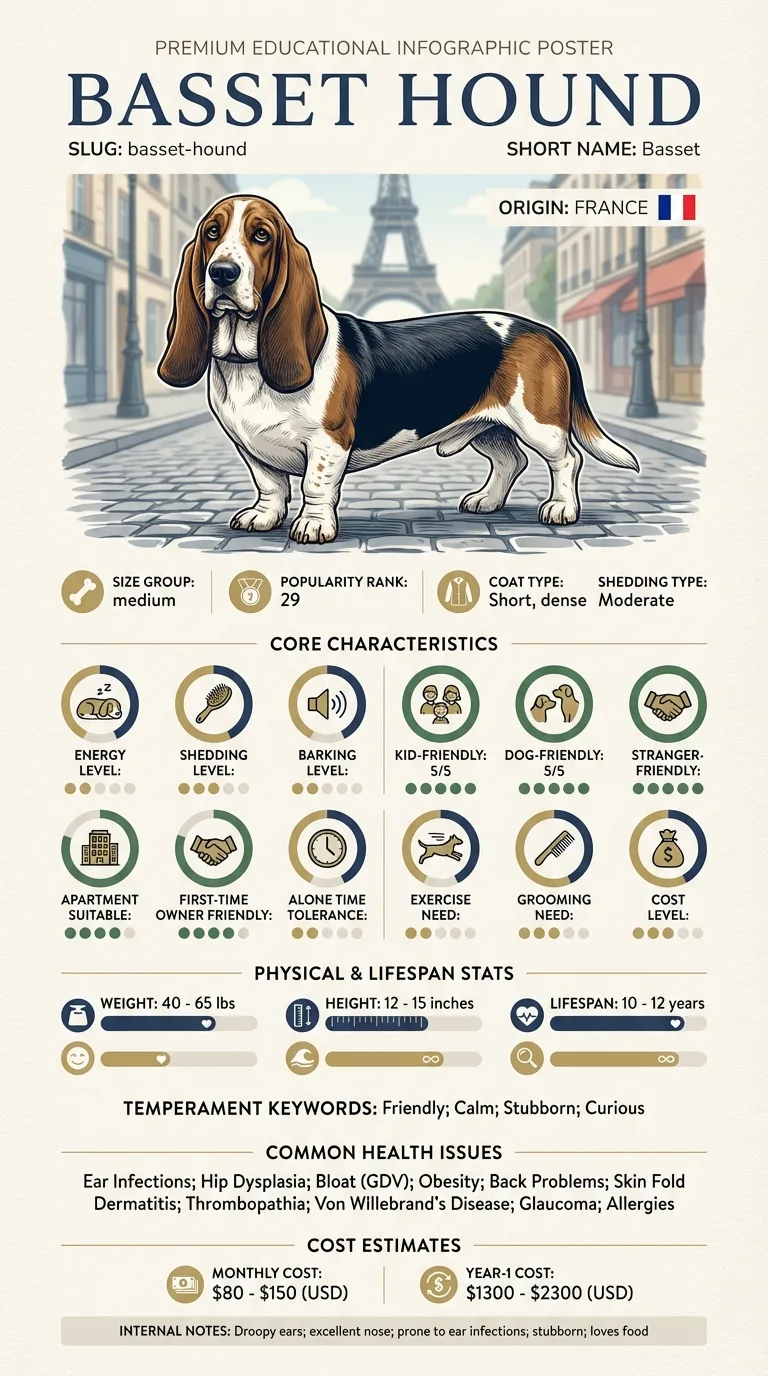
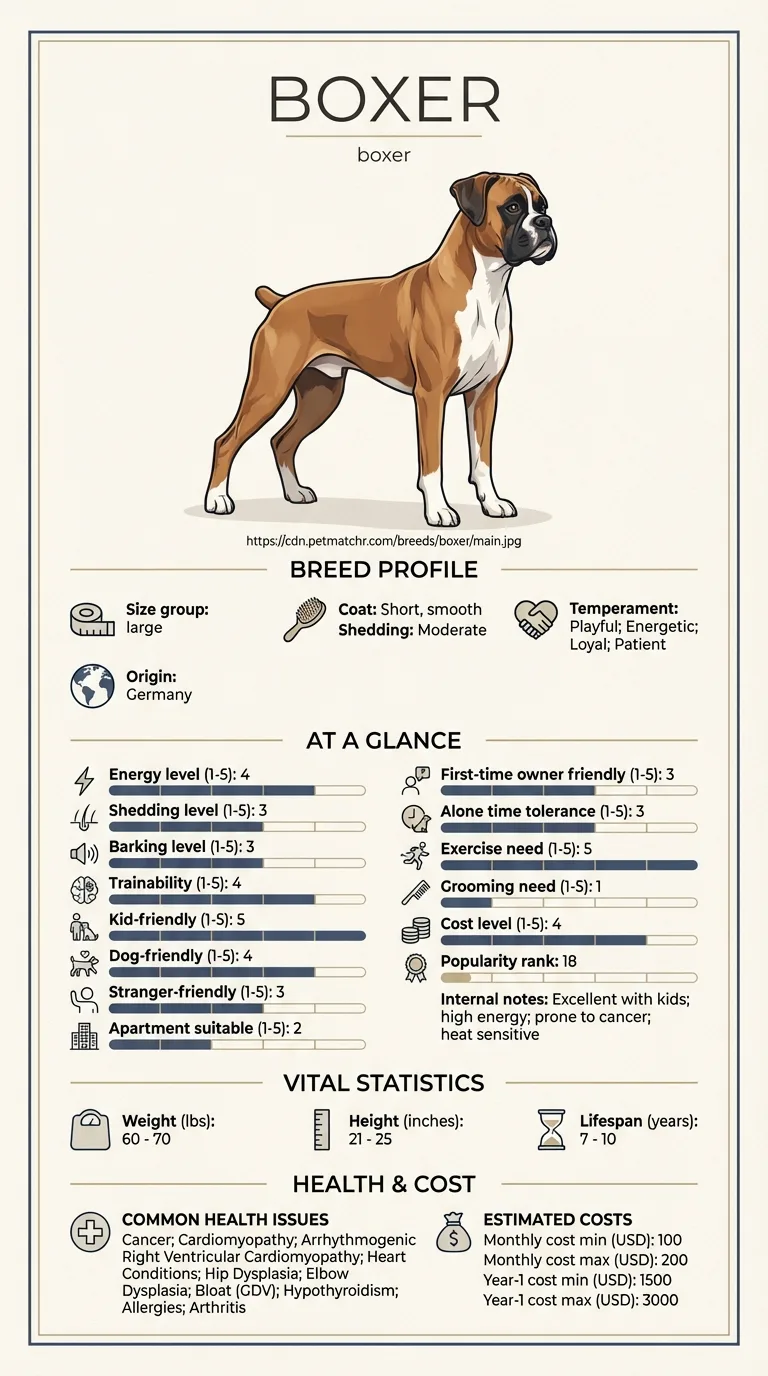
This is for someone already down to Basset Hound and Boxer and deciding between them. For this pair the decision usually turns on exercise need and grooming need, so those are covered first and in most detail. Anyone choosing from a flat has a clear answer here: Basset Hound rates 4/5 against 2/5. It is written for the decision rather than the breed history.
Between Basset Hound and Boxer, exercise need is what separates them, and Basset Hound is the lower-effort dog of the two to keep.
Choose Basset Hound if you are in a flat or a smaller home, this is your first dog and your walking routine is modest.
Choose Boxer if you do not want a standing grooming appointment, the dog will be alone during the working day and you want a dog that picks up training quickly.
| Feature | basset hound | boxer | Winner |
|---|---|---|---|
| Size class | medium | large | Equal |
| Weight | 40–65 lbs | 60–70 lbs | Equal |
| Height | 12–15 in | 21–25 in | Equal |
| Lifespan | 10–12 years | 7–10 years | basset hound |
| Exercise need | Low (2/5) | Very high (5/5) | basset hound |
| Grooming need | Moderate (3/5) | Very low (1/5) | boxer |
| Shedding | Moderate (3/5) | Moderate (3/5) | Equal |
| Energy level | Low (2/5) | High (4/5) | Equal |
| Barking | Low (2/5) | Moderate (3/5) | basset hound |
| Apartment suitability | High (4/5) | Low (2/5) | basset hound |
| Good for first-time owners | High (4/5) | Moderate (3/5) | basset hound |
| Tolerates being alone | Low (2/5) | Moderate (3/5) | boxer |
| Trainability | Low (2/5) | High (4/5) | boxer |
| Good with kids | Very high (5/5) | Very high (5/5) | Equal |
| Good with other dogs | Very high (5/5) | High (4/5) | basset hound |
| Friendly to strangers | Very high (5/5) | Moderate (3/5) | basset hound |
| Cost level | Moderate (3/5) | High (4/5) | basset hound |
| Coat | Short, dense | Short, smooth | Equal |
| Origin | France | Germany | Equal |
| Typical monthly cost | $80–$150 | $100–$200 | Equal |
| Typical first-year cost | $1,300–$2,300 | $1,500–$3,000 | Equal |
A Boxer at 60-70 lbs and 21-25 inches tall is built to move - long legs, athletic frame. The Basset Hound, at a comparable 40-65 lbs, carries that weight on legs barely a foot off the ground. Picking these two up side by side, you'd guess the weight difference is bigger than it is; the height gap is what actually separates them.
This is the starkest split in the whole comparison: Basset Hound at 2/5 exercise need, Boxer at 5/5. A Boxer that doesn't get real daily exercise - not a stroll, a workout - will find its own outlets, usually destructive ones. The Basset is satisfied with a short walk and a nap. There's no realistic middle ground here, and it's the single fact most likely to decide this comparison for a given household.
Both shed at a moderate 3/5 rate, so neither is hypoallergenic-friendly. Grooming effort differs though - the Boxer's coat needs almost nothing (1/5), while the Basset's moderate coat (3/5) plus its ears require more routine maintenance to avoid infection. Neither dog needs professional grooming on a set schedule, but the Basset's ears do need a weekly check the Boxer's coat never asks for.
The Basset scores high (4/5) for apartment life and barks rarely (2/5). The Boxer scores low (2/5) for apartments - not because of noise, which is moderate (3/5), but because a high-energy, athletic dog in a small space with no yard tends to become a handful. This pairs directly with the exercise gap above. A fenced yard changes the calculation considerably for the Boxer, but that's not something every renter has access to.
The Boxer is meaningfully easier to train (4/5 vs the Basset's 2/5) and rated moderate (3/5) for first-time owners versus the Basset's high (4/5) - so the harder-to-train dog is still considered the easier first dog overall, largely thanks to its low exercise demands and mellow nature. The Basset's temperament list calls it "stubborn," while the Boxer's calls it "patient" - two words that predict a lot about how each responds to a training session.
Both breeds are rated very high (5/5) with kids. The Basset pulls ahead with other dogs (5/5 vs 4/5) and especially with strangers (5/5 vs a middling 3/5) - the Boxer is more reserved with people it doesn't know, which matters if you host often. Both dogs' temperament lists mention loyalty, but only the Basset's includes "friendly" as a headline trait, which lines up with its stronger stranger score.
Here the Basset actually has the edge, living 10-12 years against the Boxer's 7-10. The Boxer's health list is heavy on the heart - cardiomyopathy, arrhythmogenic right ventricular cardiomyopathy, and general heart conditions all appear, alongside cancer risk. The Basset's risks are tied to its body shape rather than its heart. Owners considering a Boxer should ask a vet about cardiac screening options, since arrhythmogenic right ventricular cardiomyopathy specifically is a breed-linked condition.
The Boxer costs more to keep: high (4/5) cost level against the Basset's moderate (3/5), monthly costs of $100-200 vs $80-150, and a first-year range of $1,500-3,000 vs $1,300-2,300. Some of that gap likely reflects the heart-related veterinary monitoring a Boxer may need over its life. First-time Boxer owners should budget toward the higher end of that range if regular cardiac checkups become part of the dog's routine care.
Basset Hound weighs 40–65 lbs and lives 10–12 years; Boxer weighs 60–70 lbs and lives 7–10 years. The two diverge most on exercise need, grooming need and energy level and 3 other rated axes. They are level on good with kids and shedding, so those cannot decide it. In the table, a "winner" means easier for an ordinary household — not better. Size, coat and origin are recorded without a verdict. Because both breeds are scored the same way, the gaps are reliable even where the absolute numbers are rough.

Based on the ratings, likely yes - apartment suitability sits at 2/5 for the Boxer against 4/5 for the Basset Hound, driven by the Boxer's very high (5/5) exercise need. A Boxer without a yard and a serious daily routine is a mismatch for small spaces.
The Basset Hound, by a real margin - 10-12 years versus the Boxer's 7-10. That's despite the Basset facing more chronic conditions on its own list; the Boxer's shorter lifespan is tied largely to cardiac and cancer risk.
The Basset Hound rates very high (5/5) here; the Boxer sits at moderate (3/5). Boxers tend to be more watchful of unfamiliar people, even though both breeds score a full 5/5 with kids in the household.
Roughly $20-50 more per month and up to $700 more in the first year, according to the typical ranges given. The Boxer's cost level is rated high (4/5) against the Basset's moderate (3/5).
The Boxer, clearly - 4/5 trainability against the Basset's 2/5. The Basset's independent, scent-driven nature makes it slower to respond to obedience work.
Bloat (GDV) appears on both lists, so deep-chested-dog precautions - slower feeding, avoiding exercise right after meals - apply to either. Beyond that, their risk profiles diverge: the Basset toward back and ear issues, the Boxer toward heart disease and cancer.
Yes - it's rated 2/5 for both exercise need and general energy level, the lowest score either breed gets, and a short walk plus lounging time is enough to satisfy it.
The Basset Hound is the gentler intro - lower exercise demands and higher marks for first-time owners (4/5 vs 3/5) - even though the Boxer is actually easier to obedience-train.
The Boxer runs about $20-50 more per month ($100-200 vs $80-150) and carries a high (4/5) cost rating against the Basset's moderate (3/5).
The Boxer, by far - a 5/5 exercise need against the Basset Hound's 2/5. This is the single biggest difference between the two breeds.
The Basset Hound, at 10-12 years compared to the Boxer's 7-10 years.
Secure checkout on Stripe. We never see your card.
7-day money-back guarantee. Instant access.
Health information here is general and is not veterinary advice. If your dog shows pain, sudden behaviour change, or worsening symptoms, consult a licensed veterinarian.
Some links on this site are affiliate links. We may earn a commission at no extra cost to you, and we only suggest products we believe are helpful for dog owners.
We research and check what we publish, but we do not warrant that any figure, date, price, or statement is accurate, complete, or current, and we accept no liability for any loss, cost, injury, or other harm arising from the use of this site. Use it as one reference among several. You remain responsible for your own decisions and for your dog's care - confirm anything that matters with a licensed veterinarian or another qualified professional before you act on it. Full disclaimer.
Match your lifestyle to the right dog.
Take quizNot sure which breed is right for you? Take our 2-minute quiz to find out.
Take the quiz