Living
Which is the easier overall choice?
For most households the AmStaff is the gentler entry point, lower exercise demand, friendlier with strangers, and a slightly easier first-time-owner score.

Quick answer
Which is the easier overall choice?
For most households the AmStaff is the gentler entry point, lower exercise demand, friendlier with strangers, and a slightly easier first-time-owner score.
American Staffordshire Terrier or Doberman Pinscher? On paper they differ most on friendly to strangers, and on the scales Doberman Pinscher is the heavier at 60–100 lbs. Here is how the two compare on everything that shapes an ordinary week.
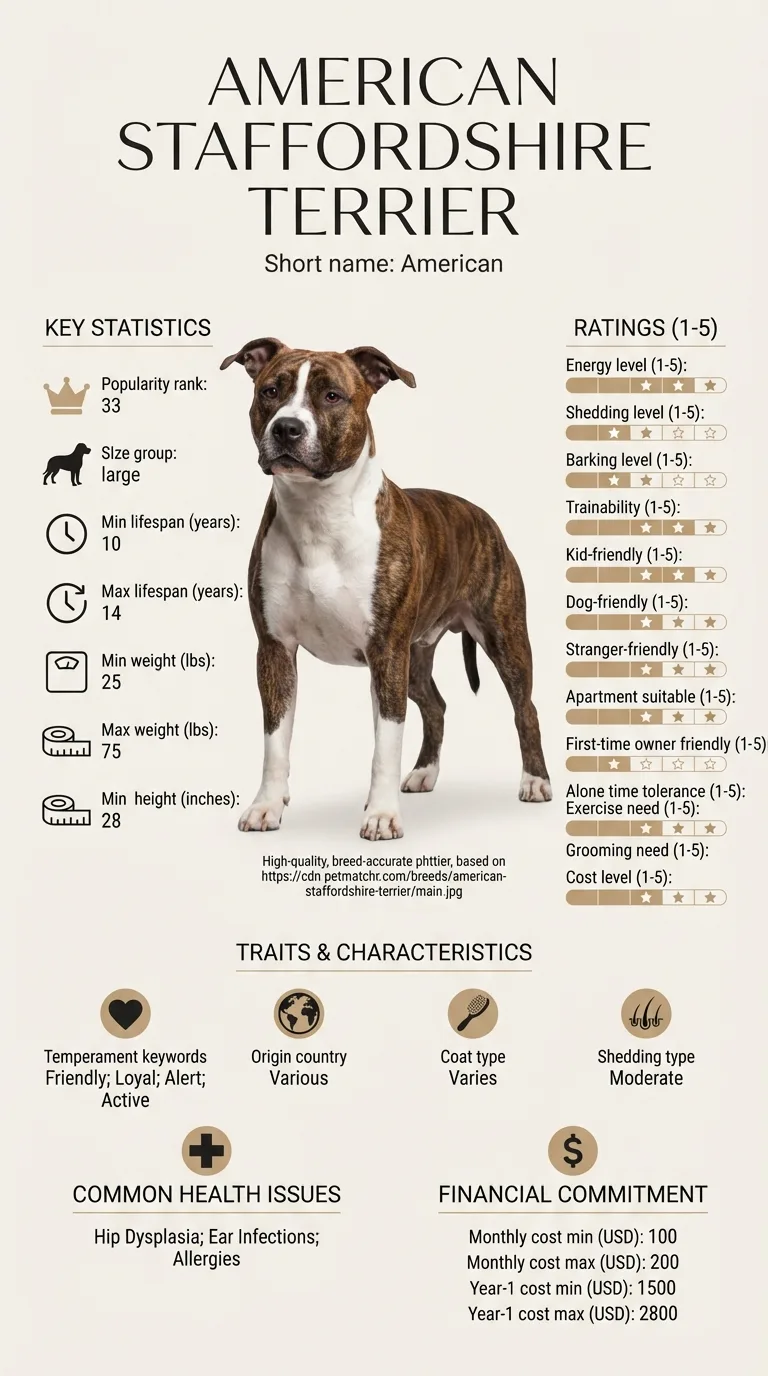
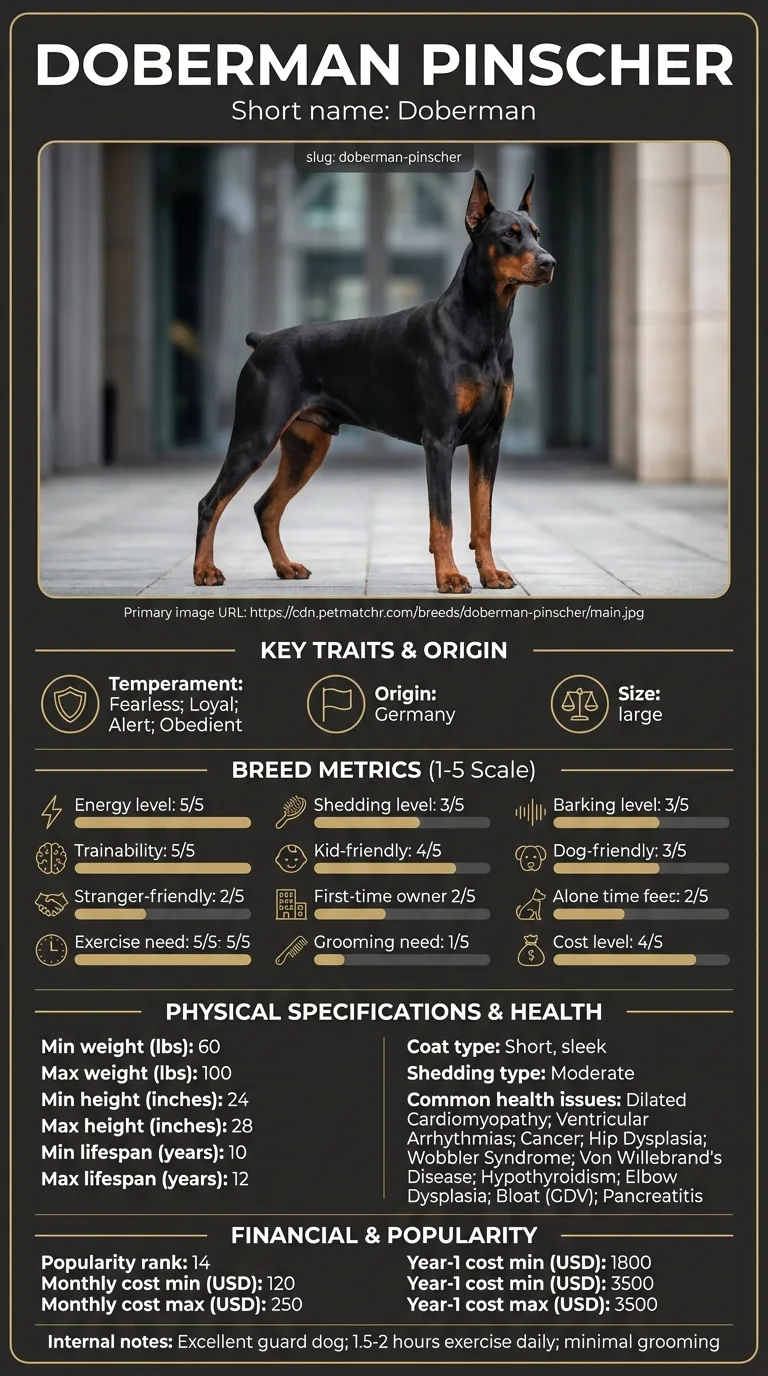
This is for someone already down to American Staffordshire Terrier and Doberman Pinscher and deciding between them. For this pair the decision usually turns on friendly to strangers, so those are covered first and in most detail. Anyone choosing from a flat has a clear answer here: American Staffordshire Terrier rates 3/5 against 2/5. The focus throughout is on daily consequences rather than breed background.
Between American Staffordshire Terrier and Doberman Pinscher, friendly to strangers is what separates them, and American Staffordshire Terrier is the lower-effort dog of the two to keep.
Choose American Staffordshire Terrier if you are in a flat or a smaller home, this is your first dog and your walking routine is modest.
Choose Doberman Pinscher if you already have another dog, you want a dog that picks up training quickly and you want a dog that can keep up with an active routine.
| Feature | american staffordshire terrier | doberman pinscher | Winner |
|---|---|---|---|
| Size class | medium | large | Equal |
| Weight | 40–70 lbs | 60–100 lbs | Equal |
| Height | 17–19 in | 24–28 in | Equal |
| Lifespan | 12–16 years | 10–12 years | american staffordshire terrier |
| Exercise need | High (4/5) | Very high (5/5) | american staffordshire terrier |
| Grooming need | Very low (1/5) | Very low (1/5) | Equal |
| Shedding | Moderate (3/5) | Moderate (3/5) | Equal |
| Energy level | High (4/5) | Very high (5/5) | Equal |
| Barking | Low (2/5) | Moderate (3/5) | american staffordshire terrier |
| Apartment suitability | Moderate (3/5) | Low (2/5) | american staffordshire terrier |
| Good for first-time owners | Moderate (3/5) | Low (2/5) | american staffordshire terrier |
| Tolerates being alone | Moderate (3/5) | Low (2/5) | american staffordshire terrier |
| Trainability | High (4/5) | Very high (5/5) | doberman pinscher |
| Good with kids | High (4/5) | High (4/5) | Equal |
| Good with other dogs | Low (2/5) | Moderate (3/5) | doberman pinscher |
| Friendly to strangers | High (4/5) | Low (2/5) | american staffordshire terrier |
| Cost level | Moderate (3/5) | High (4/5) | american staffordshire terrier |
| Coat | Short, stiff and glossy | Short, sleek | Equal |
| Origin | Various | Germany | Equal |
| Typical monthly cost | $100–$200 | $120–$250 | Equal |
| Typical first-year cost | $1,400–$2,900 | $1,800–$3,500 | Equal |
The Doberman is the bigger dog by a clear margin, 60 to 100 pounds and 24 to 28 inches at the shoulder, against the AmStaff's 40 to 70 pounds and 17 to 19 inches. Both are lean, muscled breeds rather than bulky ones, but the Doberman's added height changes how much space and how strong a leash arm you need.
Exercise need tops out near the max for the Doberman, a 5 out of 5, one full point above the AmStaff's already-high 4. Energy level mirrors that gap. If your current activity level struggles to tire out an AmStaff, a Doberman is going to ask for more, not less. Think an hour or more of real exercise a day, not just a lap around the block, if a Doberman is the one you bring home.
Coat care is a non-issue either way, both breeds rate a 1 out of 5 for grooming and a matching 3 for shedding, thanks to short, sleek coats that need little beyond an occasional wipe-down. This is one of the few categories where the two breeds line up almost exactly. Neither breed needs a groomer's help for anything beyond nail trims and the occasional bath, which keeps this category cheap and low-effort for both.
Neither breed is built for tight quarters, but the AmStaff scores a bit better across the board here: 3 versus 2 for apartment suitability, 3 versus 2 for tolerating time alone. The Doberman also barks a touch more, 3 to the AmStaff's 2. Between high exercise needs and lower alone-tolerance, a Doberman in a small apartment with an empty-all-day schedule is a tough combination.
The Doberman trains at a 5 out of 5, the top of the scale, reflecting its history as a working and protection breed. But its first-time-owner score is the lowest of the pair, a 2, against the AmStaff's 3, high trainability doesn't mean low effort, and a Doberman's drive needs an owner ready to direct it. That usually means structured obedience work early on, not just casual leash walks, if you want that trainability to translate into a manageable adult dog.
Both breeds rate a 4 with kids, so that's not the deciding factor. The bigger split is with strangers: the AmStaff rates a friendly 4, the Doberman a wary 2, consistent with its alert, protective temperament. Other dogs go slightly the Doberman's way, 3 versus 2. Neither breed's stranger score should be read as unfriendly outright, but a Doberman's wariness means more deliberate introductions when guests come over.
The AmStaff's 12 to 16 year lifespan runs meaningfully longer than the Doberman's 10 to 12. Hip dysplasia is the one shared risk; beyond that the Doberman's list is heavier on serious cardiac issues, dilated cardiomyopathy and ventricular arrhythmias both appear, plus Wobbler syndrome and bloat. The AmStaff's own list includes heart disease too, but the Doberman's cardiac risk profile is more pronounced and more specific.
Cost level rates a step higher for the Doberman, 4 out of 5 against the AmStaff's 3, and the dollar figures back it up: $120 to $250 a month versus $100 to $200, and $1,800 to $3,500 in the first year against $1,400 to $2,900. A bigger dog eats more and its vet bills tend to run higher too. Pet insurance premiums for Dobermans also tend to run above average given that cardiac risk profile, worth pricing out before you commit.
American Staffordshire Terrier weighs 40–70 lbs and lives 12–16 years; Doberman Pinscher weighs 60–100 lbs and lives 10–12 years. The two diverge most on friendly to strangers. They are level on grooming need, good with kids and shedding, so those cannot decide it. The table below marks a winner only where one breed is genuinely easier for a typical owner; size and origin are facts rather than merits and stay level. Ratings come from one source applied to both breeds, so they are meaningful against each other rather than as absolute scores.

The Doberman, clearly, up to 100 pounds and 28 inches versus the AmStaff's 70 pounds and 19 inches.
No, both rate a moderate 3 out of 5, matching low grooming needs of 1 out of 5 each.
The AmStaff scores slightly better, 3 out of 5 versus 2 for the Doberman, the lowest first-time score of the two.
Neither ideal; the AmStaff's 3 out of 5 edges the Doberman's 2, and the Doberman's alone-tolerance and 5-out-of-5 exercise need compound the problem in a small space.
About $20 to $50 more a month, $120 to $250 versus $100 to $200, and $400 to $600 more in year one.
Hip dysplasia is shared. The Doberman carries specific cardiac risks, dilated cardiomyopathy and arrhythmias, not on the AmStaff's list.
The AmStaff, 4 out of 5, well above the Doberman's 2, where the Doberman's alert, protective nature shows.
For most households the AmStaff is the gentler entry point, lower exercise demand, friendlier with strangers, and a slightly easier first-time-owner score.
$100 to $200 for the AmStaff, $120 to $250 for the Doberman, about 20% more.
The Doberman tops out at 5 out of 5, a full point above the AmStaff's 4, plan for real daily exertion.
The AmStaff, 12 to 16 years against the Doberman's 10 to 12, a gap of two to four years.
Secure checkout on Stripe. We never see your card.
7-day money-back guarantee. Instant access.
Health information here is general and is not veterinary advice. If your dog shows pain, sudden behaviour change, or worsening symptoms, consult a licensed veterinarian.
Some links on this site are affiliate links. We may earn a commission at no extra cost to you, and we only suggest products we believe are helpful for dog owners.
We research and check what we publish, but we do not warrant that any figure, date, price, or statement is accurate, complete, or current, and we accept no liability for any loss, cost, injury, or other harm arising from the use of this site. Use it as one reference among several. You remain responsible for your own decisions and for your dog's care - confirm anything that matters with a licensed veterinarian or another qualified professional before you act on it. Full disclaimer.
Match your lifestyle to the right dog.
Take quizNot sure which breed is right for you? Take our 2-minute quiz to find out.
Take the quiz