Living
Which is the better overall choice?
If you want an easygoing, social dog and don't mind grooming its ears, the Basset is the friendlier pick for most households. The AmStaff suits someone wanting a more active, trainable dog.

Quick answer
Which is the better overall choice?
If you want an easygoing, social dog and don't mind grooming its ears, the Basset is the friendlier pick for most households. The AmStaff suits someone wanting a more active, trainable dog.
American Staffordshire Terrier or Basset Hound? On paper they differ most on good with other dogs, and on the scales American Staffordshire Terrier is the heavier at 40–70 lbs. Here is how the two compare on everything that shapes an ordinary week.
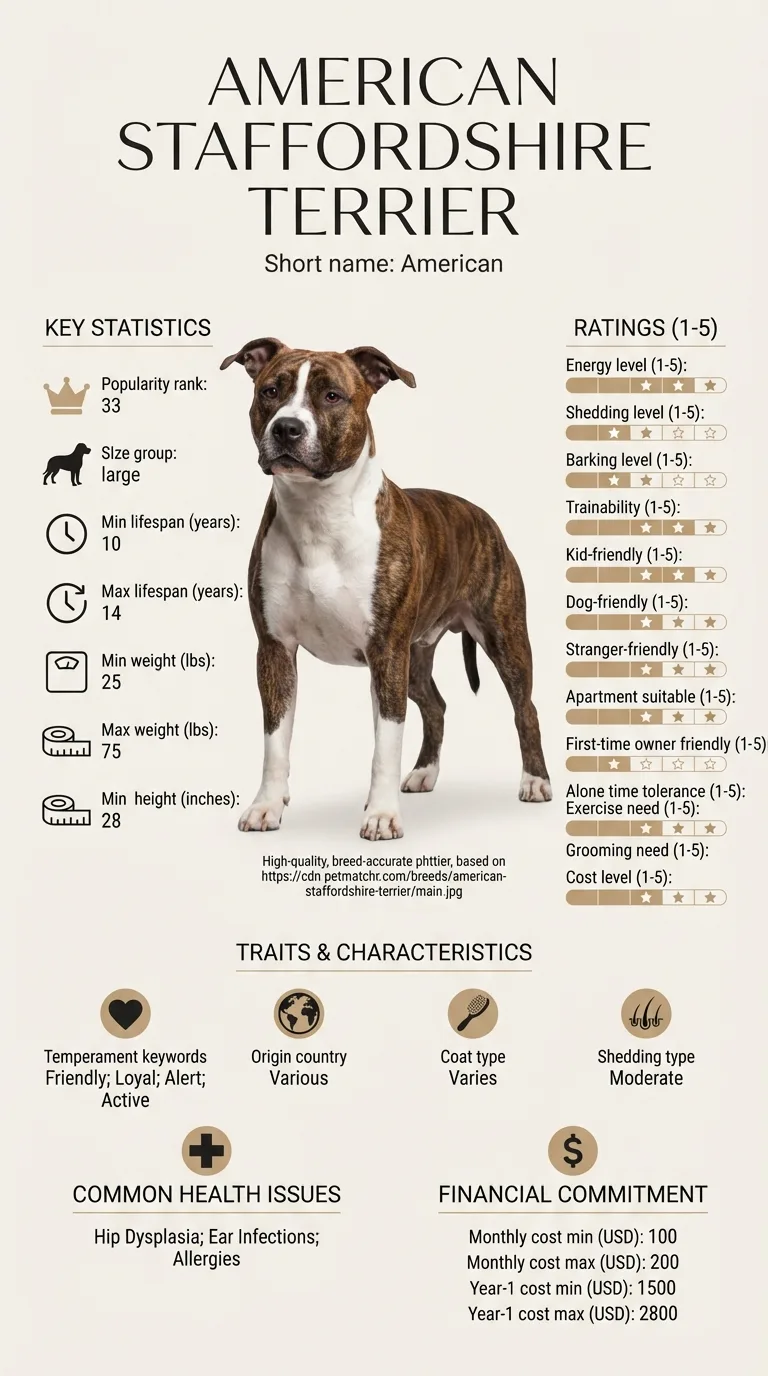
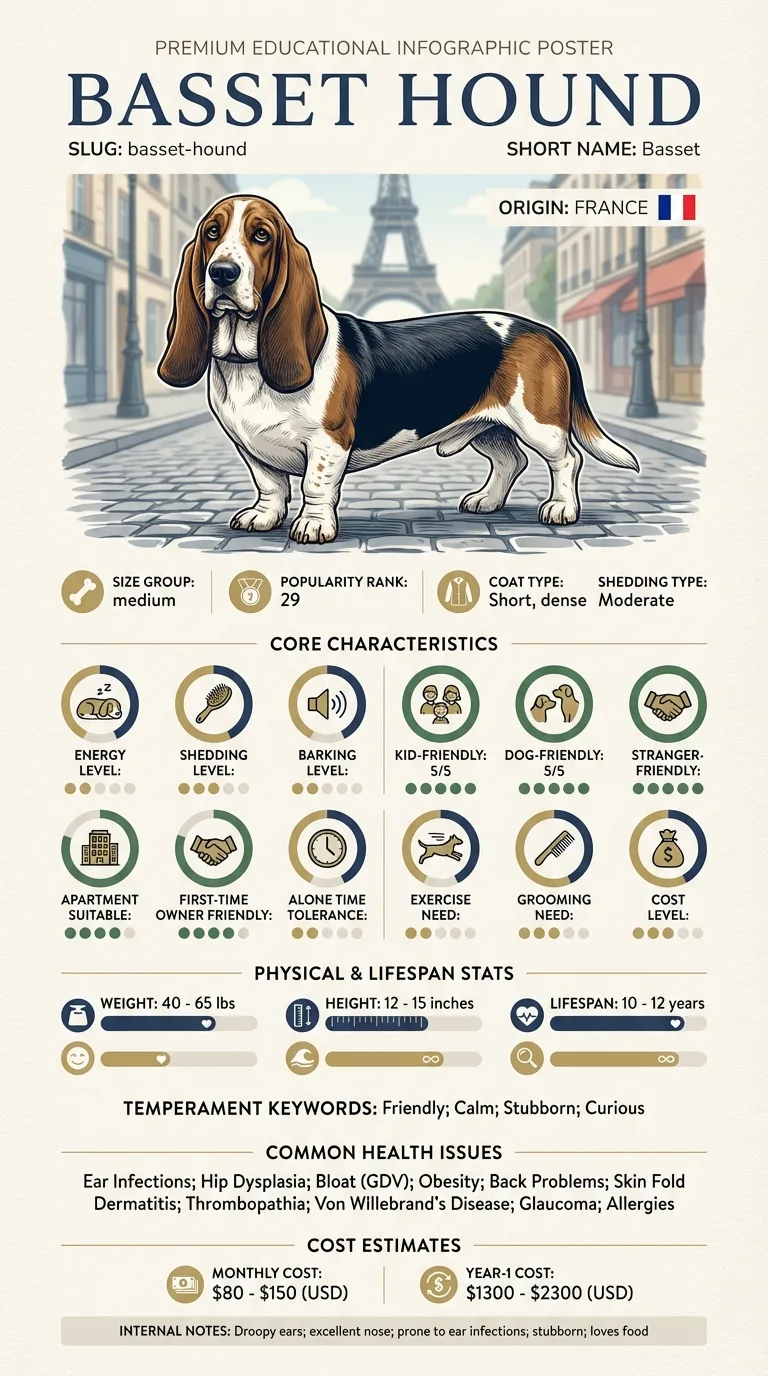
This is for someone already down to American Staffordshire Terrier and Basset Hound and deciding between them. For this pair the decision usually turns on good with other dogs and exercise need, so those are covered first and in most detail. Anyone choosing from a flat has a clear answer here: Basset Hound rates 4/5 against 3/5. There is no origin story here — only what changes about your week.
Between American Staffordshire Terrier and Basset Hound, good with other dogs is what separates them, and Basset Hound is the lower-effort dog of the two to keep.
Choose American Staffordshire Terrier if you do not want a standing grooming appointment, the dog will be alone during the working day and you want a dog that picks up training quickly.
Choose Basset Hound if you are in a flat or a smaller home, this is your first dog and your walking routine is modest.
| Feature | american staffordshire terrier | basset hound | Winner |
|---|---|---|---|
| Size class | medium | medium | Equal |
| Weight | 40–70 lbs | 40–65 lbs | Equal |
| Height | 17–19 in | 12–15 in | Equal |
| Lifespan | 12–16 years | 10–12 years | american staffordshire terrier |
| Exercise need | High (4/5) | Low (2/5) | basset hound |
| Grooming need | Very low (1/5) | Moderate (3/5) | american staffordshire terrier |
| Shedding | Moderate (3/5) | Moderate (3/5) | Equal |
| Energy level | High (4/5) | Low (2/5) | Equal |
| Barking | Low (2/5) | Low (2/5) | Equal |
| Apartment suitability | Moderate (3/5) | High (4/5) | basset hound |
| Good for first-time owners | Moderate (3/5) | High (4/5) | basset hound |
| Tolerates being alone | Moderate (3/5) | Low (2/5) | american staffordshire terrier |
| Trainability | High (4/5) | Low (2/5) | american staffordshire terrier |
| Good with kids | High (4/5) | Very high (5/5) | basset hound |
| Good with other dogs | Low (2/5) | Very high (5/5) | basset hound |
| Friendly to strangers | High (4/5) | Very high (5/5) | basset hound |
| Cost level | Moderate (3/5) | Moderate (3/5) | Equal |
| Coat | Short, stiff and glossy | Short, dense | Equal |
| Origin | Various | France | Equal |
| Typical monthly cost | $100–$200 | $80–$150 | Equal |
| Typical first-year cost | $1,400–$2,900 | $1,300–$2,300 | Equal |
The American Staffordshire Terrier stands tall and lean for its weight -- 17-19 inches carrying 40-70 lbs. The Basset Hound carries similar weight, 40-65 lbs, on a much shorter frame, just 12-15 inches at the shoulder. Same ballpark on the scale, completely different silhouette: one is a compact athlete, the other a long, low-slung hound built close to the ground.
This is where the two breeds part ways. The AmStaff rates high (4/5) for both exercise need and energy level, wanting real daily activity. The Basset rates low (2/5) on both -- a couple of short sniffy walks suits it fine, and it's not going to ask you for a run. If your schedule doesn't have room for an athletic dog, the Basset's low-key pace is the more forgiving choice.
Grooming stays easy on the AmStaff side, very low (1/5) effort with moderate (3/5) shedding. The Basset needs a bit more attention -- moderate (3/5) grooming, tied with the AmStaff on moderate (3/5) shedding -- mostly because of ear care; those long ears trap moisture and need regular checking to avoid infections, one of the breed's listed health risks.
The Basset actually scores better for apartment life, high (4/5) against the AmStaff's moderate (3/5), and both bark relatively little -- low (2/5) for the AmStaff, tied low (2/5) for the Basset. Where they differ is time alone: the AmStaff tolerates it moderately (3/5), the Basset rates low (2/5), so a Basset left alone all day is more likely to struggle than its laid-back reputation might suggest.
Trainability clearly favors the AmStaff, high (4/5) against the Basset's low (2/5) -- that famous Basset stubbornness shows up directly in the numbers. But first-time-owner suitability flips, rating high (4/5) for the Basset versus moderate (3/5) for the AmStaff. A novice owner may find the Basset's laid-back nature easier to live with, even if getting it to reliably listen takes more patience.
The Basset edges out the AmStaff across the board here: very high (5/5) with kids against the AmStaff's high (4/5), very high (5/5) with other dogs against the AmStaff's low (2/5), and very high (5/5) with strangers against the AmStaff's high (4/5). If you're building a multi-dog, multi-visitor household, the Basset's numbers are hard to beat.
Lifespan favors the AmStaff clearly, 12-16 years against just 10-12 for the Basset. The Basset's health list also runs longer, ten conditions including bloat, back problems, skin fold dermatitis, and glaucoma -- much of it tied to its long spine and heavy ears. The AmStaff's five-item list -- hip dysplasia, cerebellar ataxia, skin allergies, heart disease, cruciate tears -- is comparatively shorter, though allergies show up on both.
Cost level rates moderate (3/5) for both breeds, but the actual ranges favor the Basset slightly: $80-150 monthly and $1,300-2,300 for the first year, against $100-200 and $1,400-2,900 for the AmStaff. Not a huge gap on its own, but it compounds over a 10 to 16 year lifespan, and the Basset's shorter life expectancy means those savings get spread across fewer years than the AmStaff's costs do.
American Staffordshire Terrier weighs 40–70 lbs and lives 12–16 years; Basset Hound weighs 40–65 lbs and lives 10–12 years. The two diverge most on good with other dogs, exercise need and grooming need and 2 other rated axes. They are level on barking, cost level and shedding, so those cannot decide it. Where the table declares a winner it means less work for the owner, nothing more; descriptive rows are left as ties on purpose. The value here is in the differences between the two columns; treat any single score as approximate.

Yes -- 40-70 lbs for the AmStaff versus 40-65 for the Basset -- but the Basset carries that weight on a much shorter, longer-bodied frame.
The Basset, rated low (2/5) for both exercise need and energy level against the AmStaff's high (4/5) on both.
The Basset, rated high (4/5) versus moderate (3/5) for the AmStaff, despite being harder to train.
The Basset, high (4/5) against moderate (3/5) for the AmStaff, and both are relatively quiet breeds.
Close, with the Basset slightly cheaper -- $80-150 a month versus $100-200 for the AmStaff.
Hip dysplasia and allergies appear on both lists, but the Basset's list is twice as long, with added risks like bloat, back problems, and glaucoma tied to its body shape.
The AmStaff by a wide margin -- 12-16 years against 10-12 for the Basset.
If you want an easygoing, social dog and don't mind grooming its ears, the Basset is the friendlier pick for most households. The AmStaff suits someone wanting a more active, trainable dog.
The Basset, at $80-150 a month against $100-200 for the AmStaff.
The AmStaff, rated high (4/5) against the Basset's low (2/5).
The AmStaff, 12-16 years versus 10-12 for the Basset -- a meaningful gap.
Secure checkout on Stripe. We never see your card.
7-day money-back guarantee. Instant access.
Health information here is general and is not veterinary advice. If your dog shows pain, sudden behaviour change, or worsening symptoms, consult a licensed veterinarian.
Some links on this site are affiliate links. We may earn a commission at no extra cost to you, and we only suggest products we believe are helpful for dog owners.
We research and check what we publish, but we do not warrant that any figure, date, price, or statement is accurate, complete, or current, and we accept no liability for any loss, cost, injury, or other harm arising from the use of this site. Use it as one reference among several. You remain responsible for your own decisions and for your dog's care - confirm anything that matters with a licensed veterinarian or another qualified professional before you act on it. Full disclaimer.
Match your lifestyle to the right dog.
Take quizNot sure which breed is right for you? Take our 2-minute quiz to find out.
Take the quiz