DogBreedCompass

Poodle vs Doodle: Purebred Poodle, Goldendoodle, or Labradoodle

A Poodle's coat, cost, and health profile are fixed by more than a century of breed standardization. A Goldendoodle's or Labradoodle's are decided by which half of two different gene pools a specific puppy happens to inherit, and even the breeder won't fully know until the coat grows in.

This is for someone actively choosing between a purebred Poodle and a Goldendoodle or Labradoodle, usually because of allergies, a want for a softer-looking face than a Poodle's, or confusion about why a puppy priced like a Poodle can still shed like a retriever. It's also for anyone who has met an F1 doodle that sheds more than expected and wants to understand why that happens.

Getting this comparison wrong is expensive and hard to undo: a family with allergies who buys an F1 Goldendoodle expecting a Poodle's coat can end up needing to rehome a dog they already love. The health side matters just as much, since a Goldendoodle or Labradoodle can inherit hip dysplasia, bloat, or heart conditions from its retriever or Labrador side that a Poodle rarely carries, so a puppy that looked like a simple choice can turn into a much larger vet bill later.

Poodle vs Doodle: Purebred Poodle, Goldendoodle, or Labradoodle

Why a Poodle's Coat Is Predictable and a Doodle's Isn't

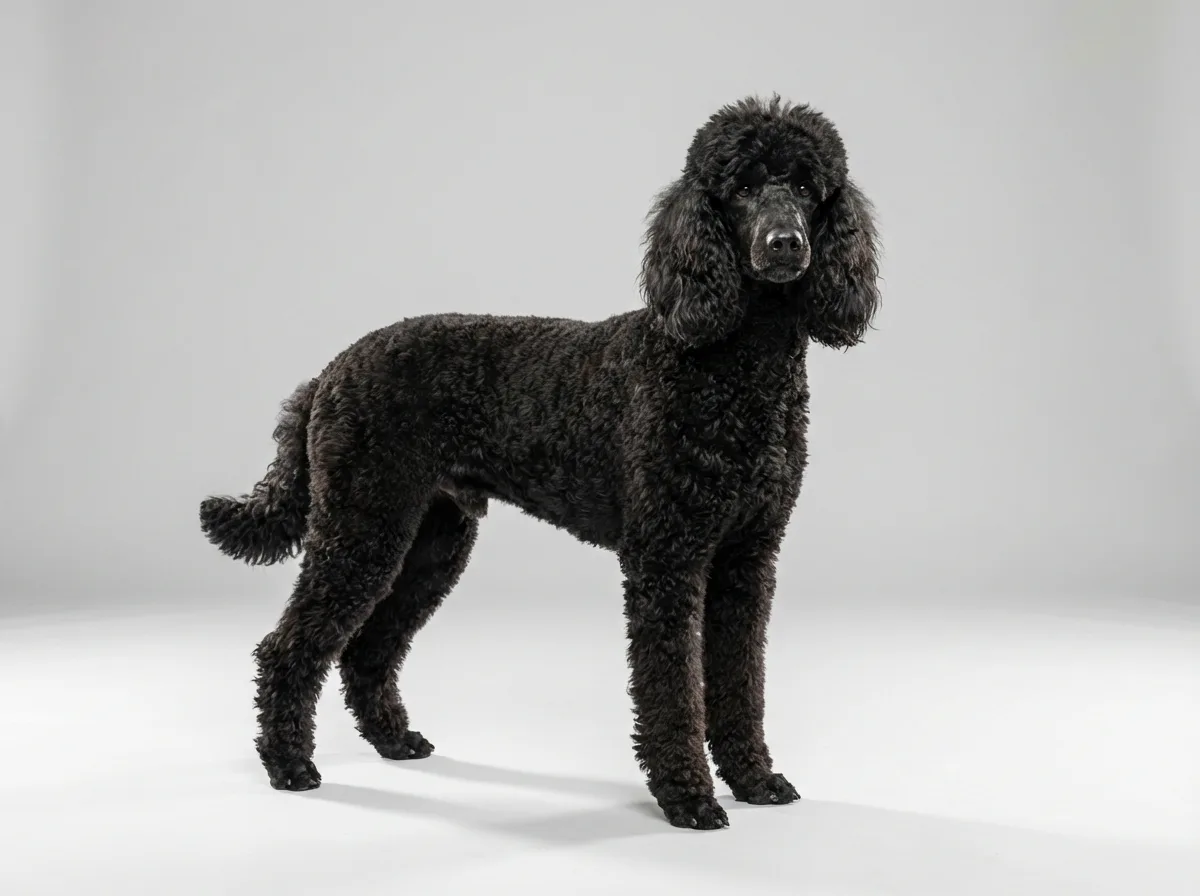
A Poodle's coat comes from more than a century of breed standardization: every Poodle, Toy, Miniature, or Standard, carries the same curly-coat gene from both parents, so the outcome is consistent — a dense, curly, low-shedding coat that needs professional grooming roughly every 4 to 6 weeks. A Goldendoodle or Labradoodle only gets that curly gene from one side, the Poodle parent, while the Golden Retriever or Labrador parent contributes a straight or wavy, shedding coat. Which version of that combination a puppy inherits depends on its exact generation, not on how the breeder markets the litter.

This is the single biggest gap between the purebred and the mixes: a Poodle buyer can predict grooming needs and shedding almost exactly from the breed alone. A doodle buyer is buying a probability, and even careful breeders cannot guarantee which combination of genes a specific puppy will get.

Coat Outcomes by Doodle Generation

Coat predictability in a Goldendoodle or Labradoodle changes by generation, so ask any breeder which one a litter actually is before you fall for a photo.

  • F1 (first generation): 50% Poodle, 50% Golden Retriever or Labrador. The least predictable coat of the three — some puppies come out wavy and low-shed, others come out with a short, shedding coat close to the retriever or Lab side.
  • F1b (backcross to Poodle): An F1 doodle bred back to a purebred Poodle, roughly 75% Poodle genetics. Coat is more consistently curly and lower-shedding, which is why F1b is the generation most often marketed to allergy sufferers.
  • F2 (F1 x F1): Two F1 doodles bred together. Coat genes reshuffle again, so a single litter can range from nearly straight-coated puppies to tightly curled ones.

Real Cost Breakdown: Purchase Price to Year One

The purchase-price gap between a Poodle and a doodle is smaller than most buyers expect; the real cost differences show up in ongoing grooming, not the sale price.

  • Purchase price: Poodle: $1,500–$3,500 from a breeder, with Standard Poodles from health-tested lines usually landing at the higher end.
  • Purchase price: Goldendoodle or Labradoodle: $1,800–$3,200 from a breeder; pricing above this range is usually a coat-color or "teddy bear" marketing premium, not a health-testing premium.
  • Recurring professional grooming: All three typically need a professional groom every 4–6 weeks at a similar per-visit cost; skipping it risks matting in all three, not just the doodles.
  • At-home coat maintenance: Doodle coats, which blend a curly gene with a straight or wavy retriever/Lab gene, usually need more frequent at-home brushing between professional grooms than a Poodle's uniform curl does.
  • First-year vet and setup costs: Comparable across all three once you account for food, vaccinations, and spay or neuter at a similar adult size — the coat, not the breed label, drives most of the ongoing cost gap.

Health: What Each One Actually Inherits

The clearest health gap in this comparison runs along the retriever and Labrador side of the pedigree, not the Poodle side.

  • Poodle: Our breed data flags very few breed-specific health issues for the Poodle relative to other breeds of similar size.
  • Goldendoodle: Hip dysplasia, ear infections, allergies, subvalvular aortic stenosis, bloat, and heart conditions — all traceable to the Golden Retriever side of the pedigree.
  • Labradoodle: Hip dysplasia, elbow dysplasia, exercise-induced collapse, joint issues, bloat, and epilepsy — traceable to the Labrador Retriever side of the pedigree.

Temperament: Three Different Personalities in Similar-Looking Dogs

The Poodle's listed temperament is Intelligent, Elegant, and Active — it was originally a water retriever and still wants mental work, not just a walk around the block. Left understimulated, a bored Poodle tends to invent its own jobs, which owners don't always appreciate.

The Goldendoodle's listed temperament is Friendly, Loving, Gentle, and Adaptable, the Golden Retriever side showing through, and it's usually the most easygoing of the three for a first-time owner. The Labradoodle's listed temperament is Energetic, Loyal, Friendly, and Athletic, and in practice it's usually the most physically demanding of the three, wanting real daily exercise rather than yard time alone.

None of these are worse temperaments, just different jobs a dog is built for. A retiree wanting a calm lap companion and a runner wanting a training partner should not end up choosing the same one of these three dogs.

Breeder Red Flags to Watch For With Any of the Three

These warning signs apply whether you end up at a Poodle breeder, a Goldendoodle breeder, or a Labradoodle breeder.

  • A guarantee of 100% hypoallergenic: No responsible breeder of a Poodle, Goldendoodle, or Labradoodle will promise zero allergic reaction, since allergens come from saliva and dander, not just shed hair.
  • No written generation label: If a doodle breeder won't specify F1, F1b, or F2 in writing, they likely can't tell you what coat or shedding level to expect either.
  • No OFA clearances on the retriever or Labrador parent: Hip, elbow, and cardiac clearances on the non-Poodle parent are what stand between a puppy and hip dysplasia, joint issues, or heart conditions later.
  • No CHIC/OFA clearance on the Poodle parent: The Poodle carries very few flagged conditions in our data, but eye and health clearances on the Poodle parent are still standard practice among health-focused breeders.
  • Pricing far above $3,200 tied only to coat looks: A "teddy bear" or rare-color premium priced well above the typical $1,800–$3,200 doodle range is a marketing markup, not a health or generation guarantee.
  • Multigeneration breeding with no outcross: Breeding doodle to doodle for several generations without ever going back to a health-tested purebred Poodle or retriever/Lab can concentrate inherited risk instead of reducing it.

Frequently asked questions

Is a Goldendoodle or Labradoodle more hypoallergenic than a Poodle?

No dog, including a purebred Poodle, is 100% hypoallergenic — the allergy-triggering protein comes from saliva and dander, not just shed fur. A Poodle's curly coat is genetically fixed the same way in every individual, so it reliably sheds very little and traps loose dander in the curl. A Goldendoodle or Labradoodle only gets half its coat genes from the Poodle parent, so an F1 puppy can just as easily inherit the retriever's or Labrador's shedding coat instead.

What do F1, F1b, and F2 mean for a doodle's coat?

F1 is a first-generation cross, 50% Poodle and 50% Golden Retriever or Labrador, and has the least predictable coat — some puppies come out wavy and low-shed, others come out with a short, shedding coat close to the retriever or Lab side. F1b is an F1 doodle bred back to a purebred Poodle, pushing the mix to roughly 75% Poodle genetics and producing a more consistently curly, lower-shedding coat. F2 (an F1 bred to another F1) reshuffles the genes again and can produce the widest range of coat types within a single litter.

Is a Poodle cheaper to buy than a Goldendoodle or Labradoodle?

Not by much — a Poodle from a breeder typically runs $1,500 to $3,500, while a Goldendoodle or Labradoodle typically runs $1,800 to $3,200, so the ranges overlap heavily. Where doodles cost more is in marketing premiums: pricing above roughly $3,200 for 'teddy bear' looks or a specific coat color is usually about appearance, not health testing.

Do Goldendoodles and Labradoodles have more health problems than Poodles?

In our breed data, the Poodle is flagged for very few breed-specific health issues, while the Goldendoodle and Labradoodle carry real inherited risk from their retriever and Labrador ancestry. Goldendoodles are flagged for hip dysplasia, ear infections, allergies, subvalvular aortic stenosis, bloat, and heart conditions; Labradoodles are flagged for hip dysplasia, elbow dysplasia, exercise-induced collapse, joint issues, bloat, and epilepsy. Ask any doodle breeder for OFA hip, elbow, and cardiac clearances on the retriever or Lab parent, not only the Poodle parent.

Which is easier to train, a Poodle or a doodle?

All three are highly trainable, but for different reasons. A Poodle is Intelligent, Elegant, and Active, and usually needs a mental job, not just repetition, or it gets bored and improvises. A Goldendoodle (Friendly, Loving, Gentle, Adaptable) and a Labradoodle (Energetic, Loyal, Friendly, Athletic) tend to be more food- and praise-motivated, which often feels more forgiving for a first-time owner.

Will a Labradoodle or Goldendoodle shed like a Poodle?

Only if the coat leans heavily toward the Poodle side, and that isn't guaranteed. An F1 Goldendoodle or Labradoodle can shed noticeably, closer to the Golden Retriever or Labrador parent; an F1b, bred back to a Poodle, sheds far less on average. A purebred Poodle's low shedding is consistent breed-wide because both parents always contribute the same curly-coat genes.

How often do Poodles vs. Goldendoodles and Labradoodles need professional grooming?

All three typically need a professional groom every 4 to 6 weeks to prevent matting, at a similar per-visit cost. Doodles usually need more frequent brushing at home between grooms, because a coat blending a curly Poodle gene with a straight or wavy retriever/Lab gene tends to mat faster than a Poodle's uniform curl.

Is a Standard Poodle a good alternative if I want a doodle's friendliness without the coat gamble?

It can be. Poodles are Intelligent, Elegant, and Active, and well-bred lines make warm family companions, just with more independence than a Goldendoodle's famously gentle, adaptable temperament. If a predictable coat and grooming routine matter more to you than getting the softest possible 'doodle look,' a Standard Poodle removes the generation gamble entirely.

Can I test whether I'm allergic to a specific puppy before buying?

Yes, and it matters more than any breed label. Spend at least an hour or two in close contact with the actual litter or parent dogs, holding and petting them, before committing, since individual reactions vary even within a breed. This matters most for an F1 Goldendoodle or Labradoodle litter, where littermates can carry noticeably different amounts of retriever or Lab coat genetics.

Which is more energetic, a Labradoodle or a Goldendoodle?

A Labradoodle is generally the higher-energy, more athletic of the two — its listed temperament traits are Energetic, Loyal, Friendly, and Athletic, reflecting its Labrador retrieving drive. A Goldendoodle is typically calmer day-to-day, with listed traits of Friendly, Loving, Gentle, and Adaptable, though both need real daily exercise, not just yard time.

Quick answers

View more answers
Living

Poodle vs doodle: which coat is more predictable?

A Poodle's curly, low-shed coat is genetically fixed, while a Goldendoodle's or Labradoodle's coat depends entirely on its F1, F1b, or F2 generation.

Costs

Poodle vs doodle: which costs more to buy?

Poodles run $1,500–$3,500 and Goldendoodles/Labradoodles run $1,800–$3,200, so their price ranges overlap heavily.

Health

Poodle vs doodle: which has more health risks?

Our data flags very few breed-specific issues for Poodles, versus hip dysplasia, bloat, and heart or joint conditions flagged for both Goldendoodles and Labradoodles.

Training

Poodle vs doodle: which is easier to train?

Poodles train through mental engagement and get bored with repetition; Goldendoodles and Labradoodles tend to be more food- and praise-driven, which often feels easier for first-time owners.

Living

Poodle vs doodle: how often do they need grooming?

All three typically need professional grooming every 4–6 weeks, but doodle coats usually need more frequent at-home brushing to avoid matting.

Health

Poodle vs doodle: is either truly hypoallergenic?

No dog is fully hypoallergenic — even a Poodle's low-shed coat still carries dander and saliva allergens, just less of them.

Living

Poodle vs doodle: which has the most energy?

Labradoodles run the most athletic of the three, Goldendoodles the most easygoing, and Poodles the most independent and mentally driven.

Related DogBreedCompass guides

  • Poodle breed guide – Readers deciding against the purebred option need the full Poodle breed profile this guide keeps comparing against.
  • Goldendoodle breed guide – Anyone leaning toward the retriever-side mix should read the full Goldendoodle profile before contacting a breeder.
  • Labradoodle breed guide – Readers weighing the Labrador-side mix need the full Labradoodle profile, including its athletic exercise needs.
  • Goldendoodle vs Labradoodle head-to-head – Readers torn between the two doodle mixes rather than the purebred should see them compared directly against each other.
  • Poodle cost by city – The purchase-price ranges in this guide are national averages; readers budgeting locally need a city-level cost breakdown.

Important reminder

This guide is not medical advice. If your dog shows pain, sudden behavior change, or worsening symptoms, consult a licensed veterinarian.

Some links may be affiliate links. We may earn a commission at no extra cost to you. We only suggest products we believe are helpful for dog owners.

We research and check what we publish, but we do not warrant that any figure, date, price, or statement is accurate, complete, or current, and we accept no liability for any loss, cost, injury, or other harm arising from the use of this site. Use it as one reference among several. You remain responsible for your own decisions and for your dog's care - confirm anything that matters with a licensed veterinarian or another qualified professional before you act on it. Full disclaimer.

Want more tailored help?

Take the Lifestyle Match quiz to see which breeds and guides best fit your day-to-day life.

Take the quiz

More guides you might like

Find your match

Not sure which breed is right for you? Take our 2-minute quiz to find out.

Take the quiz