Costs
Shetland Sheepdog cost in Des Moines
$74–$138 monthly and $1,012–$2,116 for year one, below average. The useful local lesson is insurance mechanics: congenital conditions are never covered, and enrolment timing decides the rest.

See Shetland Sheepdog price across all cities →
Quick answer
Shetland Sheepdog cost in Des Moines
$74–$138 monthly and $1,012–$2,116 for year one, below average. The useful local lesson is insurance mechanics: congenital conditions are never covered, and enrolment timing decides the rest.
Des Moines is one of the largest insurance centres in the United States, home to Principal Financial Group and a dense cluster of carriers and brokers that employ a substantial share of the metro. It is, in other words, a city full of people who understand what an exclusion is. That makes it a good place to be honest about how pet insurance treats a breed carrying five documented hereditary conditions, because the honest answer is more complicated than the marketing suggests.
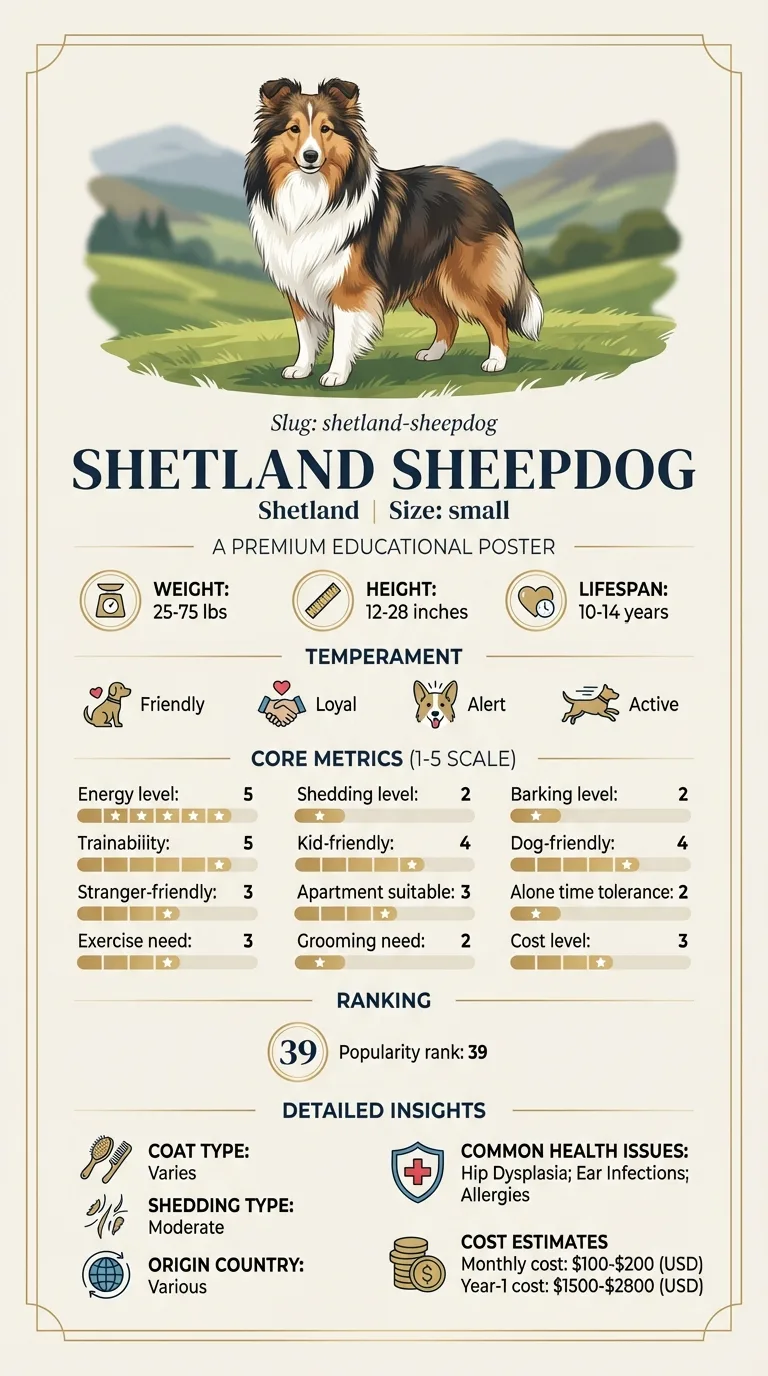
The five documented conditions are Collie Eye Anomaly, MDR1 Drug Sensitivity, Dermatomyositis, Hypothyroidism and Patellar Luxation. MDR1 is an inherited sensitivity to a set of drugs used routinely in veterinary practice, including certain parasite preventives and anesthetics, which can cause serious harm at a standard dose. Testing for it costs very little and prevents a category of disaster no policy fully compensates for.
Iowa pricing keeps the running numbers low, and a yard-heavy housing stock removes the paid-walking line, leaving insurance strategy as the decision with the most money attached.
Estimate · source: estimation · confidence: medium · updated 2026-09-06 · not a quote
| Item | Cost range |
|---|---|
Startup (exam, sterilization, MDR1 test, fencing check) The genetic test is listed here explicitly, because no insurer will pay for it and it is the best-value item on the page. | $330 - $560 |
| Item | Cost range |
|---|---|
Food Small-breed portions at below-average Iowa retail pricing. | $29 - $51 |
Insurance premium, if taken Priced for a young dog enrolled before any condition is documented, which is the only version that covers this breed properly. | $0 - $55 |
Grooming, with a concentrated spring peak Hard Iowa winters compress the spring shed, so one heavy month is normal rather than an overrun. | $22 - $47 |
Each range starts from a national baseline for this breed's size class and is then adjusted for local cost of living and veterinary pricing. The baselines, and the source each one came from, are listed on our sources page (dataset 2026.09). Two inputs, the purchase price and the emergency reserve, have no published national figure we could verify, so we leave them to you rather than invent them.
These are planning estimates, not quotes. Your own numbers will move with the individual dog, your vet and your insurer. Build a budget with your own figures.
In a city built on underwriting, the useful framing is that a pet policy is a bet on the future rather than a way to fix a hereditary hand you were already dealt.
Enrol a young, undiagnosed dog. Waiting periods and pre-existing exclusions mean every month of delay narrows what the policy can ever pay for.
Iowa's low pricing means a self-funded reserve covers more here than in most markets, which makes skipping cover a genuine option for an already-tested dog.
The money in Des Moines is saved at the point of purchase and the point of enrolment, not at the point of shopping.
Start with the hard case. Collie Eye Anomaly is congenital, meaning present from birth. A condition the dog already has when you enrol is not an insurable risk in any ordinary sense, and once it is identified it sits permanently outside cover. This is the single most important thing for a Sheltie buyer to understand, and it argues for buying from a litter that has already been examined rather than hoping to insure the question away later.
MDR1 sits in a different category again. It is a genetic trait rather than an illness, so there is nothing to claim on until an adverse drug reaction actually happens, at which point you are claiming for the reaction. Insurers do not generally pay for the genotype test either. It remains the best value in this breed's entire cost profile, and you pay for it yourself.
The four conditions that can develop over time, Dermatomyositis, Hypothyroidism, Patellar Luxation and the ordinary run of accidents and illness, are the ones cover genuinely helps with, provided you enrol before any of them is documented. Two industry practices are worth knowing. Waiting periods mean cover does not start the day you pay. And many policies treat paired body parts together, so a knee problem recorded on one side is commonly excluded on the other as well, which matters for a breed with a documented patellar risk.
The rest of a Des Moines budget is pleasantly boring. Local prices sit below the national average across services, and the prevalence of single-family homes with fenced yards means most households never need to hire a walker at all, which is the largest recurring cost in dense-city budgets.
That said, a yard is not exercise. A breed rated four out of five on energy and exercise need does not tire itself out by standing in a garden; it needs walking, work or both. The saving is real but it is a saving on paid help, not on time. Des Moines has good trail infrastructure along the rivers for exactly this.
One coat note. Iowa's seven-month parasite window and hard winters mean the spring shed arrives concentrated rather than spread out, so a single heavy grooming month is normal and worth budgeting for rather than treating as an overrun.

A Des Moines owner insured her Sheltie at two years old, a few months after a routine exam noted a mildly loose kneecap on the left side. When the right knee needed attention three years later, the claim was declined: the policy treated the knees as a pair, and a finding on one side had excluded the other from the start. Nothing had been hidden and nothing was unfair. She simply had not read that clause, and in an insurance town she found that particularly annoying.
Key takeaway: For a breed with a documented patellar risk, the clause that decides whether cover is worth anything is usually the one about paired body parts.
$74 to $138, below the national average, with the yard-heavy housing stock removing the paid-walking cost that dominates dense-city budgets.
$1,012 to $2,116 including initial vet work, sterilization and equipment.
Realistically no. It is congenital, present from birth, and once identified it sits outside cover permanently. Buying from an already-examined litter is the practical answer.
Generally not. It is a genetic trait rather than an illness, so there is nothing to claim until an adverse drug reaction occurs. The test remains excellent value paid for privately.
Accidents, illness, and the conditions that develop over time, Dermatomyositis, Hypothyroidism and Patellar Luxation, provided you enrol before any of them appears on the record.
Around $485 at Iowa pricing, which stretches noticeably further than the same sum would on either coast.
Budget $1,012–$2,116 for the first year and $74–$138 a month after that in Des Moines. The first year carries the one-off costs — purchase or adoption, vaccination, neutering and equipment — while the monthly figure covers food, preventatives, grooming and insurance.
$74–$138 monthly and $1,012–$2,116 for year one, below average. The useful local lesson is insurance mechanics: congenital conditions are never covered, and enrolment timing decides the rest.
It covers what can develop later, not what the dog was born with. Enrol before any diagnosis, expect waiting periods, and note that many policies exclude the second knee once one is recorded.
This guide is not medical advice. If your dog shows pain, sudden behavior change, or worsening symptoms, consult a licensed veterinarian.
Some links may be affiliate links. We may earn a commission at no extra cost to you. We only suggest products we believe are helpful for dog owners.
We research and check what we publish, but we do not warrant that any figure, date, price, or statement is accurate, complete, or current, and we accept no liability for any loss, cost, injury, or other harm arising from the use of this site. Use it as one reference among several. You remain responsible for your own decisions and for your dog's care - confirm anything that matters with a licensed veterinarian or another qualified professional before you act on it. Full disclaimer.
One sheet with every line item, the emergency fund and when insurance pays off - unlocks on this page.
You get: 12-month budget sheet
No spam. One-click unsubscribe. See our privacy policy.
Preview page 1 before you decide.