Costs
French Bulldog cost in Philadelphia
About $220–$415/month, $3,450–$6,150 for year one — above average, home to a nationally renowned veterinary hospital with real GI specialty depth.

See French Bulldog price across all cities →
Quick answer
French Bulldog cost in Philadelphia
About $220–$415/month, $3,450–$6,150 for year one — above average, home to a nationally renowned veterinary hospital with real GI specialty depth.
A French Bulldog in Philadelphia costs about $220–$415 a month, with the first year around $3,450–$6,150 — above the national average, in a city home to one of the country's most respected veterinary teaching hospitals.
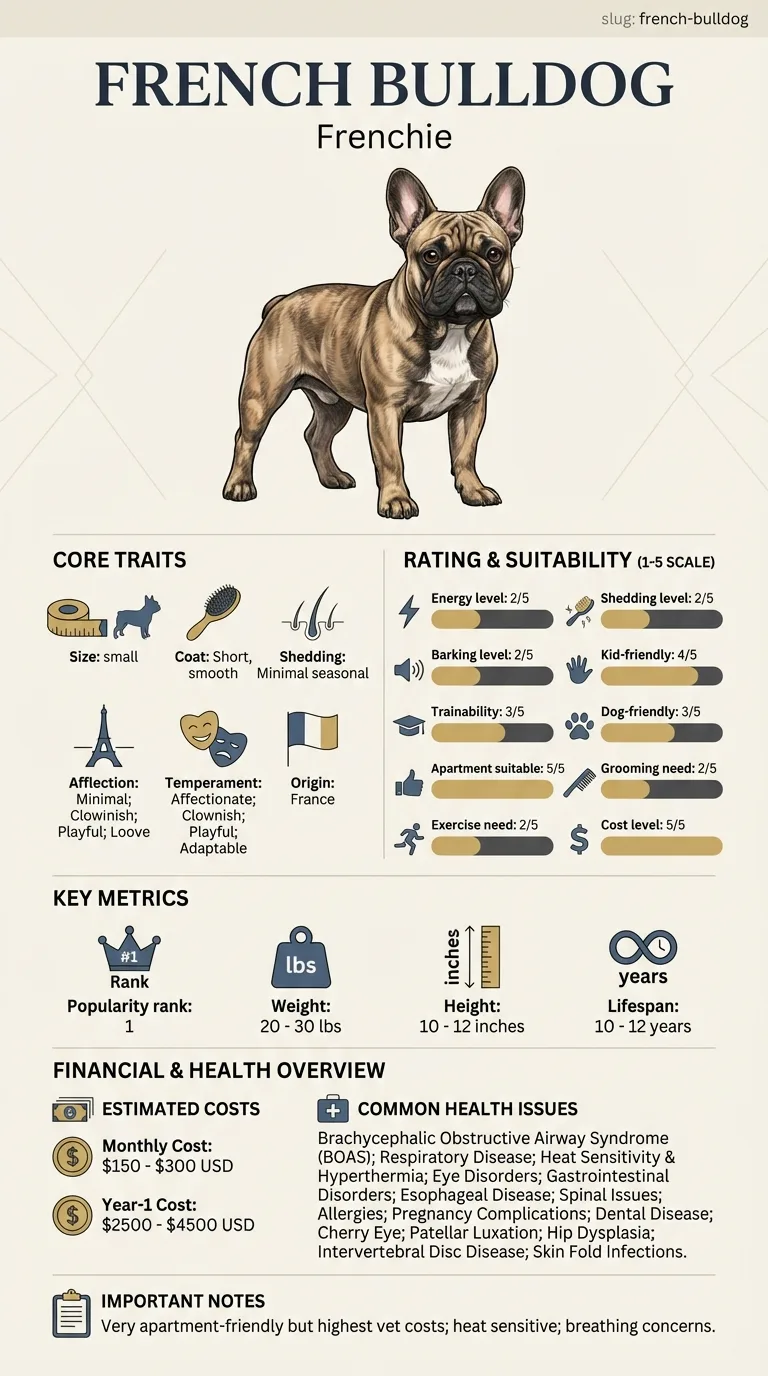
BOAS-related breathing difficulty is this breed's single most consequential health risk, sometimes requiring corrective airway surgery. GI and esophageal disease are the separate, chronic-management risk this breed's documented digestive sensitivity makes more likely than in most breeds.
These figures reflect Philadelphia's above-national-average pricing, with a note on the real value of nationally elite academic GI specialty care available locally.
Estimate · source: estimation · confidence: medium · updated 2026-09-05 · not a quote
| Item | Cost range |
|---|---|
One-time setup (initial vet visit, spay/neuter, gear) Covers the first exam, vaccinations, spay/neuter if needed, and basic gear — priced at Philadelphia's above-average rates. | $480 - $815 |
| Item | Cost range |
|---|---|
Food Above the national average for a small breed, consistent with the broader Northeast corridor's pricing. | $42 - $68 |
Dog-walking service A real, recurring cost for many owners given Philadelphia's rowhouse-heavy housing stock, though softened by this breed's documented low exercise needs. | $65 - $130 |
Each range starts from a national baseline for this breed's size class and is then adjusted for local cost of living and veterinary pricing. The baselines, and the source each one came from, are listed on our sources page (dataset 2026.09). Two inputs, the purchase price and the emergency reserve, have no published national figure we could verify, so we leave them to you rather than invent them.
These are planning estimates, not quotes. Your own numbers will move with the individual dog, your vet and your insurer. Build a budget with your own figures.
For a French Bulldog in Philadelphia, insurance is worth taking seriously given this breed's extensive documented health risks, made more valuable here by genuinely strong local academic GI specialty access.
This breed's real BOAS and GI-related statistics make insurance a near-necessity here — buy before a diagnosis, not after, since pre-existing conditions won't be covered.
Self-insuring is reasonable only for a household that's already earmarked real, substantial savings for this exact scenario.
Philadelphia's above-average costs are real, but the city's genuinely elite academic GI specialty access is worth using deliberately for this breed's digestive sensitivity.
The University of Pennsylvania's Ryan Veterinary Hospital ranks among the most respected academic veterinary teaching hospitals in the country, with board-certified internal medicine specialists whose depth in gastrointestinal and esophageal disease is directly relevant to this breed's documented digestive sensitivity. A chronic case that a general practice struggles to fully resolve, recurring regurgitation, unexplained weight changes, persistent GI upset, is exactly the kind of problem this level of specialty depth is built to untangle, a real resource most cities on this site can't offer at this caliber.
That access comes at real cost: Philadelphia's general cost of living runs above the national average, consistent with the broader Northeast corridor, and the city's rowhouse-heavy neighborhoods, often without much private yard space, make dog-walking a real, recurring cost for many owners, though this breed's documented low exercise needs make that somewhat more manageable than for a higher-energy breed.
Pennsylvania's temperate climate keeps flea-and-tick prevention seasonal rather than year-round, a modest, real offset against the region's otherwise elevated pricing.

A Philadelphia French Bulldog had cycled through months of recurring regurgitation and inconsistent appetite despite several rounds of diet changes at a general practice, leaving the family increasingly frustrated. A referral to Penn's veterinary hospital connected them with a board-certified internal medicine specialist who identified a specific underlying esophageal issue the general workup hadn't fully captured, leading to a targeted, effective management plan. The family didn't have to travel out of state to access that level of expertise.
Key takeaway: In Philadelphia specifically, this breed's real GI sensitivity can be evaluated by genuinely elite academic specialists without the travel many other cities on this site require.
About $220–$415, above the national average, consistent with the broader Northeast corridor's pricing.
Roughly $3,450–$6,150, including the initial vet exam, spay/neuter if needed, and gear on top of ongoing monthly costs.
Genuinely, yes — the University of Pennsylvania's Ryan Veterinary Hospital is a nationally elite academic teaching hospital with board-certified internal medicine specialists whose GI and esophageal disease expertise is directly relevant to this breed's documented digestive sensitivity.
Reasonably, yes — this breed's documented low exercise needs make rowhouse living without a private yard more manageable than it would be for a higher-energy breed, though dog-walking still shows up as a recurring cost for many owners.
Especially worth pricing out given this breed's extensive documented health risks combined with Philadelphia's above-average pricing, bought while the dog is young and before anything is on record.
Around $1,150 covers a typical significant vet visit in this market, reflecting Philadelphia's above-average general pricing.
About $220–$415/month, $3,450–$6,150 for year one — above average, home to a nationally renowned veterinary hospital with real GI specialty depth.
This guide is not medical advice. If your dog shows pain, sudden behavior change, or worsening symptoms, consult a licensed veterinarian.
Some links may be affiliate links. We may earn a commission at no extra cost to you. We only suggest products we believe are helpful for dog owners.
We research and check what we publish, but we do not warrant that any figure, date, price, or statement is accurate, complete, or current, and we accept no liability for any loss, cost, injury, or other harm arising from the use of this site. Use it as one reference among several. You remain responsible for your own decisions and for your dog's care - confirm anything that matters with a licensed veterinarian or another qualified professional before you act on it. Full disclaimer.
One sheet with every line item, the emergency fund and when insurance pays off - unlocks on this page.
You get: 12-month budget sheet
No spam. One-click unsubscribe. See our privacy policy.
Preview page 1 before you decide.
