Living
Which breed should you pick overall?
These two sit at opposite ends of nearly every metric — pick the Griffon for a small, low-exercise apartment dog, the Rottweiler for a large, protective, active one with room to match.

Quick answer
Which breed should you pick overall?
These two sit at opposite ends of nearly every metric — pick the Griffon for a small, low-exercise apartment dog, the Rottweiler for a large, protective, active one with room to match.
Brussels Griffon or Rottweiler? On paper they differ most on apartment suitability, and on the scales Rottweiler is the heavier at 80–135 lbs. Here is how the two compare on everything that shapes an ordinary week.
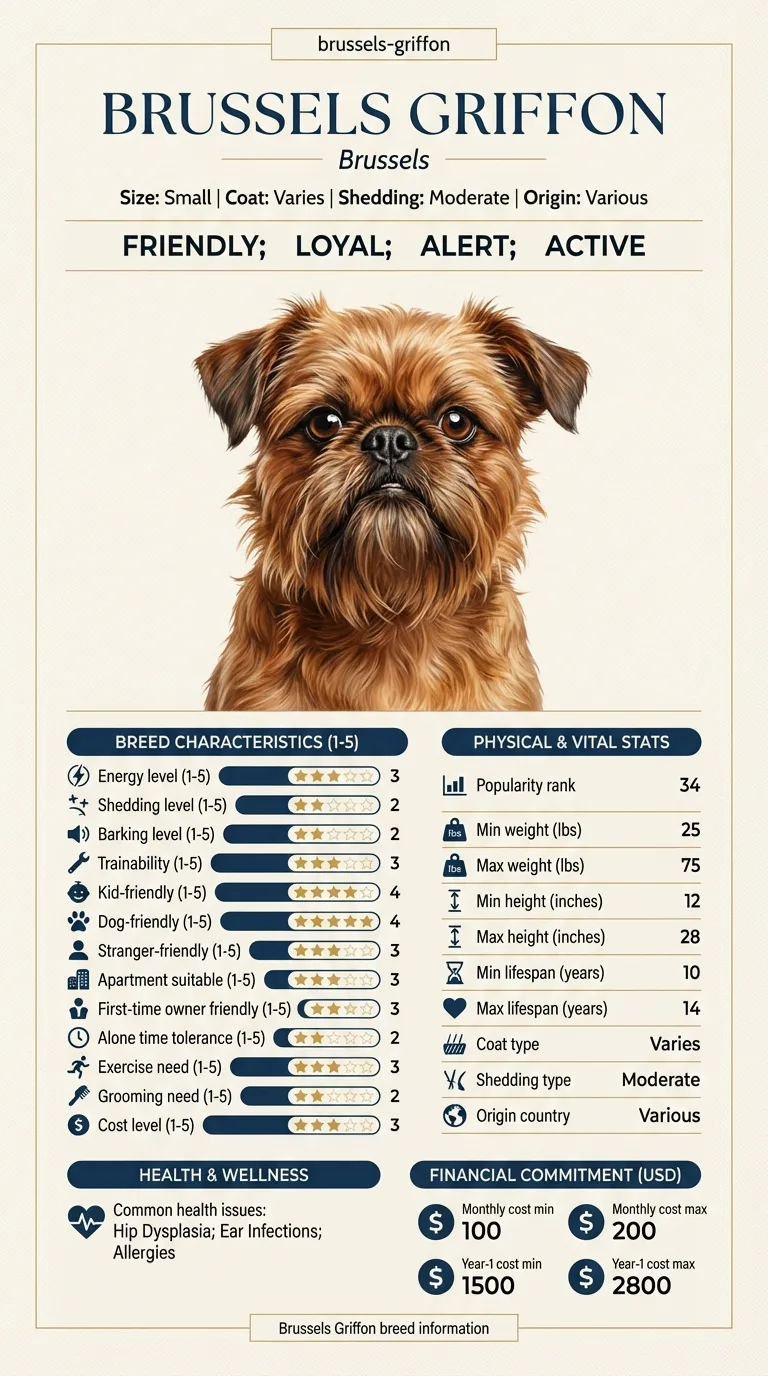
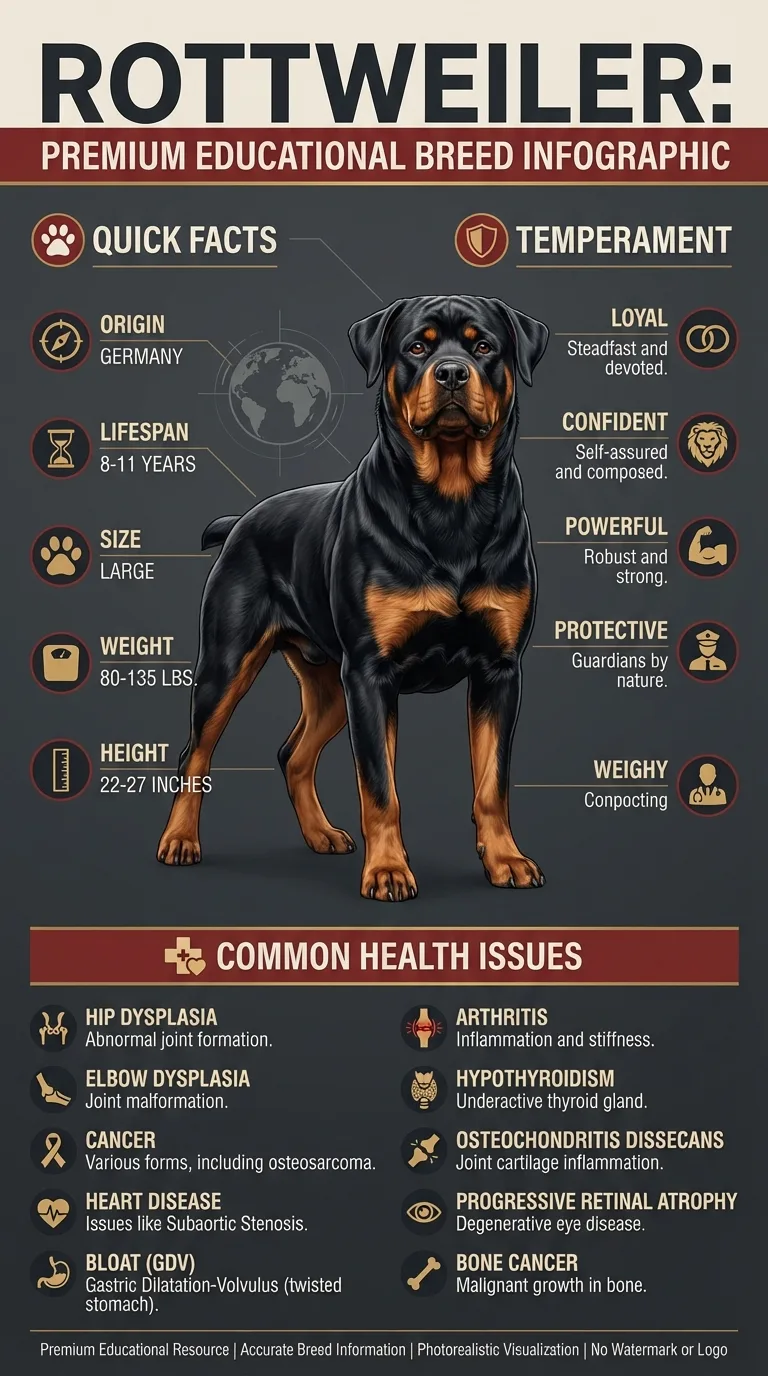
This is for someone already down to Brussels Griffon and Rottweiler and deciding between them. For this pair the decision usually turns on apartment suitability and exercise need, so those are covered first and in most detail. Anyone choosing from a flat has a clear answer here: Brussels Griffon rates 5/5 against 2/5. The focus throughout is on daily consequences rather than breed background.
Between Brussels Griffon and Rottweiler, apartment suitability is what separates them, and Brussels Griffon is the lower-effort dog of the two to keep.
Choose Brussels Griffon if you are in a flat or a smaller home, this is your first dog and shedding is a problem in your house.
Choose Rottweiler if you do not want a standing grooming appointment, there are young children at home and you want a dog that picks up training quickly.
| Feature | brussels griffon | rottweiler | Winner |
|---|---|---|---|
| Size class | small | large | Equal |
| Weight | 8–12 lbs | 80–135 lbs | Equal |
| Height | 7–10 in | 22–27 in | Equal |
| Lifespan | 12–15 years | 8–11 years | brussels griffon |
| Exercise need | Low (2/5) | High (4/5) | brussels griffon |
| Grooming need | Moderate (3/5) | Low (2/5) | rottweiler |
| Shedding | Low (2/5) | High (4/5) | brussels griffon |
| Energy level | Moderate (3/5) | High (4/5) | Equal |
| Barking | Moderate (3/5) | Moderate (3/5) | Equal |
| Apartment suitability | Very high (5/5) | Low (2/5) | brussels griffon |
| Good for first-time owners | Moderate (3/5) | Low (2/5) | brussels griffon |
| Tolerates being alone | Low (2/5) | Low (2/5) | Equal |
| Trainability | Moderate (3/5) | High (4/5) | rottweiler |
| Good with kids | Moderate (3/5) | High (4/5) | rottweiler |
| Good with other dogs | Moderate (3/5) | Moderate (3/5) | Equal |
| Friendly to strangers | Moderate (3/5) | Low (2/5) | brussels griffon |
| Cost level | Moderate (3/5) | High (4/5) | brussels griffon |
| Coat | Rough or smooth | Double coat, short | Equal |
| Origin | Various | Germany | Equal |
| Typical monthly cost | $80–$150 | $125–$250 | Equal |
| Typical first-year cost | $1,100–$2,300 | $2,000–$3,500 | Equal |
Few comparisons on this site are this lopsided: the Rottweiler runs 80 to 135 pounds and stands up to 27 inches, against the Brussels Griffon's 8-to-12-pound, under-10-inch frame. A Rottweiler at the top of its range can outweigh ten Griffons combined. If you're not prepared to handle a dog that size — physically, on a leash, in a car — this comparison answers itself before you get to temperament.
The Rottweiler's exercise need rates high (4/5) against the Griffon's low (2/5), and a dog carrying 80-plus pounds of muscle needs that activity to stay balanced both physically and behaviorally. This is not a breed you can under-exercise without consequences. The Griffon, by contrast, is content with far less structured activity. Skipping that daily commitment with a Rottweiler tends to show up as restlessness or destructive behavior faster than it would with a lower-energy small breed.
The Rottweiler actually needs less grooming attention, rating low (2/5) against the Griffon's moderate (3/5) — its short double coat is simpler to maintain than the Griffon's rough or smooth coat. Shedding tells a different story: the Rottweiler sheds high (4/5) against the Griffon's low (2/5), so expect more vacuuming despite the lower brushing demand. A lint roller becomes a permanent fixture in the house either way, just for different reasons.
The Griffon rates a full 5/5 for apartment suitability; the Rottweiler rates a low 2/5, reflecting both its size and its exercise needs. Barking ties at a moderate 3/5 for both breeds. Neither tolerates being left alone particularly well, both landing at a low 2/5 — a long workday is a challenge with either dog. A house with outdoor access suits the Rottweiler's needs far better than a high-rise unit ever will.
The Griffon actually rates higher for first-time owners, a moderate 3/5 against the Rottweiler's low 2/5, despite the Rottweiler's stronger trainability score (high 4/5 versus the Griffon's moderate 3/5). The read here: a Rottweiler is more capable of learning complex training, but its size and strength mean mistakes carry higher stakes for an inexperienced owner. An experienced trainer or obedience class is worth the investment if you're set on the Rottweiler despite a limited dog-owning background.
The Rottweiler rates high (4/5) with kids against the Griffon's moderate (3/5), though its temperament — loyal, confident, powerful, protective — means socialization and supervision matter more given its size. Friendliness to strangers actually favors the Griffon, moderate (3/5) against the Rottweiler's low (2/5); the Rottweiler's protective instincts show up here as reserve around people it doesn't know. Early socialization with unfamiliar people and situations matters more for the Rottweiler precisely because of that protective streak.
This is the starkest number on the page: the Griffon's 12-to-15-year lifespan against the Rottweiler's 8 to 11 — a gap of several years, typical of the size difference between small and giant-leaning breeds. Hip dysplasia is the one shared risk; the Rottweiler's much longer list also includes cancer, heart disease, bloat, and bone cancer, health burdens that come with its size and weight.
Cost level favors the Griffon, moderate (3/5) against the Rottweiler's high (4/5), and the dollar figures scale with size: $80 to $150 monthly for the Griffon versus $125 to $250 for the Rottweiler, and $1,100–$2,300 against $2,000–$3,500 in the first year. Food, vet visits, and insurance all cost more for an 80-to-135-pound dog — pet insurance premiums in particular tend to run higher for large breeds, a line item worth pricing out before you commit.
Brussels Griffon weighs 8–12 lbs and lives 12–15 years; Rottweiler weighs 80–135 lbs and lives 8–11 years. The two diverge most on apartment suitability, exercise need and shedding. They are level on tolerates being alone, barking and good with other dogs, so those cannot decide it. The table below marks a winner only where one breed is genuinely easier for a typical owner; size and origin are facts rather than merits and stay level. Ratings come from one source applied to both breeds, so they are meaningful against each other rather than as absolute scores.

Dramatically — 80 to 135 pounds against 8 to 12, one of the widest weight gaps you'll find in any comparison on this site.
The Griffon, and by a wide margin — 12 to 15 years against the Rottweiler's 8 to 11, a common trade-off for larger breeds.
The data says no, relatively — it rates a low 2/5 for first-time owners against the Griffon's moderate 3/5, largely because its size raises the stakes of training mistakes.
The Rottweiler, rating high (4/5) against the Griffon's low (2/5) — it needs consistent, real exercise to stay balanced.
About 50 to 70% more at the low end — $125 to $250 monthly against the Griffon's $80 to $150.
Only hip dysplasia overlaps directly; the Rottweiler's much longer health list includes several cancer risks tied to its size.
The Griffon, moderate (3/5) against the Rottweiler's low (2/5) — the Rottweiler's protective temperament shows up as reserve around unfamiliar people.
These two sit at opposite ends of nearly every metric — pick the Griffon for a small, low-exercise apartment dog, the Rottweiler for a large, protective, active one with room to match.
The Rottweiler runs $125 to $250 a month against the Griffon's $80 to $150.
The Rottweiler needs substantially more activity, rated high (4/5) against the Griffon's low (2/5).
The Griffon typically lives 12 to 15 years, several years longer than the Rottweiler's 8 to 11.
Secure checkout on Stripe. We never see your card.
7-day money-back guarantee. Instant access.
Health information here is general and is not veterinary advice. If your dog shows pain, sudden behaviour change, or worsening symptoms, consult a licensed veterinarian.
Some links on this site are affiliate links. We may earn a commission at no extra cost to you, and we only suggest products we believe are helpful for dog owners.
We research and check what we publish, but we do not warrant that any figure, date, price, or statement is accurate, complete, or current, and we accept no liability for any loss, cost, injury, or other harm arising from the use of this site. Use it as one reference among several. You remain responsible for your own decisions and for your dog's care - confirm anything that matters with a licensed veterinarian or another qualified professional before you act on it. Full disclaimer.
Match your lifestyle to the right dog.
Take quizNot sure which breed is right for you? Take our 2-minute quiz to find out.
Take the quiz