Living
Which is quieter?
The Basset Hound, rating 2/5 for barking against the Yorkie's notably vocal 4/5.

Quick answer
Which is quieter?
The Basset Hound, rating 2/5 for barking against the Yorkie's notably vocal 4/5.
Basset Hound or Yorkshire Terrier? On paper they differ most on friendly to strangers, and on the scales Basset Hound is the heavier at 40–65 lbs. Here is how the two compare on everything that shapes an ordinary week.
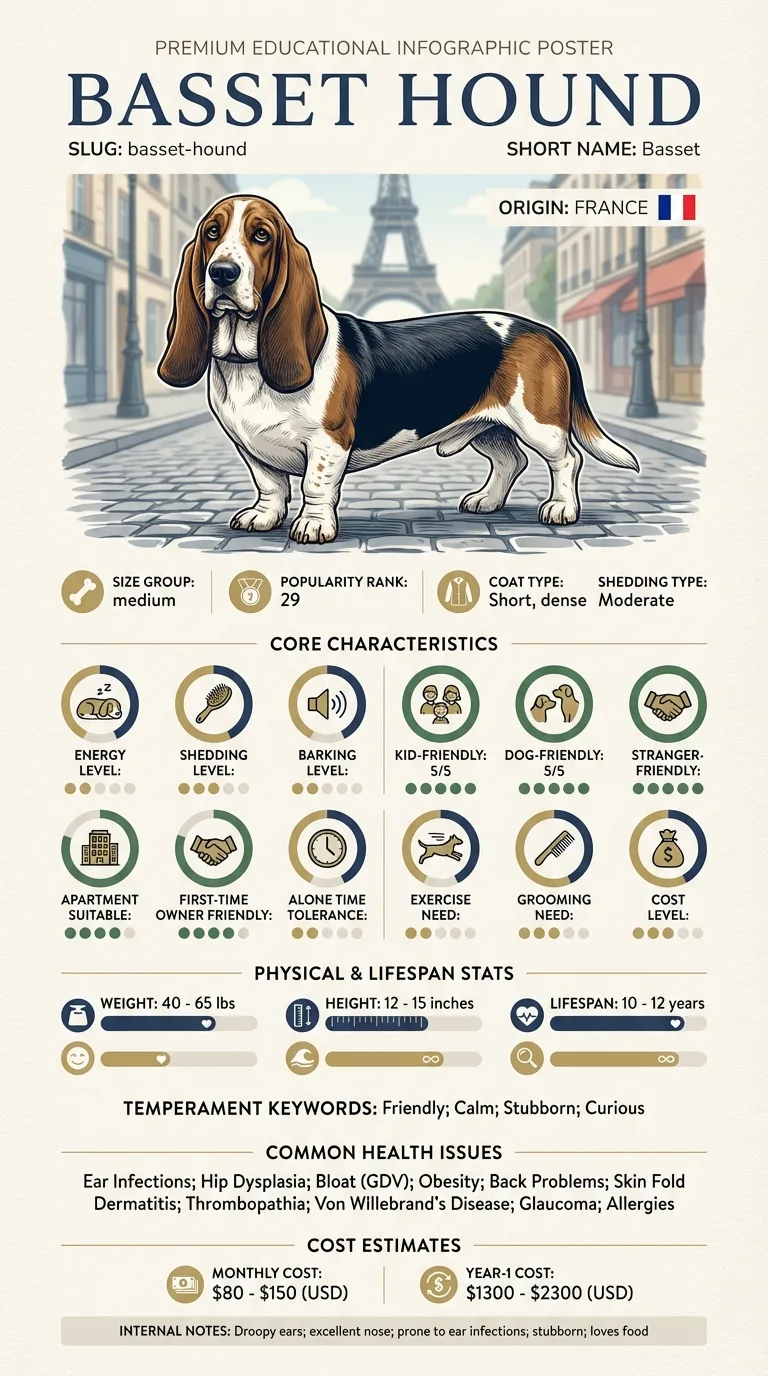
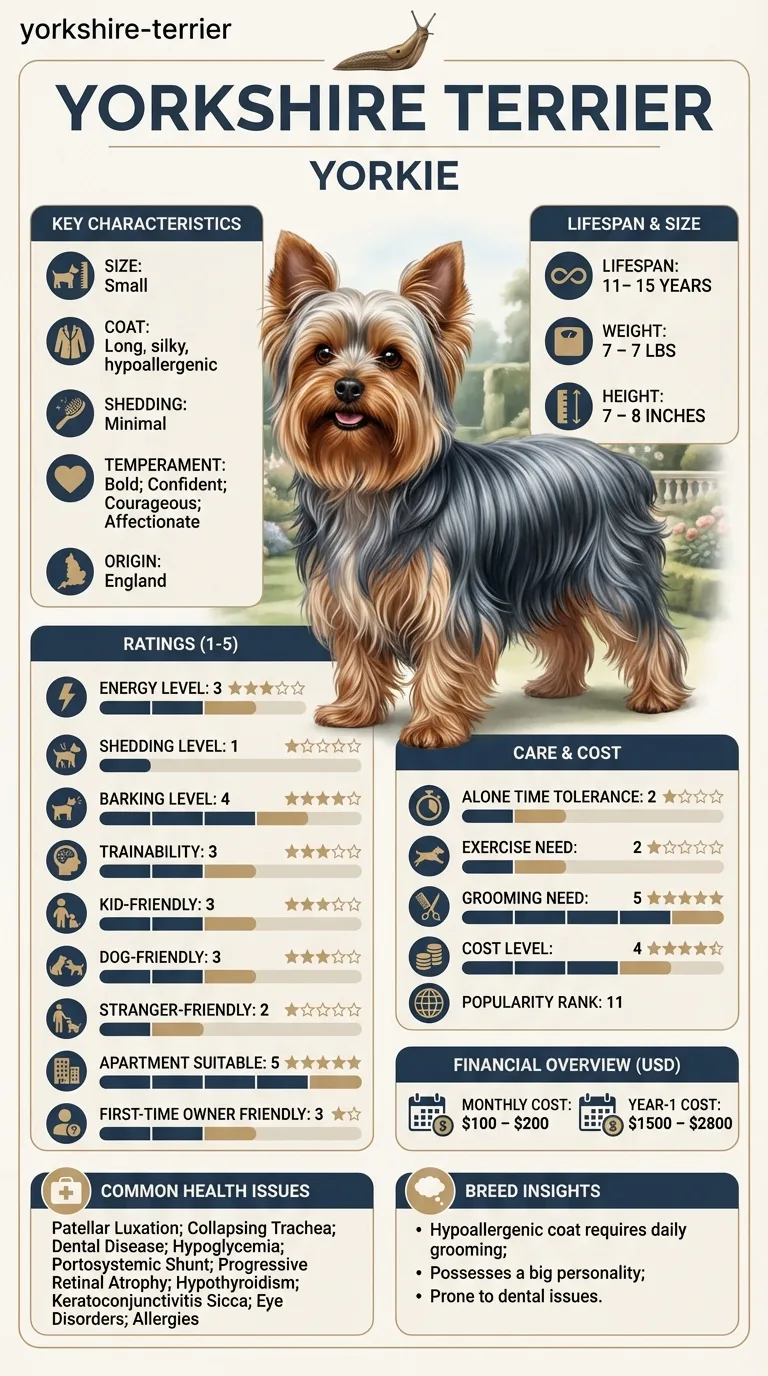
This is for someone already down to Basset Hound and Yorkshire Terrier and deciding between them. For this pair the decision usually turns on friendly to strangers and grooming need, so those are covered first and in most detail. Anyone choosing from a flat has a clear answer here: Yorkshire Terrier rates 5/5 against 4/5. It is written for the decision rather than the breed history.
Between Basset Hound and Yorkshire Terrier, friendly to strangers is what separates them, and Basset Hound is the lower-effort dog of the two to keep.
Choose Basset Hound if this is your first dog, you do not want a standing grooming appointment and there are young children at home.
Choose Yorkshire Terrier if you are in a flat or a smaller home, shedding is a problem in your house and you want a dog that picks up training quickly.
| Feature | basset hound | yorkshire terrier | Winner |
|---|---|---|---|
| Size class | medium | small | Equal |
| Weight | 40–65 lbs | 4–7 lbs | Equal |
| Height | 12–15 in | 7–8 in | Equal |
| Lifespan | 10–12 years | 11–15 years | yorkshire terrier |
| Exercise need | Low (2/5) | Low (2/5) | Equal |
| Grooming need | Moderate (3/5) | Very high (5/5) | basset hound |
| Shedding | Moderate (3/5) | Very low (1/5) | yorkshire terrier |
| Energy level | Low (2/5) | Moderate (3/5) | Equal |
| Barking | Low (2/5) | High (4/5) | basset hound |
| Apartment suitability | High (4/5) | Very high (5/5) | yorkshire terrier |
| Good for first-time owners | High (4/5) | Moderate (3/5) | basset hound |
| Tolerates being alone | Low (2/5) | Low (2/5) | Equal |
| Trainability | Low (2/5) | Moderate (3/5) | yorkshire terrier |
| Good with kids | Very high (5/5) | Moderate (3/5) | basset hound |
| Good with other dogs | Very high (5/5) | Moderate (3/5) | basset hound |
| Friendly to strangers | Very high (5/5) | Low (2/5) | basset hound |
| Cost level | Moderate (3/5) | High (4/5) | basset hound |
| Coat | Short, dense | Long, silky, hypoallergenic | Equal |
| Origin | France | England | Equal |
| Typical monthly cost | $80–$150 | $100–$190 | Equal |
| Typical first-year cost | $1,300–$2,300 | $1,400–$2,900 | Equal |
There's no gentler way to say it: a Basset Hound can weigh ten times what a Yorkshire Terrier weighs. The Basset runs 40 to 65 pounds; the Yorkie runs 4 to 7 pounds, standing just 7 to 8 inches tall against the Basset's 12 to 15. This is less a comparison of two medium dogs and more a comparison of two entirely different categories of pet -- one you can carry in a tote bag, one you can't lift with one arm.
Exercise need is actually tied here -- both rate 2/5, low for their respective sizes. Energy level tips slightly toward the Yorkie at 3/5 versus the Basset's 2/5, but in practice a Yorkie's energy burns off in short indoor bursts, while a Basset's lower energy is more a function of its build than its temperament. Neither dog needs long runs, but for different physical reasons.
This is the Yorkie's steepest cost: 5/5 grooming need against the Basset's 3/5, driven by that long, silky coat that mats without regular brushing and needs a real haircut on a schedule. In exchange, the Yorkie barely sheds (1/5, versus the Basset's 3/5) and is often marketed as hypoallergenic. You're trading a vacuum-cleaner problem for a scissors-and-brush problem.
Both dogs handle apartment living reasonably well, though the Yorkie edges ahead at 5/5 versus the Basset's still-solid 4/5. The real difference is noise: Yorkies rate 4/5 for barking, a genuinely vocal small-dog trait, while Bassets rate a low 2/5. If thin walls and a barking-sensitive neighbor are a concern, the quieter Basset is the safer bet despite being the bigger dog.
The Basset rates higher for first-time owners (4/5 vs. the Yorkie's 3/5), which surprises people who assume small automatically means easy. Yorkies rate slightly better on trainability (3/5 vs. 2/5) but are notoriously prone to small-dog stubbornness and selective hearing of their own. Neither breed is a natural obedience-class star; both reward patience over drilling repetition.
Here the Basset pulls well ahead. It rates 5/5 with kids against the Yorkie's 3/5, 5/5 with other dogs against 3/5, and 5/5 with strangers against a notably low 2/5. A Yorkie's small size makes it more fragile around rough handling from young kids, and its wariness of strangers is a real trait, not a stereotype -- this is a breed that tends to bond tightly and stay guarded elsewhere.
These two breeds don't share a single condition on their health lists, which tells you their risk profiles come from completely different places -- the Basset's from its long back and heavy build, the Yorkie's from being a tiny toy breed (collapsing trachea, hypoglycemia, portosystemic shunt). The Yorkie also lives notably longer, 11 to 15 years against the Basset's 10 to 12, which is typical of the size-to-lifespan pattern across dog breeds generally.
The Yorkie actually costs more overall despite being tiny -- it rates 4/5 on the cost scale against the Basset's 3/5, and its monthly cost of $100-$190 runs close to or above the Basset's $80-$150. Grooming is the main driver: regular professional trims add up in a way that a Basset's occasional bath doesn't. First-year costs land close together, $1,300-$2,300 versus $1,400-$2,900.
Basset Hound weighs 40–65 lbs and lives 10–12 years; Yorkshire Terrier weighs 4–7 lbs and lives 11–15 years. The two diverge most on friendly to strangers, grooming need and shedding and 3 other rated axes. They are level on tolerates being alone and exercise need, so those cannot decide it. In the table, a "winner" means easier for an ordinary household — not better. Size, coat and origin are recorded without a verdict. Because both breeds are scored the same way, the gaps are reliable even where the absolute numbers are rough.

Dramatically bigger -- 40-65 lbs versus the Yorkie's 4-7 lbs, close to a tenfold difference in weight.
The Yorkshire Terrier, rated 1/5 for shedding against the Basset's 3/5, thanks to its long, hair-like coat.
The Basset Hound rates slightly higher (4/5) than the Yorkie (3/5), which surprises people who assume a small dog is automatically the easier choice.
The Yorkshire Terrier by a wide margin -- 4/5 versus the Basset's 2/5 -- a genuinely vocal breed.
$80-$150 for the Basset and $100-$190 for the Yorkie, despite the size difference, largely due to grooming costs.
No -- their health lists don't overlap at all, reflecting how differently their bodies are built.
The Yorkshire Terrier, at 11-15 years versus the Basset's 10-12, consistent with smaller breeds generally outliving larger ones.
The Basset Hound, rating 2/5 for barking against the Yorkie's notably vocal 4/5.
The Yorkshire Terrier, rated 4/5 on the cost scale versus the Basset's 3/5, mostly due to grooming.
No overlap at all -- their health lists are entirely different, reflecting their very different body types.
The Basset Hound by far -- 5/5 versus the Yorkie's 2/5, which tends to be wary of new people.
Secure checkout on Stripe. We never see your card.
7-day money-back guarantee. Instant access.
Health information here is general and is not veterinary advice. If your dog shows pain, sudden behaviour change, or worsening symptoms, consult a licensed veterinarian.
Some links on this site are affiliate links. We may earn a commission at no extra cost to you, and we only suggest products we believe are helpful for dog owners.
We research and check what we publish, but we do not warrant that any figure, date, price, or statement is accurate, complete, or current, and we accept no liability for any loss, cost, injury, or other harm arising from the use of this site. Use it as one reference among several. You remain responsible for your own decisions and for your dog's care - confirm anything that matters with a licensed veterinarian or another qualified professional before you act on it. Full disclaimer.
Match your lifestyle to the right dog.
Take quizNot sure which breed is right for you? Take our 2-minute quiz to find out.
Take the quiz