Living
Which breed fits more lifestyles?
The Basset Hound, low exercise need and high apartment suitability make it workable for more households; the Springer needs an active owner with space.

Quick answer
Which breed fits more lifestyles?
The Basset Hound, low exercise need and high apartment suitability make it workable for more households; the Springer needs an active owner with space.
Basset Hound or English Springer Spaniel? On paper they differ most on exercise need, and on the scales Basset Hound is the heavier at 40–65 lbs. Here is how the two compare on everything that shapes an ordinary week.
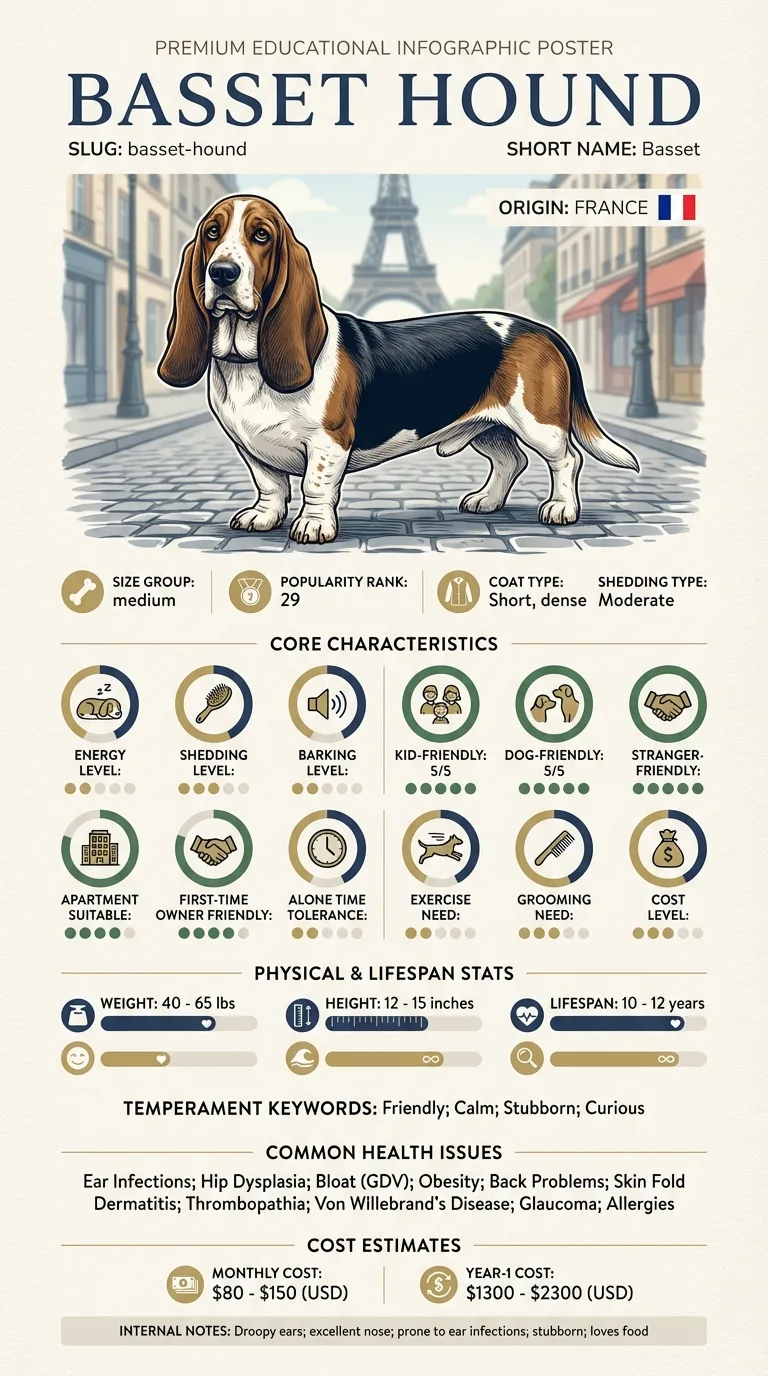
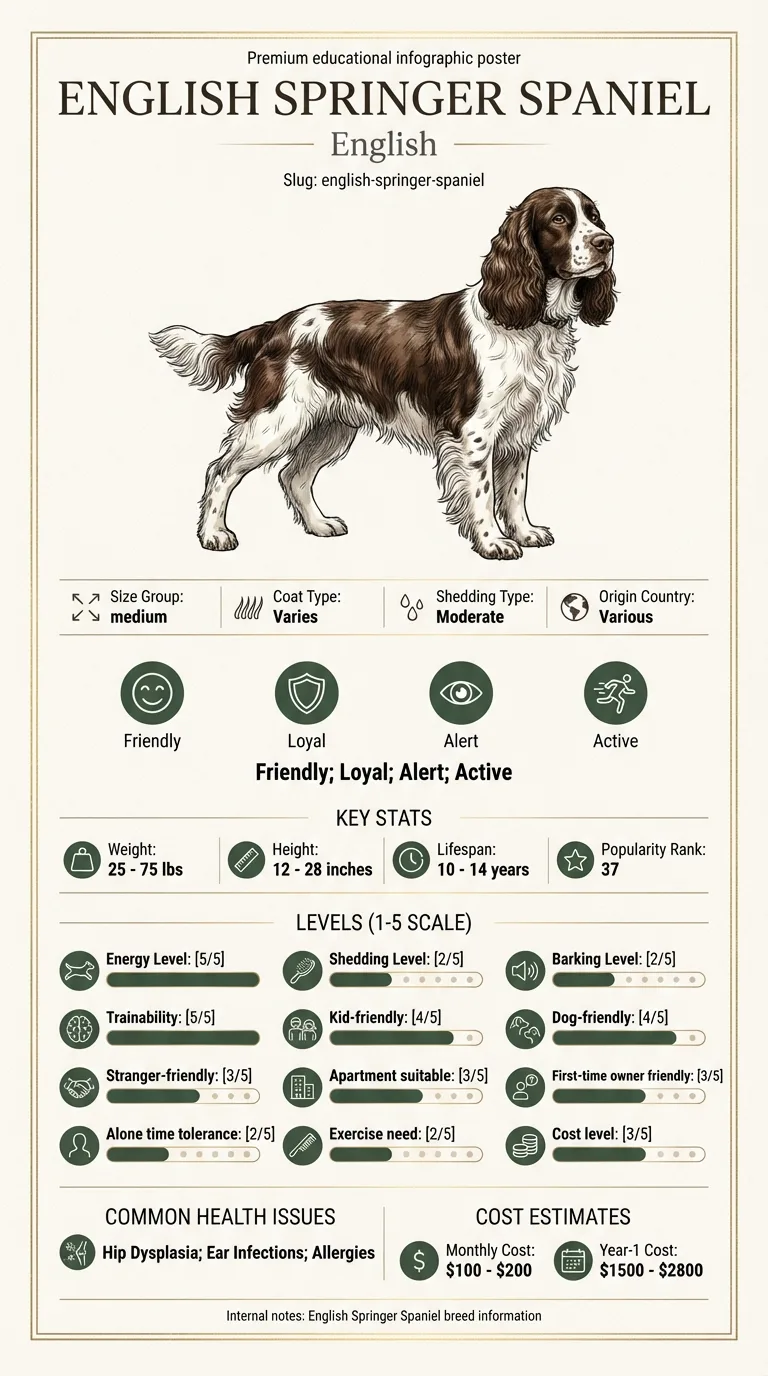
This is for someone already down to Basset Hound and English Springer Spaniel and deciding between them. For this pair the decision usually turns on exercise need and energy level, so those are covered first and in most detail. Anyone choosing from a flat has a clear answer here: Basset Hound rates 4/5 against 2/5. Breed history is left out; what follows is what you will actually live with.
Between Basset Hound and English Springer Spaniel, exercise need is what separates them, and Basset Hound is the lower-effort dog of the two to keep.
Choose Basset Hound if you are in a flat or a smaller home, this is your first dog and you do not want a standing grooming appointment.
Choose English Springer Spaniel if you want a dog that picks up training quickly, a smaller dog suits your car, your home or your back and you want a dog that can keep up with an active routine.
| Feature | basset hound | english springer spaniel | Winner |
|---|---|---|---|
| Size class | medium | medium | Equal |
| Weight | 40–65 lbs | 40–50 lbs | Equal |
| Height | 12–15 in | 19–20 in | Equal |
| Lifespan | 10–12 years | 12–14 years | english springer spaniel |
| Exercise need | Low (2/5) | Very high (5/5) | basset hound |
| Grooming need | Moderate (3/5) | High (4/5) | basset hound |
| Shedding | Moderate (3/5) | Moderate (3/5) | Equal |
| Energy level | Low (2/5) | Very high (5/5) | Equal |
| Barking | Low (2/5) | Moderate (3/5) | basset hound |
| Apartment suitability | High (4/5) | Low (2/5) | basset hound |
| Good for first-time owners | High (4/5) | Moderate (3/5) | basset hound |
| Tolerates being alone | Low (2/5) | Low (2/5) | Equal |
| Trainability | Low (2/5) | Very high (5/5) | english springer spaniel |
| Good with kids | Very high (5/5) | Very high (5/5) | Equal |
| Good with other dogs | Very high (5/5) | High (4/5) | basset hound |
| Friendly to strangers | Very high (5/5) | High (4/5) | basset hound |
| Cost level | Moderate (3/5) | Moderate (3/5) | Equal |
| Coat | Short, dense | Medium, feathered double coat | Equal |
| Origin | France | Various | Equal |
| Typical monthly cost | $80–$150 | $100–$200 | Equal |
| Typical first-year cost | $1,300–$2,300 | $1,400–$2,900 | Equal |
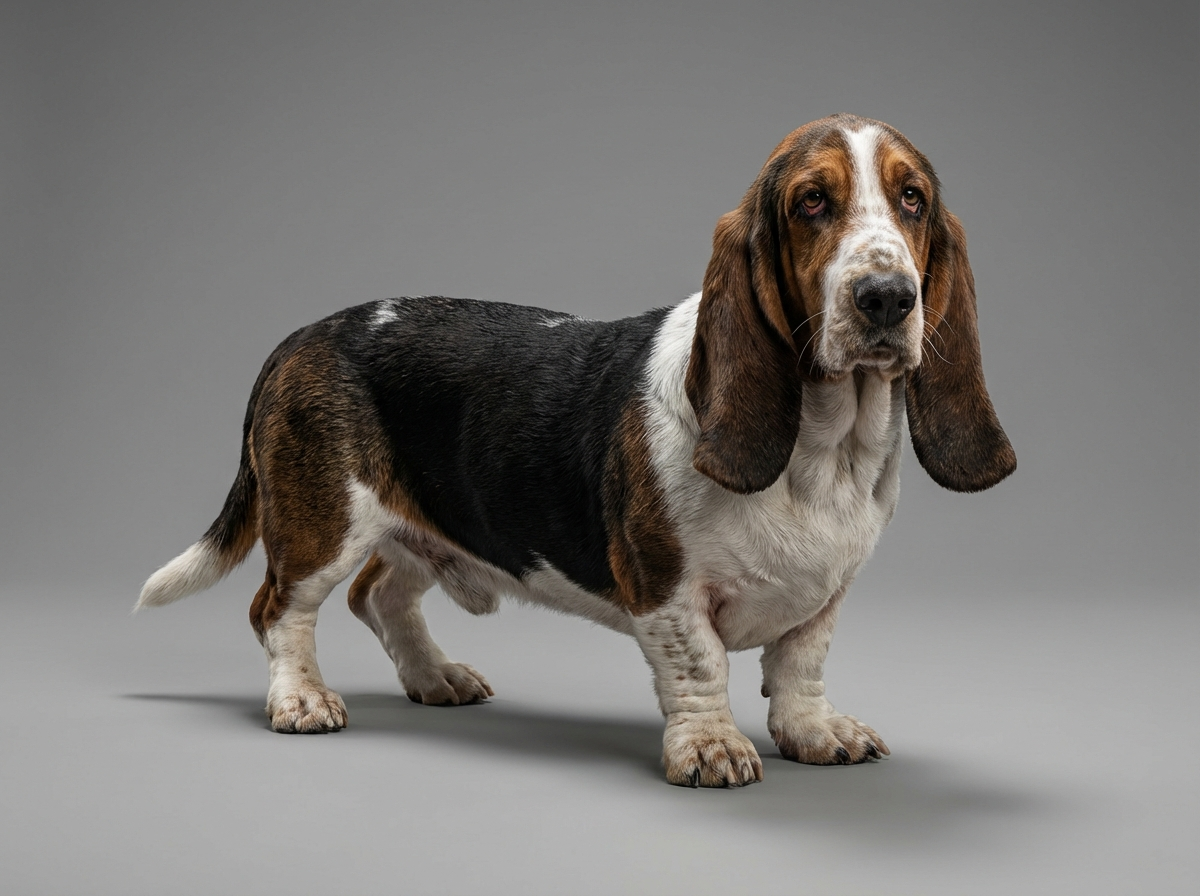
The English Springer Spaniel stands nearly a foot and a half taller at the shoulder, 19-20 inches versus the Basset Hound's 12-15, despite weighing less, 40-50 lbs against the Basset's 40-65. That's the whole story of these two builds: one is a low, heavy hound, the other an athletic, leggy sporting dog built to cover ground. Neither breed's weight range is unusual on its own; it's the combination with height that makes the difference so visible side by side.
Exercise need doesn't get more lopsided than this: Basset Hounds rate 2/5, Springers rate 5/5, the top of the scale. A Springer bred for flushing game wants serious daily work, running, retrieving, hiking, not a walk around the block. A Basset genuinely doesn't need that, and trying to make a Basset do it will end in a dog that just sits down.
The Springer's feathered double coat pushes its grooming need to High (4/5), a step above the Basset's Moderate (3/5). Both shed at the same moderate rate, so the difference is in maintenance, not mess: expect regular brushing and coat trims for the Springer, and mostly ear care and wipe-downs for the Basset's short, dense coat. Neither coat is difficult exactly, but the Springer's asks for a standing weekly commitment the Basset's doesn't.
Here the Basset has a clear edge: High (4/5) apartment suitability against the Springer's Low (2/5). A dog rated 5/5 for exercise and energy struggles in a small space without a yard or serious daily commitment. Barking runs Low (2/5) for the Basset and Moderate (3/5) for the Springer. Both, notably, tolerate being alone poorly, 2/5 each, so neither is a good match for long solo days regardless of square footage.
Trainability flips the usual script for hound breeds, the Springer rates a full 5/5, the highest score in this comparison, reflecting its Biddable, Eager temperament. The Basset rates 2/5 and is flagged Stubborn. That gap also shows up in the first-time-owner scores: Basset at High (4/5), Springer only Moderate (3/5), because a Springer's exercise and training needs ask more of a new owner even as the dog itself is easier to teach.
Both breeds are rated Very High (5/5) with kids, so that's not a differentiator. The Basset pulls ahead with other dogs and strangers, both Very High (5/5) versus the Springer's High (4/5) on each, still strong numbers, just not quite as unflappable as the Basset's Friendly, Curious temperament suggests. A High score on a 5-point scale is nothing to worry about when picking a family dog.
Springers live longer on average, 12-14 years versus the Basset's 10-12. The Basset's health list is longer and tied to its body shape, Bloat, Back Problems, Skin Fold Dermatitis among ten flagged conditions. The Springer's five-item list includes Hip Dysplasia and Ear Infections, both of which also appear on the Basset's list, plus Progressive Retinal Atrophy, Phosphofructokinase Deficiency, and Elbow Dysplasia, which don't.
Both land at Moderate (3/5) for overall cost level, but the actual numbers favor the Basset: $80-150 monthly and $1,300-2,300 in year one, against $100-200 monthly and $1,400-2,900 for the Springer. Higher grooming needs and a working-dog appetite both nudge the Springer's number up. Factor in occasional professional grooming for the Springer's feathered coat, and the real-world gap can run wider than the ranges alone suggest.
Basset Hound weighs 40–65 lbs and lives 10–12 years; English Springer Spaniel weighs 40–50 lbs and lives 12–14 years. The two diverge most on exercise need, energy level and trainability and 1 other rated axes. They are level on tolerates being alone, cost level and good with kids, so those cannot decide it. The comparison marks an easier option only where one exists. Facts like weight and country of origin are not scored. Both dogs are rated from the same dataset, which is what makes the numbers comparable with each other even though any individual dog sits somewhere inside its breed's range.

Yes, it's the largest single gap in the data. Springers rate 5/5 for exercise need, Bassets rate 2/5. A Springer left under-exercised tends to get restless; a Basset is content with modest walks.
Neither, technically, both rate Moderate (3/5) for shedding. The Springer's coat just takes more brushing to manage because it's longer and feathered.
The data leans Basset, rated High (4/5) for first-time owners versus the Springer's Moderate (3/5), mostly because the Springer's exercise and grooming demands are a bigger commitment for a beginner, even though it's easier to train.
Not well, according to the ratings, Low (2/5) for apartment suitability, driven by that 5/5 exercise need. The Basset rates High (4/5) and is the better apartment fit by a wide margin.
The Basset, modestly, $80-150 a month and $1,300-2,300 in year one, versus $100-200 and $1,400-2,900 for the Springer.
Hip Dysplasia and Ear Infections appear on both lists. The Basset's remaining risks trace to its long body and folded skin; the Springer's include Progressive Retinal Atrophy and Phosphofructokinase Deficiency, which aren't on the Basset's list.
The Springer, clearly, 5/5 trainability against the Basset's 2/5. That biddability is part of why Springers do well in active, structured households despite needing more exercise.
The Basset Hound, low exercise need and high apartment suitability make it workable for more households; the Springer needs an active owner with space.
$80-150 for the Basset versus $100-200 for the Springer.
A lot, it rates 5/5, the top of the scale, versus 2/5 for the Basset.
The Springer, at 12-14 years versus 10-12 for the Basset.
Secure checkout on Stripe. We never see your card.
7-day money-back guarantee. Instant access.
Health information here is general and is not veterinary advice. If your dog shows pain, sudden behaviour change, or worsening symptoms, consult a licensed veterinarian.
Some links on this site are affiliate links. We may earn a commission at no extra cost to you, and we only suggest products we believe are helpful for dog owners.
We research and check what we publish, but we do not warrant that any figure, date, price, or statement is accurate, complete, or current, and we accept no liability for any loss, cost, injury, or other harm arising from the use of this site. Use it as one reference among several. You remain responsible for your own decisions and for your dog's care - confirm anything that matters with a licensed veterinarian or another qualified professional before you act on it. Full disclaimer.
Match your lifestyle to the right dog.
Take quizNot sure which breed is right for you? Take our 2-minute quiz to find out.
Take the quiz