Living
Which breed fits more homes overall?
The Mini Poodle, given its apartment suitability and lower exercise demand. The Aussie only makes sense if you can meet its very high exercise need consistently.

Quick answer
Which breed fits more homes overall?
The Mini Poodle, given its apartment suitability and lower exercise demand. The Aussie only makes sense if you can meet its very high exercise need consistently.
Australian Shepherd or Poodle (Miniature)? On paper they differ most on apartment suitability, and on the scales Australian Shepherd is the heavier at 40–65 lbs. Here is how the two compare on everything that shapes an ordinary week.
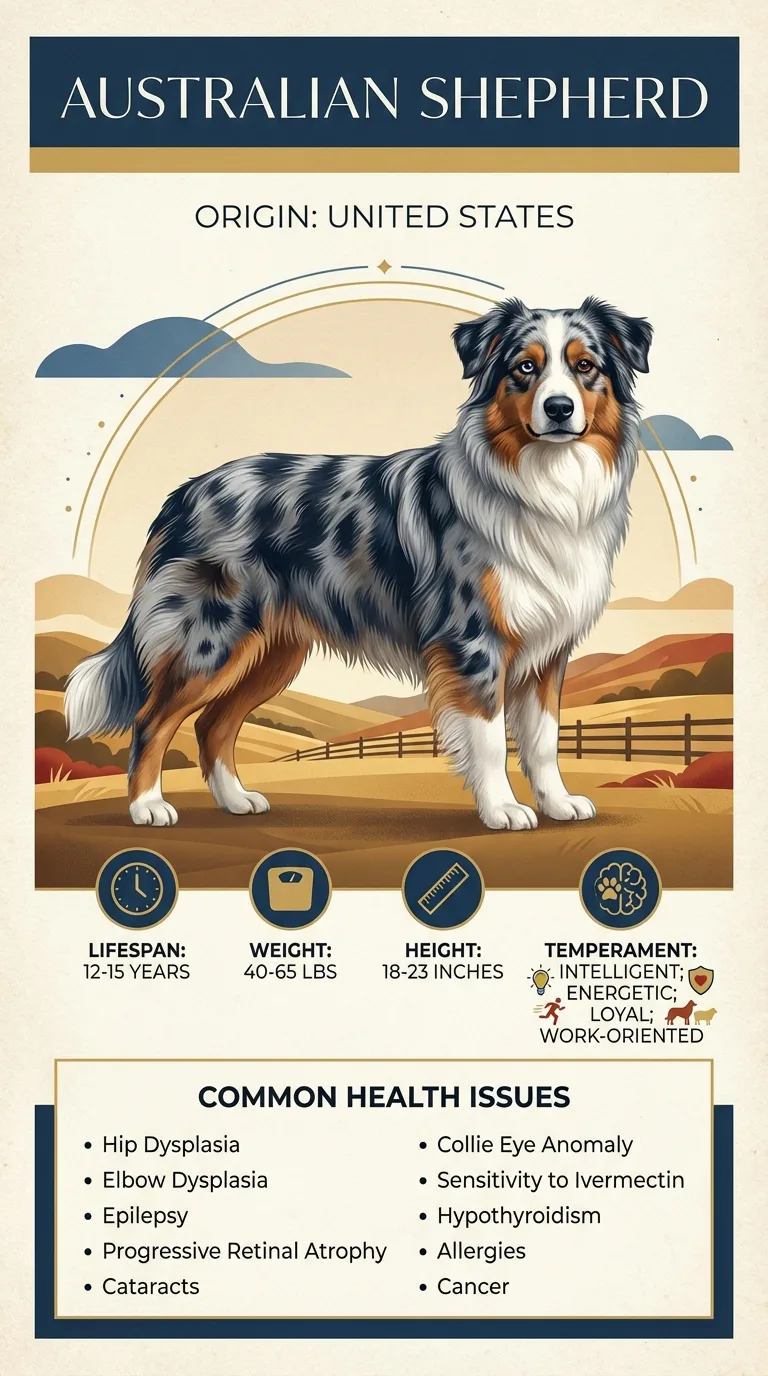
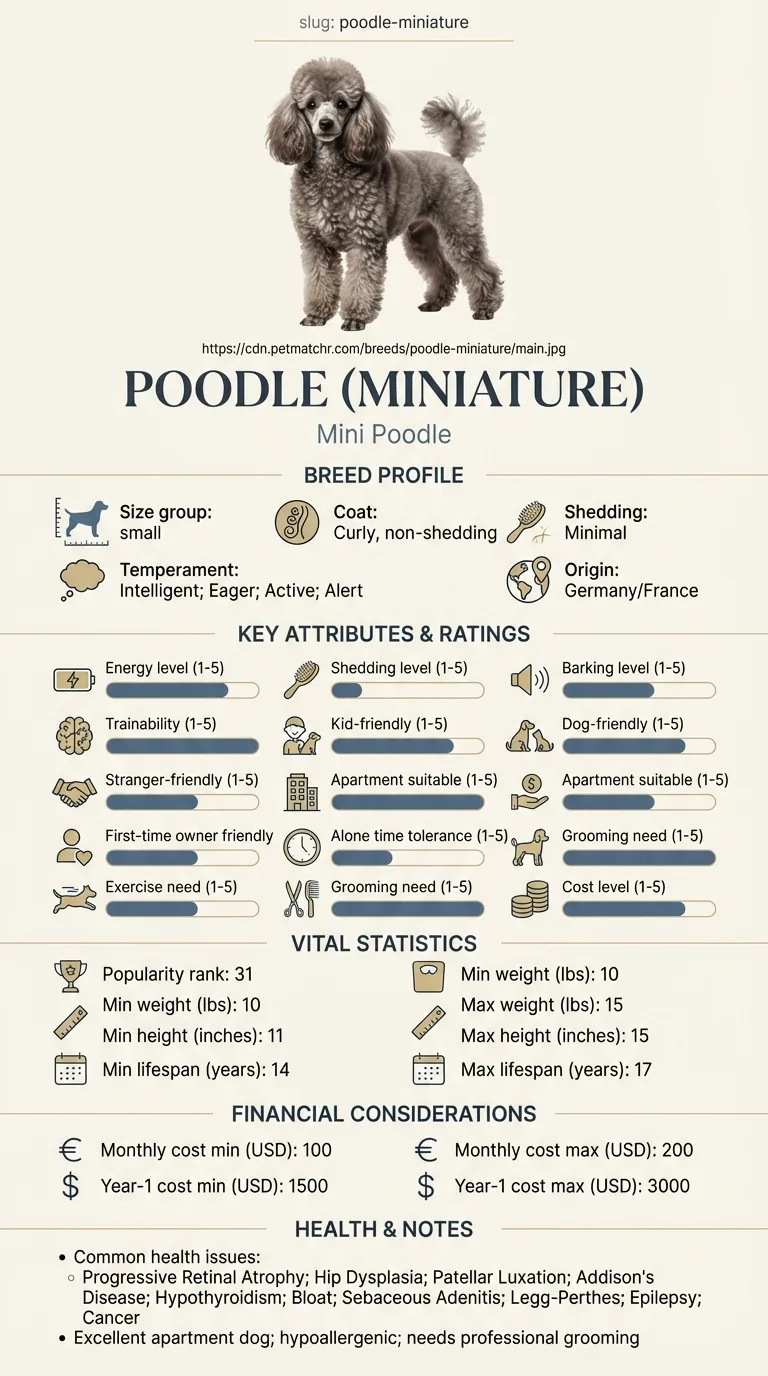
This is for someone already down to Australian Shepherd and Poodle (Miniature) and deciding between them. For this pair the decision usually turns on apartment suitability and shedding, so those are covered first and in most detail. Anyone choosing from a flat has a clear answer here: Poodle (Miniature) rates 5/5 against 1/5. There is no origin story here — only what changes about your week.
Between Australian Shepherd and Poodle (Miniature), apartment suitability is what separates them, and Poodle (Miniature) is the lower-effort dog of the two to keep.
Choose Australian Shepherd if you do not want a standing grooming appointment, you want a dog that can keep up with an active routine and you want a dog that is more watchful with visitors.
Choose Poodle (Miniature) if you are in a flat or a smaller home, this is your first dog and shedding is a problem in your house.
| Feature | australian shepherd | poodle miniature | Winner |
|---|---|---|---|
| Size class | medium | small | Equal |
| Weight | 40–65 lbs | 10–15 lbs | Equal |
| Height | 18–23 in | 11–15 in | Equal |
| Lifespan | 12–15 years | 14–17 years | poodle miniature |
| Exercise need | Very high (5/5) | Moderate (3/5) | poodle miniature |
| Grooming need | Moderate (3/5) | Very high (5/5) | australian shepherd |
| Shedding | High (4/5) | Very low (1/5) | poodle miniature |
| Energy level | Very high (5/5) | High (4/5) | Equal |
| Barking | Moderate (3/5) | Moderate (3/5) | Equal |
| Apartment suitability | Very low (1/5) | Very high (5/5) | poodle miniature |
| Good for first-time owners | Low (2/5) | Moderate (3/5) | poodle miniature |
| Tolerates being alone | Low (2/5) | Low (2/5) | Equal |
| Trainability | Very high (5/5) | Very high (5/5) | Equal |
| Good with kids | High (4/5) | High (4/5) | Equal |
| Good with other dogs | High (4/5) | High (4/5) | Equal |
| Friendly to strangers | Low (2/5) | Moderate (3/5) | poodle miniature |
| Cost level | Moderate (3/5) | High (4/5) | australian shepherd |
| Coat | Medium-length double coat | Curly, non-shedding | Equal |
| Origin | United States | Germany/France | Equal |
| Typical monthly cost | $100–$200 | $100–$200 | Equal |
| Typical first-year cost | $1,500–$2,800 | $1,500–$3,000 | Equal |
No confusion about sizing here. The Miniature Poodle weighs 10-15 lbs and stands 11-15 inches, a small fraction of the Aussie's 40-65 lbs and 18-23 inches. Despite the size gap, the Mini Poodle isn't a fragile toy breed — it's a scaled-down working dog with real substance, just built at a fraction of the Aussie's mass. Pick either one up and you'll notice real muscle underneath, not the fragility people sometimes expect from a small breed.
The Aussie rates very high (5/5) on exercise need; the Mini Poodle sits at moderate (3/5), a real but more manageable amount of daily activity. A brisk walk plus some mental work covers a Mini Poodle's needs most days. The Aussie wants considerably more — sustained physical work, not just a stroll around the block. Match either dog's exercise to its actual rating, not its size, and you'll avoid the boredom-driven bad habits that show up when a smart dog is under-stimulated.
Here the pattern flips. Grooming rates very high (5/5) for the Mini Poodle against moderate (3/5) for the Aussie — that curly coat needs regular clipping. Shedding runs the opposite direction: very low (1/5) for the Poodle versus high (4/5) for the Aussie. You're trading a vacuum problem for a grooming-bill problem, not eliminating either one. Which trade you'd rather make is really a household-priorities question more than a right-or-wrong one.
The Mini Poodle rates very high (5/5) for apartment suitability; the Aussie sits at very low (1/5). Barking is a tie at moderate (3/5) for both, so neither is notably quiet. Both also tolerate being alone equally poorly, rated low (2/5) — a smaller home suits the Poodle better, but neither breed does well with long stretches of solitude. Crate training or a midday dog walker is worth planning for either one if your workday runs long.
Trainability ties at very high (5/5) for both breeds — this is a genuine match in intelligence and responsiveness. Where they split is beginner-friendliness: the Mini Poodle rates moderate (3/5) for first-time owners against the Aussie's low (2/5), since the Aussie's working instincts demand more structure than most newcomers naturally provide. In practice, both dogs pick up new commands fast, but the Aussie gets restless and inventive without a job to focus on, while the Mini Poodle settles for a shorter daily session.
Kids and other dogs both come out tied, high (4/5) for each breed — a comfortable match on either count. With strangers, the Mini Poodle edges ahead, moderate (3/5) against the Aussie's low (2/5), making it the more sociable choice if you regularly have visitors or unfamiliar faces around. Neither breed is a liability in a busy household — the numbers here point to a mild preference, not a warning.
The Mini Poodle tends to outlive the Aussie by a couple of years, 14-17 versus 12-15. Their health lists overlap substantially — progressive retinal atrophy, hip dysplasia, hypothyroidism, epilepsy and cancer all appear on both — so eye, joint and thyroid screening matters for either breed. The Mini Poodle's list adds Addison's disease, bloat and sebaceous adenitis as its own additional concerns.
The Mini Poodle carries a higher overall cost rating, high (4/5) against the Aussie's moderate (3/5), largely a reflection of grooming bills. Monthly costs tie at $100-200, but first-year totals run slightly higher for the Poodle, $1,500-3,000 versus $1,500-2,800 — that early gap is mostly purchase price and setup, not ongoing food. Over several years, a regular six-to-eight-week grooming schedule for the Mini Poodle is likely the bigger recurring line item to plan around.
Australian Shepherd weighs 40–65 lbs and lives 12–15 years; Poodle (Miniature) weighs 10–15 lbs and lives 14–17 years. The two diverge most on apartment suitability, shedding and exercise need and 1 other rated axes. They are level on tolerates being alone, barking and good with other dogs, so those cannot decide it. Where the table declares a winner it means less work for the owner, nothing more; descriptive rows are left as ties on purpose. The value here is in the differences between the two columns; treat any single score as approximate.

Considerably — 10-15 lbs and 11-15 inches for the Mini Poodle against 40-65 lbs and 18-23 inches for the Aussie. It's a genuinely small dog, not a mid-size one.
It rates very low (1/5) for shedding here, versus high (4/5) for the Aussie, which is about as close to non-shedding as this scale gets. That comes at the cost of grooming, though — the Poodle rates very high (5/5) there.
They're tied, both rated very high (5/5) for trainability. This is one of the closer matches on this page — the real difference is in how much direction each breed needs day to day, not raw intelligence.
Yes, rated very high (5/5) for apartment suitability. The Aussie is the opposite end of the scale at very low (1/5), so this is one of the clearest splits in the comparison.
Quite a few — progressive retinal atrophy, hip dysplasia, hypothyroidism, epilepsy and cancer all show up on both breeds' lists. Ask breeders of either dog about eye and hip screening specifically.
The Mini Poodle rates higher overall (high, 4/5, versus moderate, 3/5), mostly from grooming. Monthly costs are the same range for both ($100-200), but the Poodle's first-year total runs slightly higher.
The Mini Poodle, typically 14-17 years against the Aussie's 12-15 — a solid multi-year edge, one of the more notable lifespan gaps on this site.
The Mini Poodle, given its apartment suitability and lower exercise demand. The Aussie only makes sense if you can meet its very high exercise need consistently.
Both land in the same $100-200 range. The Poodle's higher overall cost rating shows up more in grooming bills and first-year total than in routine monthly spend.
The Aussie rates very high (5/5); the Mini Poodle moderate (3/5). Both need real activity, but the Aussie's is on another level entirely.
The Mini Poodle, at 14-17 years against 12-15 for the Aussie — a genuine multi-year advantage worth factoring into a long-term decision.
Secure checkout on Stripe. We never see your card.
7-day money-back guarantee. Instant access.
Health information here is general and is not veterinary advice. If your dog shows pain, sudden behaviour change, or worsening symptoms, consult a licensed veterinarian.
Some links on this site are affiliate links. We may earn a commission at no extra cost to you, and we only suggest products we believe are helpful for dog owners.
We research and check what we publish, but we do not warrant that any figure, date, price, or statement is accurate, complete, or current, and we accept no liability for any loss, cost, injury, or other harm arising from the use of this site. Use it as one reference among several. You remain responsible for your own decisions and for your dog's care - confirm anything that matters with a licensed veterinarian or another qualified professional before you act on it. Full disclaimer.
Match your lifestyle to the right dog.
Take quizNot sure which breed is right for you? Take our 2-minute quiz to find out.
Take the quiz