Living
Is a Sheltie's coat making it hotter?
Only if it is packed with dead undercoat. A brushed-out coat allows air movement and shields against sun, so grooming beats clipping in most cases.

Quick answer
Is a Sheltie's coat making it hotter?
Only if it is packed with dead undercoat. A brushed-out coat allows air movement and shields against sun, so grooming beats clipping in most cases.
Heat is one of the few genuine daily risks in this breed, and most of what owners do about it in summer makes it worse rather than better.
Owners in hot or humid climates, anyone whose Sheltie has just blown its coat and left half of it in the hallway, and anyone weighing up whether to book the summer shave-down the groomer keeps suggesting.
This guide is not medical advice. If your dog shows pain, sudden behavior change, or worsening symptoms, consult a licensed veterinarian.
Some links may be affiliate links. We may earn a commission at no extra cost to you. We only suggest products we believe are helpful for dog owners.
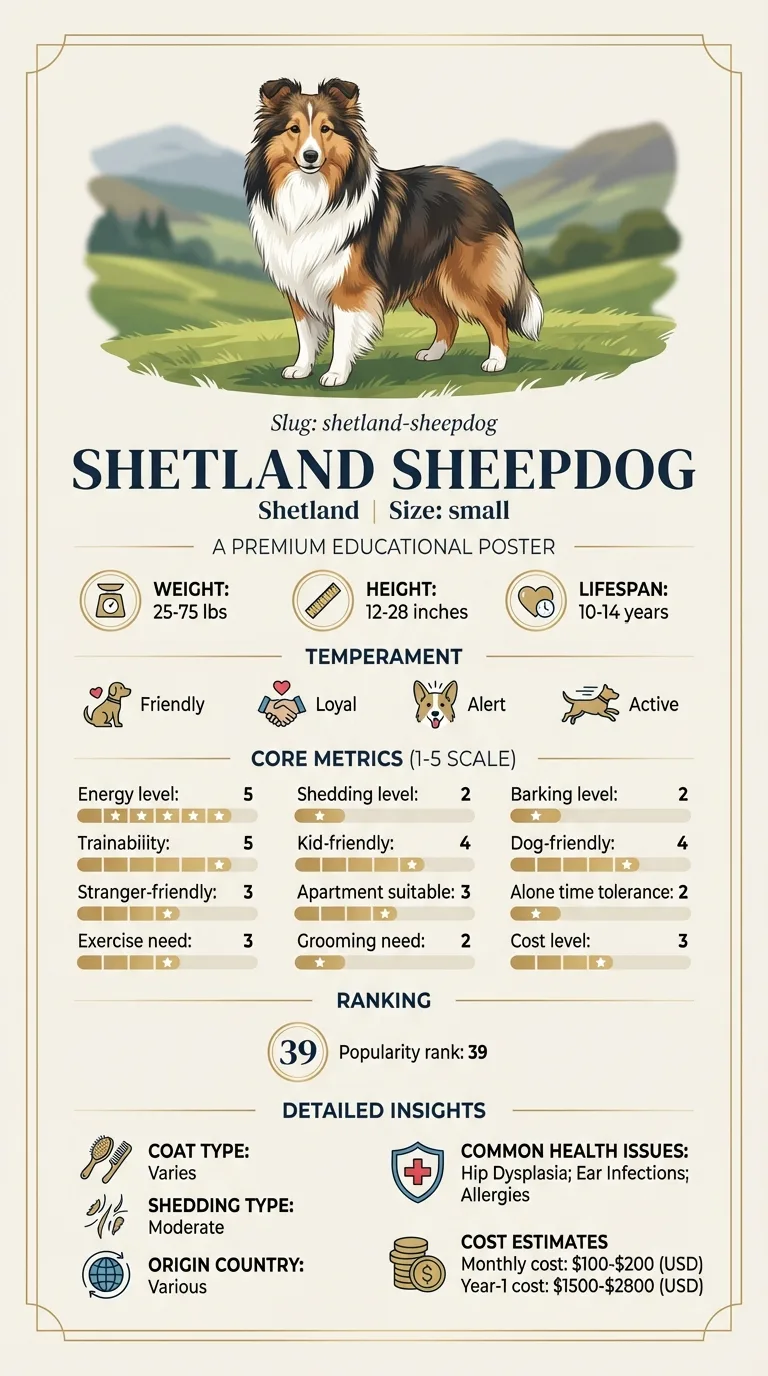
Heat sensitivity in a Shetland Sheepdog is a coat-management problem before it is a medical one. The breed's long, dense double coat sheds heavily by season, and when dead undercoat is left in place it packs into a felt that stops air moving and traps moisture. Day to day this shows up as a dog that wants to lie on tile rather than carpet, refuses midday walks, and takes a long time to stop panting after ordinary activity.
Near universal as a management issue in warm climates and rare as an emergency in owners who adjust the routine. Almost every Sheltie owner in a hot region ends up reorganising walks around the sun. Actual heat emergencies in the breed cluster around confinement, midday exertion and matted coats.
The coat is the whole story. A Shetland Sheepdog carries a long, dense double coat with heavy seasonal shedding, which is a superb piece of weatherproofing and a liability in sustained heat if it is not maintained. Body size compounds it: a fifteen to twenty five pound dog has limited thermal mass and heats up faster than a larger animal. Temperament adds the final ingredient, because a bright, devoted, high-drive herding dog will keep working in conditions where it should have quit, so the usual behavioural safety valve does not operate.
Humidity is the underrated factor. Panting sheds heat by evaporating water from the airways, and in humid air that mechanism loses most of its power, which is why a Sheltie can struggle at twenty six degrees with wet air and be fine at thirty in dry air. Surfaces matter too, since pavement, decking and artificial grass hold and radiate heat directly onto a low-slung dog. Confined spaces without airflow, including cars, crates and glazed rooms, remove the last option a coated dog has.
Get to a vet immediately, this is an emergency: frantic or noisy panting that does not settle in shade, bright red or unusually pale gums, drooling thick saliva, vomiting or diarrhoea after heat exposure, staggering, glazed eyes, or collapse. Begin cooling on the way, with cool water to the belly and limbs and air movement, and do not delay transport to finish cooling at home. Book within days: a dog that has become noticeably less heat tolerant than it was last summer, unexplained panting at rest in a cool room, or skin that is red, damp or smelly under the coat. Reduced heat tolerance can be an early sign of a thyroid, cardiac or airway problem rather than the weather.
See all Shetland Sheepdog health problems, which breeds are prone to heat sensitivity, or the full Shetland Sheepdog breed guide for temperament, exercise needs and ownership costs.
Coat management shows results within two or three weeks of consistent line brushing; the dog visibly seeks cool surfaces less often once the packed undercoat is gone. Adjusting the daily routine works immediately. A shaved coat, if you go that route, takes six months to a year to regrow and may never return to its original texture. Heat tolerance itself does not improve with training, so plan around it rather than trying to condition it away.
Success is a Sheltie that pants normally and settles within a few minutes after summer activity, that has no damp or matted patches behind the ears or under the trousers, and whose exercise happens at the ends of the day without anyone feeling short-changed. It is not a dog that tolerates midday heat, because that is not achievable in this coat, and pursuing it is how heat emergencies happen.
A Sheltie's coat is two garments worn together. Underneath sits a short, soft, dense undercoat, which is the insulating layer and traps a cushion of still air against the skin. Over that lie the long, coarse guard hairs, which shed water, block wind and reflect a surprising amount of sun.
Insulation works in both directions. The same trapped air that keeps cold out in February slows heat coming in during July. A coat in good condition, brushed clear of dead undercoat so air can move through it, is part of the cooling system rather than an obstacle to it.
The failure mode is not the coat existing, it is the coat being packed. When shed undercoat is left in place it mats into a dense felt against the skin. Felt does not breathe, does not let sweat evaporate from the paw pads and skin surface, holds moisture after rain or swimming, and turns the dog into an insulated bag. A packed coat is a genuine heat hazard. A brushed one is not.
That is why the useful summer intervention is a slicker brush and an undercoat rake used regularly, not clippers.
Shaving a Sheltie is a decision with real trade-offs and it is not automatically wrong, but it is usually oversold.
What you lose is significant. You remove the sun barrier from a dog whose skin has never seen daylight, which raises the risk of sunburn and, over years, of sun-related skin damage. In a breed that already carries a documented immune-mediated skin condition affecting the face, ear tips and bony points, exposing skin is not a neutral act. You also remove the insulation that slows radiant heat gain, so a shaved dog lying on a hot patio may actually be worse off. And a double coat clipped short does not always grow back with the same texture; the undercoat often returns faster and coarser than the guard hairs, leaving a permanently woolly, less functional coat.
What you gain is real too, in specific cases: a matted coat that cannot be brushed out humanely, an elderly or arthritic dog that cannot tolerate long grooming sessions, a dog with a skin condition needing direct treatment, or a dog in a climate where matting is constant. Those are veterinary and welfare reasons, and they are legitimate.
The middle option most groomers will offer, and the one worth asking for, is a thorough de-shed and a tidy of the trousers, belly and feet, which improves airflow without stripping the dog's protection.

Dev moved from Manchester to Phoenix with a five-year-old Sheltie called Juno and booked a full shave-down in his first week, on the reasonable assumption that less coat meant a cooler dog. His groomer refused, and explained why: Juno's problem was not the length of her coat but the four months of dead undercoat compacted underneath it, which was why she smelled damp behind the ears and would not lie anywhere but the bathroom floor. She spent two hours raking it out instead and sent Dev home with an undercoat rake and instructions. Within a fortnight Juno was lying on the living room rug again. Dev moved her walks to five in the morning and after nine at night, put a cooling mat on the tile by the back door, and kept up the raking twice a week. He never did have her shaved. Three summers later her coat is intact and she has not had a single heat episode or hot spot.
Key takeaway: In a Shetland Sheepdog, the summer intervention that works is removing dead undercoat and moving the clock, not removing the coat. Clipping trades a manageable problem for a permanent one.
Worse than a short-coated dog of the same size, yes. They cool primarily by panting, and a heavy insulating coat plus a small body mass makes them less tolerant of sustained heat than their energy level suggests. Most manage fine with sensible routine adjustment; problems come from asking a coated dog to work in the middle of a hot day.
Usually not. A well-brushed double coat helps a Sheltie more than bare skin does, and clipped double coats frequently regrow with altered texture. Shaving is justified for severe matting, skin treatment, or a dog that cannot tolerate grooming. Ask for a de-shedding groom instead as the default.
Daily while it is happening, and at least weekly the rest of the year. Shelties shed heavily on a seasonal cycle and the aim during that period is to get dead undercoat out before it packs. Line brushing down to the skin is what does it; surface brushing just tidies the top.
There is no single number, because humidity matters as much as air temperature. The workable rule is to judge by the ground and the shade: if the pavement is uncomfortable on the back of your hand for five seconds, or if there is no shade on the route, move the walk to dawn or after dusk.
Cooling mats are genuinely useful for a coated indoor dog, especially placed on a hard floor rather than carpet. Cooling vests work only if kept wet and used somewhere with airflow; a damp vest on a still, humid day traps heat instead of shedding it, which defeats the purpose.
Generally yes. Older Shelties are less able to regulate, more likely to be carrying extra weight under the coat, and more likely to have a heart or airway issue in the background. A routine that worked at four often needs shortening by ten.
Many enjoy it, and it works, but the coat must be dried properly afterwards. A wet undercoat that stays wet against the skin is how hot spots and skin infection start in this breed, and it also stops the coat insulating correctly.
Only if it is packed with dead undercoat. A brushed-out coat allows air movement and shields against sun, so grooming beats clipping in most cases.
Early morning before the ground has heated, or well after sunset. Midday walks are where heat trouble in this breed usually starts.
Move to shade, wet the belly, groin, armpits and paws with cool water, and get air moving over the dog. Do not use ice water and do not wrap in wet towels.
Usually yes. Extra de-shedding appointments during coat blow add to this breed's already moderate grooming budget, but they cost far less than a heat emergency.
Train indoors or split sessions into short pieces with shade and water. This breed will keep working past its limit for you, so the handler sets the stop point.
A one-page prep sheet for this condition: the signs, the questions to ask, what to get priced. Unlocks here.
You get: Vet visit prep sheet
No spam. One-click unsubscribe. See our privacy policy.
Preview page 1 before you decide.