DogBreedCompass

Best Dog Food for Goldendoodles

The most useful question for feeding a Goldendoodle is not 'what do doodles eat' — it is which size category yours falls into, because a 15-pound mini and an 80-pound standard have almost nothing in common nutritionally.

Owners and prospective owners of mini, medium or standard Goldendoodles at any life stage.

Because Goldendoodles are a mix rather than a standardized breed, generic 'doodle food' marketing tends to gloss over the size differences that actually drive nutrition needs. Feeding a standard-sized doodle puppy like a small breed under-supports joint development; feeding a mini like a large breed overshoots calorie needs and risks obesity.

Start With Size, Not the Word 'Doodle'

Goldendoodles are usually grouped as miniature (roughly 15 to 35 pounds, from a Miniature or Toy Poodle parent), medium (30 to 45 pounds) or standard (45 to over 90 pounds, from a Standard Poodle parent). These are not small variations — a standard Goldendoodle puppy will follow a large-breed growth curve similar to a purebred Golden Retriever or Labrador, while a mini Goldendoodle puppy grows and matures more like a Cocker Spaniel or similarly sized small breed. This distinction changes real feeding decisions. A standard Goldendoodle puppy benefits from a large-breed puppy formula with controlled calcium to manage growth rate and reduce joint stress, the same reasoning that applies to giant and large purebred breeds. A mini Goldendoodle puppy does not need that formula — a standard or small-breed puppy formula is the better calorie match, and using a large-breed formula on a mini doodle can under-deliver the calorie density a small, fast-metabolizing puppy actually needs. If you do not know which size category your dog or puppy will land in — common with first-generation or unclear-pedigree doodles — a vet can estimate adult size from paw size, parent weights if known, and growth trajectory, and adjust the feeding plan as that becomes clearer rather than committing to one formula from week one.

What Coat Type Does (and Does Not) Change About Food

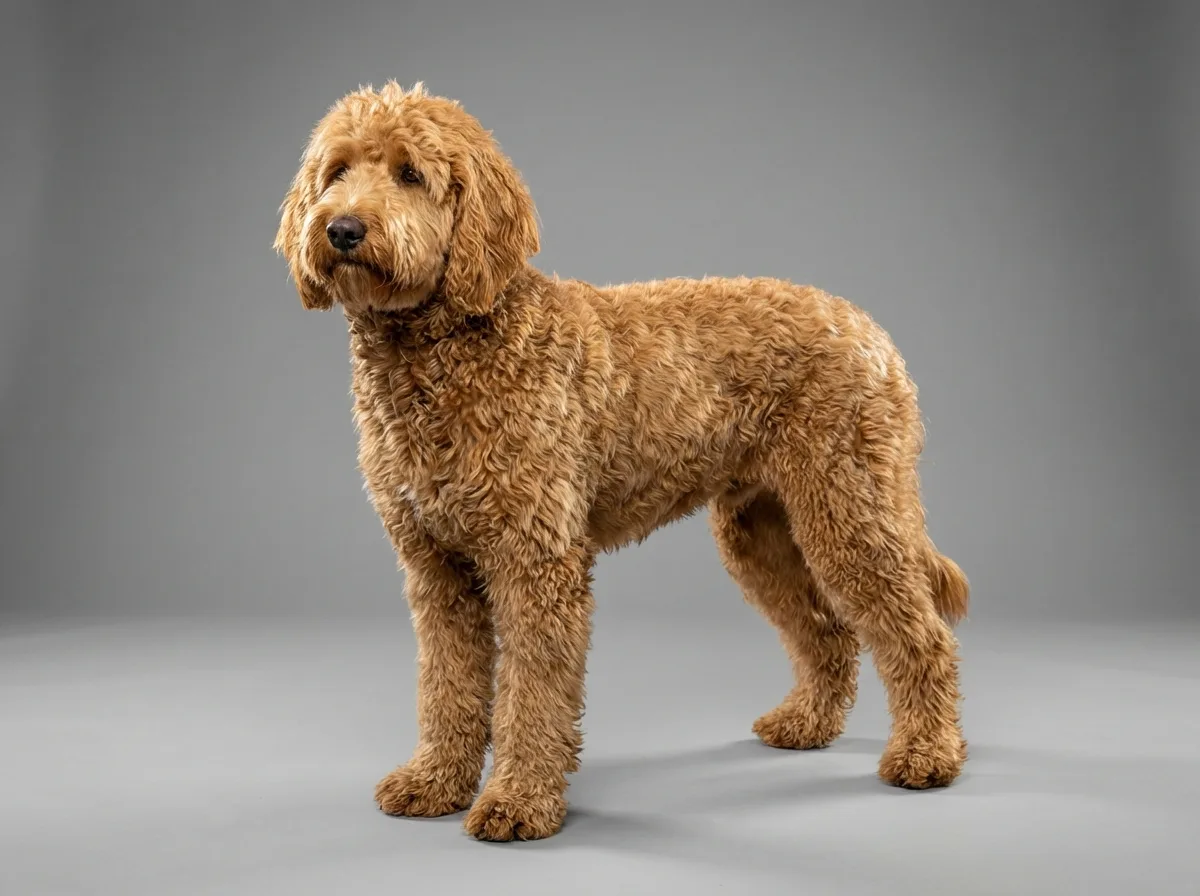
Goldendoodle coats range from loose and wavy to tightly curled, depending on how much Poodle coat genetics a given dog inherited, and owners sometimes assume coat type should drive food choice the way it might for a purely cosmetic concern. In practice, coat texture itself does not change nutritional needs — what does matter is that omega-3 fatty acids (fish oil, salmon-based formulas) support skin and coat health generally, which is worth prioritizing for curlier-coated doodles prone to matting and skin irritation under a dense coat if grooming lapses. Skin issues under a curly coat are more often a grooming and moisture problem — a mat pulling on skin, or trapped moisture after a bath — than a food problem, so before assuming a food change will fix skin irritation, rule out a grooming cause first, especially for standard and medium doodles with denser coats.

Feeding by Life Stage

A practical breakdown once you know your dog's size category.
  • Mini/small Goldendoodle puppy: a small-breed puppy formula, three to four small measured meals a day given their faster metabolism, transitioning to adult food around nine to twelve months.
  • Medium Goldendoodle puppy: a standard puppy formula is usually adequate, though checking growth rate with a vet is worth it if the dog is trending toward the larger end of the medium range.
  • Standard Goldendoodle puppy: a large-breed puppy formula with controlled calcium, measured meals rather than free feeding, and a longer growth window (up to about eighteen months) before switching to adult food.
  • All sizes, adult: a moderate-calorie complete and balanced formula, portioned by actual body weight and activity level, with treats counted toward the daily calorie total.
  • All sizes, senior (roughly seven-plus for standard, a little later for mini): consider a senior or joint-support formula, particularly for standard-sized doodles carrying more weight on the same joint structure over time.

Weight Control Matters Across All Sizes

Goldendoodles inherit Golden Retriever traits that include being food-motivated and prone to weight gain, regardless of size category. Excess weight has the same consequences it does in any breed — added joint stress, particularly relevant for standard doodles who already carry a Golden-Retriever-linked risk of hip and elbow dysplasia, and increased strain on the heart and metabolism. Measuring food with a cup or scale rather than eyeballing, checking body condition by feel every few weeks (ribs easily felt, a visible waist from above), and counting training treats as part of the daily ration rather than extra are the same practical habits that matter for a purebred Golden Retriever, and apply just as much here.

What to Check on the Bag

Regardless of size, check these before buying.
  • An AAFCO nutrient adequacy statement for the correct life stage.
  • A large-breed growth statement specifically if feeding a standard-sized puppy.
  • A named animal protein first on the ingredient list.
  • A calorie-per-cup figure to calculate an actual portion by your dog's real weight, not a generic 'doodle' feeding chart.
  • Skip 'grain-free' as a default choice unless a vet has a specific reason to recommend it — it is not automatically better and has been part of an ongoing FDA look into a possible link with heart disease in some dogs.

Does F1, F1B or Multigen Generation Change Feeding?

Owners researching Goldendoodles often run into generation labels — F1 (first-cross Golden Retriever x Poodle), F1B (a first-cross bred back to a Poodle), multigenerational doodle-to-doodle crosses — and wonder whether generation should change how a dog is fed. It does not, directly. Generation affects coat type and shedding predictability far more than it affects nutritional needs; an F1B doodle with a tighter, more Poodle-like coat has the same basic feeding priorities as an F1 doodle of the same size and age. Where generation matters indirectly is genetic health risk. Because Goldendoodles inherit traits from both parent breeds, and both Golden Retrievers and Poodles carry their own known health considerations, a well-bred doodle from health-tested parents (hip and elbow scoring, eye and heart screening on both the Golden Retriever and Poodle sides) is a meaningfully better starting point than one from untested parents, regardless of generation label. Good nutrition and weight management support a dog's health either way, but they do not substitute for starting with health-tested parents where that is an option.

Switching Foods Without Upsetting Digestion

Whenever moving between formulas — puppy to adult, or one brand to another — transition gradually rather than switching overnight.
  • Mix a small amount of the new food into the current food and increase the new food's share over seven to ten days.
  • Watch stool quality during the transition; a day or two of softer stool is common, but ongoing diarrhea or vomiting means slowing down further.
  • Avoid transitioning during a stressful period (a move, travel, a new household member) if you can time it around that.
  • Standard-sized doodles moving from a large-breed puppy formula to adult food benefit from a slower, vet-guided transition, since growth timing varies dog to dog.
  • Keep a small amount of the old food on hand in case you need to slow the transition down partway through.

Treats and Human Foods Worth Avoiding

Goldendoodles inherit the Golden Retriever side's food-focused, persistent-at-the-table temperament, which makes it worth being deliberate about treats and table food across every size category.
  • Onions, garlic, grapes and raisins, chocolate, and xylitol (a sweetener in many sugar-free products) are genuinely toxic to dogs, not just calorie-dense — keep them fully off-limits rather than 'just a little.'
  • High-fat table scraps (fried food, fatty meat trimmings) can trigger digestive upset or, in more serious cases, pancreatitis — a condition worth taking seriously rather than assuming it is just an upset stomach.
  • Count training treats as part of the daily calorie total rather than extra, especially for a breed this responsive to food-based training.
  • Bones that splinter (cooked bones especially) are a real choking and internal injury risk — if offering a bone or chew, ask your vet or a trusted source for one appropriate to your dog's size and chewing style.
  • When in doubt about a specific human food, it is safer to skip it than assume it is fine — a quick check with your vet or a reliable source takes less time than treating an emergency.

Frequently asked questions

What is the best dog food for Goldendoodles?

It depends on size: mini and medium doodles do best on small or standard puppy/adult formulas, while standard-sized doodles need large-breed formulas with controlled calcium during growth, the same as a purebred Golden Retriever.

Do Goldendoodles need large breed puppy food?

Only standard-sized Goldendoodles (from Standard Poodle lines, typically 45 to 90+ pounds as adults). Mini and medium doodles are better matched to small or standard puppy formulas.

Is grain-free food good for Goldendoodles?

Not automatically. Grain-free is not proven to be better for coat or skin, and has been part of an FDA investigation into a possible link with heart disease in some dogs. Choose it only for a specific, vet-confirmed reason.

Do Goldendoodles need special food for their coat?

Coat texture itself does not change nutritional needs, but omega-3 fatty acids support skin and coat health generally. Chronic skin irritation under a curly coat is more often a grooming or moisture issue than a food problem.

How do I know what size my Goldendoodle puppy will be?

A vet can estimate adult size from paw size, parent weights if known, and growth trajectory. Until that is clear, feed conservatively and reassess the formula as the puppy's growth pattern becomes clearer.

Are Goldendoodles prone to weight gain?

Yes, across all size categories, inherited from the Golden Retriever side. Measured portions, tracking body condition every few weeks, and counting treats toward the daily calorie total help manage it.

What human foods are dangerous for Goldendoodles?

Onions, garlic, grapes and raisins, chocolate, and xylitol (found in many sugar-free products) are genuinely toxic, not just calorie-dense. High-fat table scraps can also trigger digestive upset or pancreatitis, so it is safer to keep them off-limits entirely.

Is a raw or homemade diet safe for a Goldendoodle?

It can be, but it needs correct formulation, especially for a standard-sized puppy in a large-breed growth window where calcium and calorie precision matters. Work with a veterinary nutritionist rather than a general online recipe.

How many times a day should I feed my Goldendoodle?

Puppies typically do best on three to four measured meals a day, tapering to two once growth slows. Adults of any size category generally do well on two measured meals a day rather than one large meal or free feeding.

Do mini and standard Goldendoodles eat different amounts?

Yes, significantly — portion by your dog's actual weight and the calorie-per-cup figure on the bag, not a single generic 'doodle' amount, since a mini and a standard can differ by 50 pounds or more as adults.

Do Goldendoodles need omega-3 supplements for their coat?

Many formulas already include fish-oil-based omega-3s, which support skin and coat health across all sizes. A separate additional supplement is rarely necessary on top of that unless a vet recommends one for a specific ongoing skin issue.

Quick answers

View more answers
Health

Best dog food for goldendoodles

Match the formula to size — small/standard for mini and medium doodles, large-breed with controlled calcium for standard-sized doodles during growth.

Related DogBreedCompass guides

  • Goldendoodle breed guideThe breed page covers full Goldendoodle temperament and size variation.
  • Goldendoodle cost of ownership by cityFood, vet and grooming costs vary a lot by Goldendoodle size.
  • hip dysplasia risk in GoldendoodlesStandard Goldendoodles inherit Golden Retriever joint risks this guide's growth advice addresses.
  • best dog food for Golden RetrieversThe purebred Golden Retriever diet guide covers the same size and weight-control reasoning.
  • best dogs for first-time dog ownersFirst-time owners often compare Goldendoodles against other family-friendly breeds before choosing.
  • Poodle breed guideOwners often compare a purebred Poodle against a Goldendoodle before adopting.

Important reminder

This guide is not medical advice. If your dog shows pain, sudden behavior change, or worsening symptoms, consult a licensed veterinarian.

Some links may be affiliate links. We may earn a commission at no extra cost to you. We only suggest products we believe are helpful for dog owners.

Want more tailored help?

Take the Lifestyle Match quiz to see which breeds and guides best fit your day-to-day life.

Take the quiz

More guides you might like

Find your match

Not sure which breed is right for you? Take our 2-minute quiz to find out.

Take the quiz