Living
Which is easier for a first-time owner?
The Basset Hound, rated High (4/5) versus the Schnauzer's Moderate (3/5).

Quick answer
Which is easier for a first-time owner?
The Basset Hound, rated High (4/5) versus the Schnauzer's Moderate (3/5).
Basset Hound or Schnauzer (Standard)? On paper they differ most on trainability, and on the scales Basset Hound is the heavier at 40–65 lbs. Here is how the two compare on everything that shapes an ordinary week.
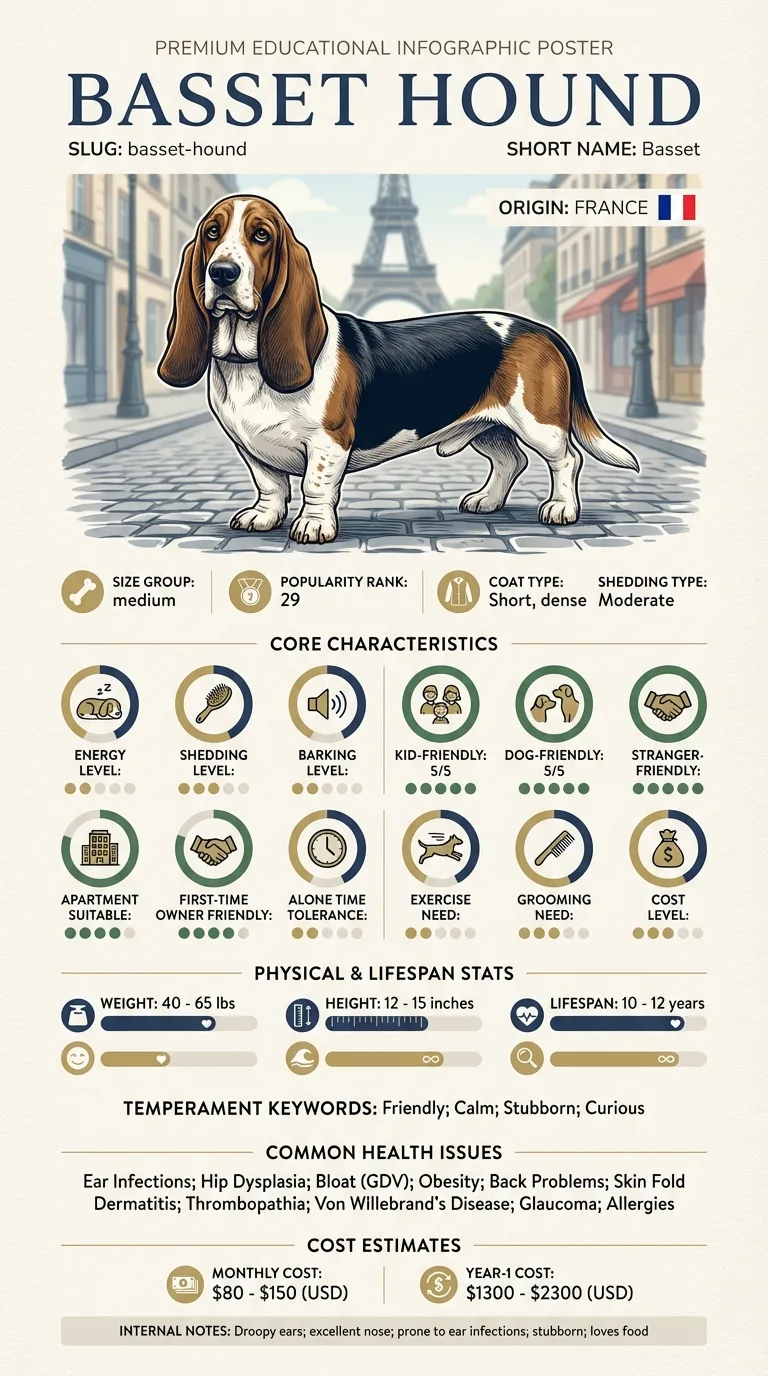
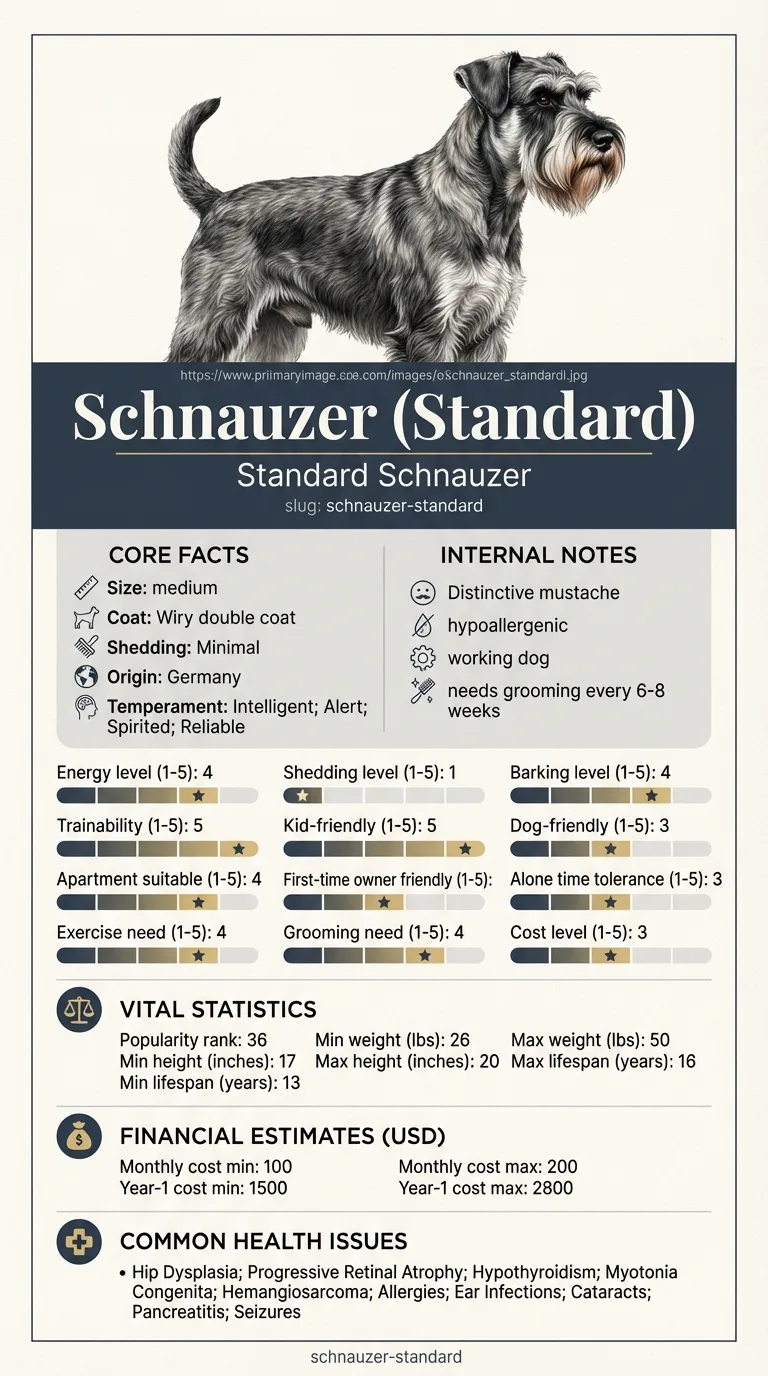
This is for someone already down to Basset Hound and Schnauzer (Standard) and deciding between them. For this pair the decision usually turns on trainability and exercise need, so those are covered first and in most detail. Both rate 4/5 for flats, so housing does not settle this one. There is no origin story here — only what changes about your week.
Between Basset Hound and Schnauzer (Standard), trainability is what separates them, and Basset Hound is the lower-effort dog of the two to keep.
Choose Basset Hound if this is your first dog, you do not want a standing grooming appointment and your walking routine is modest.
Choose Schnauzer (Standard) if shedding is a problem in your house, the dog will be alone during the working day and you want a dog that picks up training quickly.
| Feature | basset hound | schnauzer standard | Winner |
|---|---|---|---|
| Size class | medium | medium | Equal |
| Weight | 40–65 lbs | 26–50 lbs | Equal |
| Height | 12–15 in | 17–20 in | Equal |
| Lifespan | 10–12 years | 13–16 years | schnauzer standard |
| Exercise need | Low (2/5) | High (4/5) | basset hound |
| Grooming need | Moderate (3/5) | High (4/5) | basset hound |
| Shedding | Moderate (3/5) | Very low (1/5) | schnauzer standard |
| Energy level | Low (2/5) | High (4/5) | Equal |
| Barking | Low (2/5) | High (4/5) | basset hound |
| Apartment suitability | High (4/5) | High (4/5) | Equal |
| Good for first-time owners | High (4/5) | Moderate (3/5) | basset hound |
| Tolerates being alone | Low (2/5) | Moderate (3/5) | schnauzer standard |
| Trainability | Low (2/5) | Very high (5/5) | schnauzer standard |
| Good with kids | Very high (5/5) | Very high (5/5) | Equal |
| Good with other dogs | Very high (5/5) | Moderate (3/5) | basset hound |
| Friendly to strangers | Very high (5/5) | Moderate (3/5) | basset hound |
| Cost level | Moderate (3/5) | Moderate (3/5) | Equal |
| Coat | Short, dense | Wiry double coat | Equal |
| Origin | France | Germany | Equal |
| Typical monthly cost | $80–$150 | $100–$200 | Equal |
| Typical first-year cost | $1,300–$2,300 | $1,500–$2,800 | Equal |
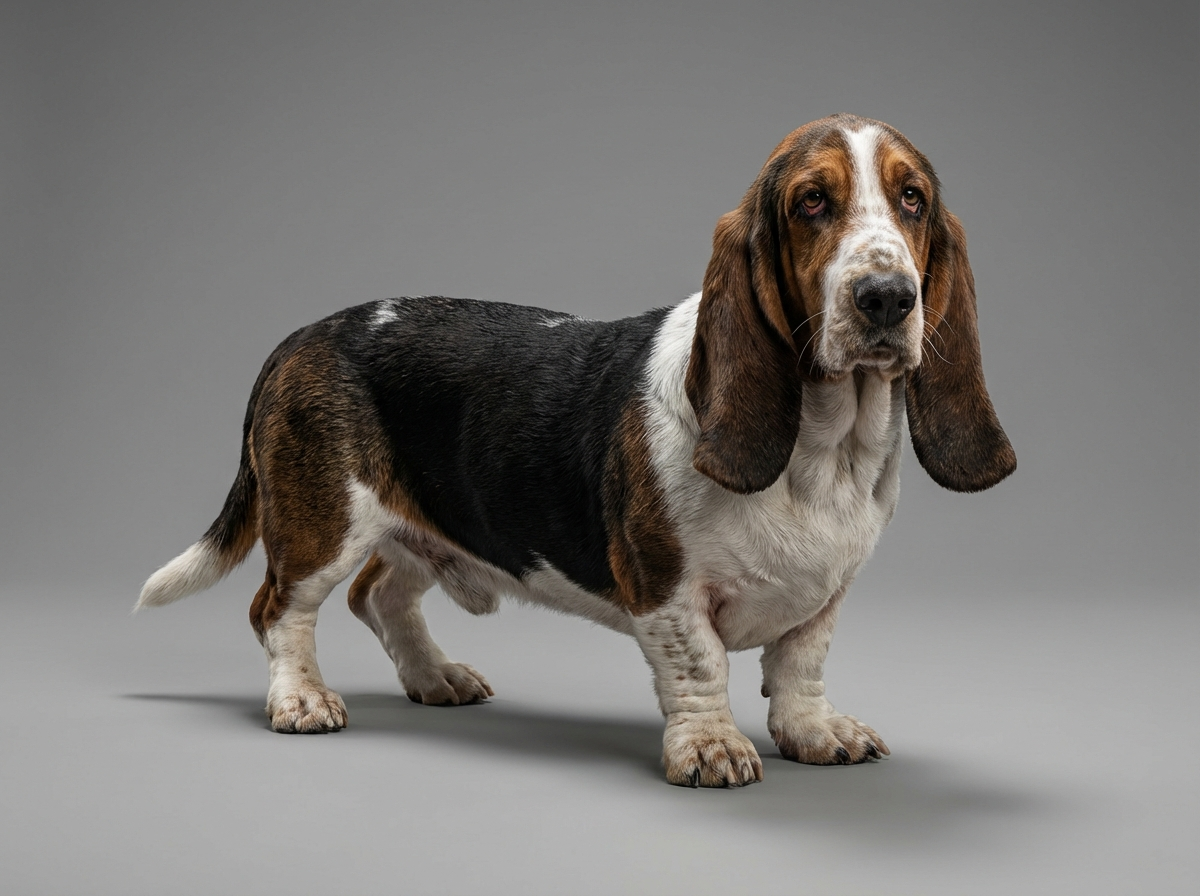
Twelve to fifteen inches tall is unusually low for a dog that can weigh up to 65 pounds, and that mismatch is the whole story of the Basset Hound's build: a long, heavy body on short, angled legs. The Standard Schnauzer stands taller at 17 to 20 inches but weighs less at the top end, 26 to 50 pounds, giving it a square, athletic silhouette that's almost the visual opposite of the Basset's low-to-the-ground frame. The Basset's short dense coat needs little upkeep by comparison to the Schnauzer's wiry double coat, which also foreshadows a very different grooming routine between the two.
Two out of five against four out of five: that's the exercise-need gap between the Basset Hound and the Standard Schnauzer, and it's a wide one. Bassets were bred to trail scent at a slow, methodical pace, not to run, and their Low exercise rating and Low energy level reflect a dog content with a couple of unhurried walks a day. The Schnauzer rates High on both counts, wanting real daily activity - jogging, fetch, agility-style games - to avoid boredom-driven behavior. An owner picturing lazy Sunday strolls is picturing the Basset; an owner who wants a hiking companion is picturing the Schnauzer instead.
A Basset Hound's ears alone can make grooming feel like a bigger job than its Moderate (3/5) rating suggests - those long, low-hanging ears trap moisture and need regular checking to head off the ear infections that show up on its health list. The Standard Schnauzer rates higher on grooming overall, High (4/5), because its wiry double coat needs hand-stripping or clipping to stay tidy. Shedding tells the opposite story: Moderate (3/5) for the Basset versus Very Low (1/5) for the Schnauzer, whose coat sheds minimally once properly maintained. Neither breed is wash-and-go, but the maintenance shows up in different places for each.
Apartment suitability ties at High (4/5) for both breeds, which might surprise anyone picturing the Schnauzer's higher exercise needs - but a securely fenced yard isn't required for either if daily walks happen. Barking is where they split hard: Low (2/5) for the Basset against High (4/5) for the Schnauzer, whose alert, spirited temperament makes it quicker to sound off at hallway noise. Tolerance for being alone tips slightly toward the Schnauzer too, Moderate (3/5) versus the Basset's Low (2/5) - despite its laid-back reputation, a Basset can struggle with solitude more than its calm demeanor suggests.
A five-point gap on trainability - Very High (5/5) for the Standard Schnauzer against Low (2/5) for the Basset Hound - is one of the largest differences on this whole table. Bassets are famously stubborn, a trait that shows up directly in their temperament list, and their nose-driven focus can override commands mid-walk. First-time-owner suitability actually favors the Basset anyway, High (4/5) against the Schnauzer's Moderate (3/5), because a Basset's low exercise needs and calm nature forgive training shortcuts that a Schnauzer's higher drive would not. Put simply: the Schnauzer learns faster, but the Basset asks less of a first-time handler overall.
At a backyard barbecue with kids running around, an unfamiliar dog wandering by, and a new guest at the gate, both breeds hold up - good with kids ties at Very High (5/5) for both. But the Basset pulls ahead with other dogs (Very High, 5/5, against the Schnauzer's Moderate, 3/5) and with strangers (Very High, 5/5, against Moderate, 3/5), consistent with its friendly, curious temperament. The Schnauzer's alert and reliable nature makes it a more discerning greeter, warming up more slowly to new dogs and new people even though it's not unfriendly once it decides someone's trustworthy.
Thirteen to sixteen years for the Standard Schnauzer beats the Basset Hound's 10-to-12-year range by a meaningful margin, even though both breeds carry ten-item health lists. The Basset's list leans structural and metabolic - bloat, back problems, obesity, skin fold dermatitis, and two clotting disorders, thrombopathia and Von Willebrand's disease - largely consequences of its long back and heavy frame. The Schnauzer's list includes hemangiosarcoma, seizures, pancreatitis, and myotonia congenita alongside more common issues like hip dysplasia and allergies. Both lists are substantial, but the Basset's cluster of back and weight-related conditions ties more directly to its distinctive body shape than the Schnauzer's does.
Cost level ties at Moderate (3/5) for both breeds, with the Basset running slightly cheaper on paper: $80-$150 a month against $100-$200 for the Schnauzer, and $1,300-$2,300 versus $1,500-$2,800 in the first year. The Schnauzer's higher grooming score (4/5 versus the Basset's 3/5) accounts for most of that gap, since a wiry double coat typically needs professional stripping or clipping. The Basset's costs skew instead toward preventive vet care - ear cleaning supplies and weight management to head off the obesity and back problems on its health list - rather than a groomer's invoice.
Basset Hound weighs 40–65 lbs and lives 10–12 years; Schnauzer (Standard) weighs 26–50 lbs and lives 13–16 years. The two diverge most on trainability, exercise need and energy level and 4 other rated axes. They are level on apartment suitability, cost level and good with kids, so those cannot decide it. Where the table declares a winner it means less work for the owner, nothing more; descriptive rows are left as ties on purpose. The value here is in the differences between the two columns; treat any single score as approximate.

It's a structural trait, not a health defect on its own, but that long, heavy body on short legs contributes to the back problems and hip dysplasia listed on its health profile, so controlling weight matters more for this breed than most.
Yes - it's rated High (4/5) for barking, well above the Basset's Low (2/5), reflecting its alert, watchful temperament.
The Basset Hound by a wide margin - it rates Low (2/5) on trainability against the Schnauzer's Very High (5/5), and "stubborn" appears directly in its listed temperament.
The Standard Schnauzer, typically 13 to 16 years versus the Basset Hound's 10 to 12 years.
Very much so - rated Very High (5/5), the top score available, versus the Schnauzer's Moderate (3/5).
The Standard Schnauzer, rated High (4/5) against the Basset Hound's Low (2/5).
Ear infections are on their health list, and their long, low-hanging ears trap moisture and debris more readily than an upright-eared breed like the Schnauzer, so regular cleaning matters.
The Basset Hound, rated High (4/5) versus the Schnauzer's Moderate (3/5).
The Standard Schnauzer, rated Very Low (1/5) against the Basset's Moderate (3/5).
The Basset Hound, rated Very High (5/5) versus the Schnauzer's Moderate (3/5).
The Standard Schnauzer, rated Very High (5/5) against the Basset's Low (2/5).
Secure checkout on Stripe. We never see your card.
7-day money-back guarantee. Instant access.
Health information here is general and is not veterinary advice. If your dog shows pain, sudden behaviour change, or worsening symptoms, consult a licensed veterinarian.
Some links on this site are affiliate links. We may earn a commission at no extra cost to you, and we only suggest products we believe are helpful for dog owners.
We research and check what we publish, but we do not warrant that any figure, date, price, or statement is accurate, complete, or current, and we accept no liability for any loss, cost, injury, or other harm arising from the use of this site. Use it as one reference among several. You remain responsible for your own decisions and for your dog's care - confirm anything that matters with a licensed veterinarian or another qualified professional before you act on it. Full disclaimer.
Match your lifestyle to the right dog.
Take quizNot sure which breed is right for you? Take our 2-minute quiz to find out.
Take the quiz