Basset Hound vs Poodle (All Sizes): Which Suits Your Home?
Quick answer
Basset hound or poodle -- which should I get?
It comes down to activity level and grooming tolerance. Pick the basset for a low-energy, low-drama dog and moderate shedding; pick the poodle for an active, trainable dog if you're prepared to pay for coat upkeep.
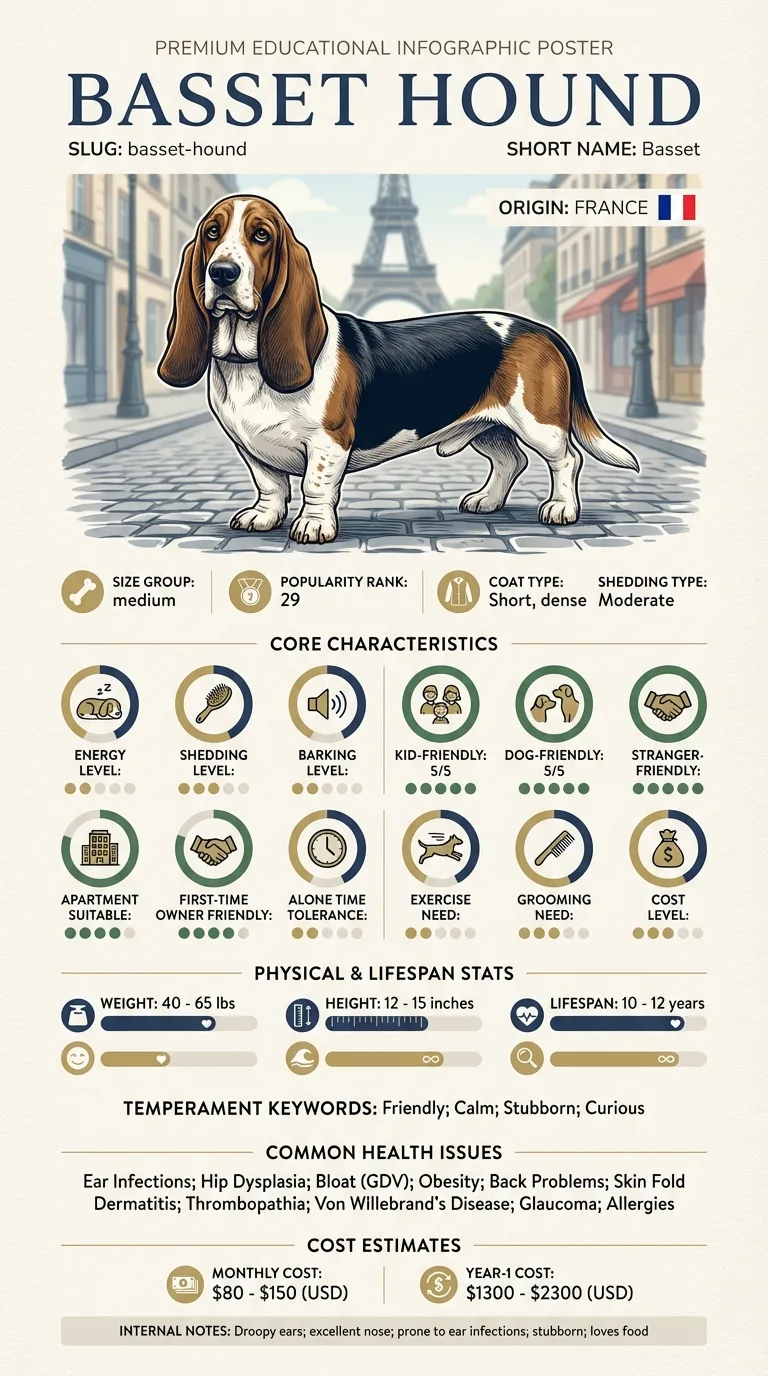
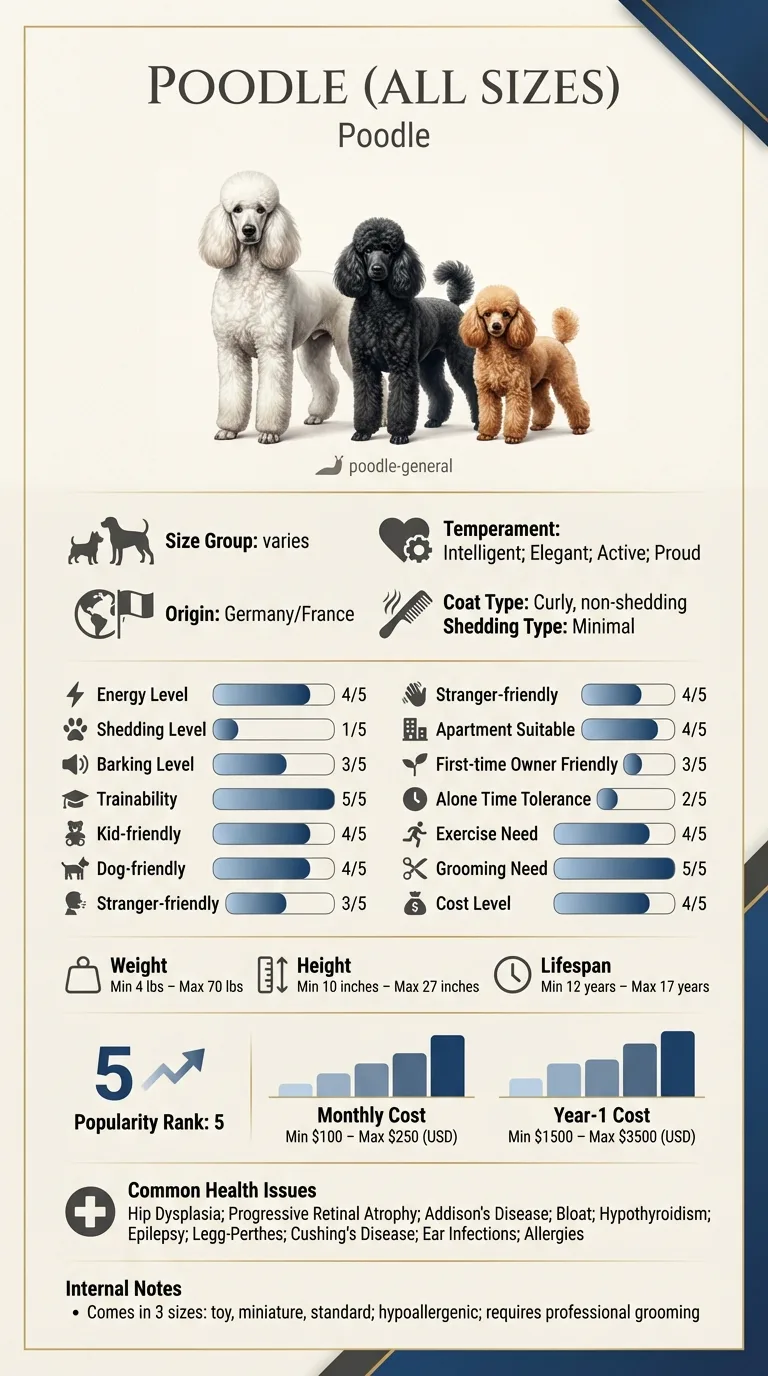
Basset Hound or Poodle (All Sizes)? On paper they differ most on trainability, and on the scales Basset Hound is the heavier at 40–65 lbs. Here is how the two compare on everything that shapes an ordinary week.
This is for someone already down to Basset Hound and Poodle (All Sizes) and deciding between them. For this pair the decision usually turns on trainability and exercise need, so those are covered first and in most detail. Both rate 4/5 for flats, so housing does not settle this one. It is written for the decision rather than the breed history.
Quick verdict
Between Basset Hound and Poodle (All Sizes), trainability is what separates them, and Basset Hound is the lower-effort dog of the two to keep.
Choose basset hound if...
Choose Basset Hound if this is your first dog, you do not want a standing grooming appointment and your walking routine is modest.
Choose poodle general if...
Choose Poodle (All Sizes) if shedding is a problem in your house, you want a dog that picks up training quickly and a smaller dog suits your car, your home or your back.
Head-to-head comparison
Feature
basset hound
poodle general
Winner
Size class
medium
varies
Equal
Weight
40–65 lbs
4–70 lbs
Equal
Height
12–15 in
10–27 in
Equal
Lifespan
10–12 years
12–17 years
poodle general
Exercise need
Low (2/5)
High (4/5)
basset hound
Grooming need
Moderate (3/5)
Very high (5/5)
basset hound
Shedding
Moderate (3/5)
Very low (1/5)
poodle general
Energy level
Low (2/5)
High (4/5)
Equal
Barking
Low (2/5)
Moderate (3/5)
basset hound
Apartment suitability
High (4/5)
High (4/5)
Equal
Good for first-time owners
High (4/5)
Moderate (3/5)
basset hound
Tolerates being alone
Low (2/5)
Low (2/5)
Equal
Trainability
Low (2/5)
Very high (5/5)
poodle general
Good with kids
Very high (5/5)
High (4/5)
basset hound
Good with other dogs
Very high (5/5)
High (4/5)
basset hound
Friendly to strangers
Very high (5/5)
Moderate (3/5)
basset hound
Cost level
Moderate (3/5)
High (4/5)
basset hound
Coat
Short, dense
Curly, non-shedding
Equal
Origin
France
Germany/France
Equal
Typical monthly cost
$80–$150
$100–$250
Equal
Typical first-year cost
$1,300–$2,300
$1,500–$3,500
Equal
Deep dive
Size and build
Poodle comes in three official sizes, so weight for the breed as a whole spans 4 to 70 lbs and height 10 to 27 inches -- the standard covers what are really three different dogs under one name. The basset holds steady at 40-65 lbs and a squat 12-15 inches, all low-slung frame and long ears. Against a toy or miniature poodle the basset outweighs it several times over; against a standard poodle they're close in weight but the poodle stands nearly twice as tall.
Energy and exercise
Basset hound rates low (2/5) on exercise need -- a couple of short walks and a scent trail in the yard covers it. Poodles across the size range rate high (4/5). That's not a small gap. A poodle wants daily structured activity: fetch, swim, agility, something that uses its brain and legs. Skip that with a poodle and you'll see it in the dog's behavior, not just its waistline.
Grooming and shedding
Here the scores flip. Basset grooming sits at moderate (3/5) with moderate (3/5) shedding -- brush weekly, expect some hair on the couch. Poodle grooming is very high (5/5): the curly, non-shedding coat needs clipping every 4-6 weeks or it mats into cords. In exchange shedding drops to a bare 1/5, good news if allergies are a factor in your house, bad news for your grooming budget.
Apartment living, noise and time alone
Both breeds score high (4/5) for apartment suitability, so square footage isn't the deciding factor. Barking runs low (2/5) for the basset and moderate (3/5) for the poodle -- the basset's most likely noise complaint is baying at something outside, not routine barking. Neither dog tolerates being left alone well; both sit at low (2/5), so plan for a dog walker or shorter workdays either way.
Training and owner experience
This is the widest gap in the whole comparison. Basset trainability rates low (2/5) -- stubborn, scent-driven, easily distracted. Poodle trainability rates very high (5/5), among the best of any breed. Correspondingly bassets rate high (4/5) for first-time owners because their laid-back nature forgives inexperience, while poodles rate moderate (3/5) -- trainable but needing real engagement, not a dog you can ignore.
Kids, other dogs and visitors
Both score well with kids and other dogs, though the basset edges out at very high (5/5) on both versus the poodle's high (4/5). The real separation is strangers: basset rates very high (5/5) for friendliness to visitors, poodle moderate (3/5) -- poodles tend to be more reserved or watchful with people they don't know, a trait some households actually prefer.
Health and lifespan
The basset's lifespan of 10-12 years trails the poodle's 12-17 by a meaningful margin. Both share hip dysplasia, bloat, and allergies on their lists, so neither is risk-free there. The basset's own list adds back problems and ear infections tied to its build; the poodle's adds Addison's disease, epilepsy, and Cushing's disease -- a different risk profile, not a smaller one.
Cost to keep
Basset cost rates moderate (3/5) against the poodle's high (4/5), and the numbers back it up: $80-150 a month for the basset versus $100-250 for the poodle, with first-year costs of $1,300-2,300 versus $1,500-3,500. Most of that gap is grooming -- a poodle's coat maintenance adds up fast whether you DIY or pay a groomer every month.
Basset Hound vs Poodle (All Sizes) at a glance
Basset Hound weighs 40–65 lbs and lives 10–12 years; Poodle (All Sizes) weighs 4–70 lbs and lives 12–17 years. The two diverge most on trainability, exercise need and grooming need and 3 other rated axes. They are level on tolerates being alone and apartment suitability, so those cannot decide it. In the table, a "winner" means easier for an ordinary household — not better. Size, coat and origin are recorded without a verdict. Because both breeds are scored the same way, the gaps are reliable even where the absolute numbers are rough.
Basset Hound vs Poodle (All Sizes): Which Suits Your Home? - Basset Hound vs Poodle (All Sizes) at a glance
Frequently asked questions
Which sheds less, the basset hound or the poodle?
The poodle, by a wide margin. It rates very low (1/5) for shedding thanks to its curly, non-shedding coat, while the basset sits at moderate (3/5). If shedding is your main concern the poodle wins clearly -- but you'll trade that for a much heavier grooming schedule.
Is a basset hound or a poodle better for a first-time owner?
The basset rates high (4/5) for first-time owners versus the poodle's moderate (3/5). Bassets are more forgiving of an inexperienced handler because they're low-energy and easygoing; poodles need an owner willing to keep up with their intelligence and activity needs.
How much more does a poodle cost to keep than a basset?
Expect $100-250 a month for a poodle against $80-150 for a basset, and $1,500-3,500 in the first year compared to $1,300-2,300. The gap is driven mostly by grooming, which the poodle needs every 4-6 weeks.
Do basset hounds and poodles get along with kids?
Both do well. The basset rates very high (5/5) with kids, the poodle high (4/5) -- either is a reasonable family dog on this measure, with the basset having a slight edge.
Which breed lives longer?
The poodle, typically 12-17 years versus 10-12 for the basset. Size plays a role too -- toy and miniature poodles tend toward the longer end of that range.
Do they share any health risks?
Yes -- both breeds' lists include hip dysplasia, bloat, allergies, and ear infections. Beyond that they diverge: the basset is prone to back problems from its long spine, while the poodle carries higher risk for Addison's disease and epilepsy.
Which is easier to train?
The poodle, decisively. It rates very high (5/5) for trainability, one of the best scores a breed can get, while the basset rates low (2/5) and is known for working around commands rather than following them.
It comes down to activity level and grooming tolerance. Pick the basset for a low-energy, low-drama dog and moderate shedding; pick the poodle for an active, trainable dog if you're prepared to pay for coat upkeep.
Costs
What's the monthly cost difference?
Basset hounds run $80-150 a month; poodles run $100-250, mostly due to grooming.
Behavior
Which breed needs more exercise?
The poodle by a full 2 points -- high (4/5) versus the basset's low (2/5).
Health
Which breed lives longer?
Poodles, at 12-17 years versus the basset's 10-12.
Related DogBreedCompass guides
Basset Hound breed guide – Readers comparing the two usually want the full profile of Basset Hound before deciding.
Health information here is general and is not veterinary advice. If your dog shows pain, sudden behaviour change, or worsening symptoms, consult a licensed veterinarian.
Some links on this site are affiliate links. We may earn a commission at no extra cost to you, and we only suggest products we believe are helpful for dog owners.
We research and check what we publish, but we do not warrant that any figure, date, price, or statement is accurate, complete, or current, and we accept no liability for any loss, cost, injury, or other harm arising from the use of this site. Use it as one reference among several. You remain responsible for your own decisions and for your dog's care - confirm anything that matters with a licensed veterinarian or another qualified professional before you act on it. Full disclaimer.