Legg-Calve-Perthes Disease and the Bernese Mountain Dog
If your young Bernese has gone lame behind, this is almost certainly not what he has. The distinction matters, because the things it actually is have different treatments.

What you can try
- Film the limp from behind and from the side before the appointment. Lameness often disappears in the consulting room and video is the best evidence you can bring.
- Note which leg, at what time of day, and whether it is worse after rest or after exercise. Those three details narrow the list considerably.
- Keep a growing Bernese lean, since growth-stage body weight is the best supported modifiable factor in large-breed joint disease.
- Lay runners on hard floors and use a car ramp from puppyhood rather than after a diagnosis.
- Avoid forced repetitive running with a dog under about eighteen months, and let free play on soft ground do the conditioning instead.
Why this is a small dog disease
The femoral head in a growing dog is supplied by a set of small vessels that run along the neck of the femur. In Legg-Calve-Perthes disease that supply is interrupted, the bone tissue dies, and the weight-bearing surface collapses over weeks to months.
The breeds affected are consistent and specific: terriers, toy poodles, miniature pinschers, pugs and similar dogs, almost all under roughly twenty-five pounds, typically between five and eight months of age. The predisposition appears to be inherited and tied to the vascular anatomy of that region in small breeds.
A Bernese Mountain Dog is not in that group by any measure. He stands 23 to 27 inches, will reach 70 to 115 pounds, and his documented health issues are hip dysplasia, elbow dysplasia, bloat, degenerative myelopathy, progressive retinal atrophy, histiocytosis, von Willebrand's disease, allergies, arthritis and cancer. Legg-Calve-Perthes is not on that list, and it is not a condition Bernese owners are routinely warned about by breeders or breed clubs.
That does not make hind limb lameness in a young Berner unimportant. It makes it important for other reasons. A large breed puppy limping behind is far more likely to have a growth-related orthopaedic condition, and several of those genuinely do affect this breed and do benefit from early diagnosis.
So the useful takeaway is not reassurance. It is redirection: take the limp seriously, and take it to a veterinarian who will work through the large-breed list rather than the toy-breed one.
What hind limb lameness in a young Bernese usually is
This is the list a veterinarian works through for a lame Bernese puppy. Note that every entry on it involves a different treatment and a different prognosis from the toy-breed condition this page is named after.
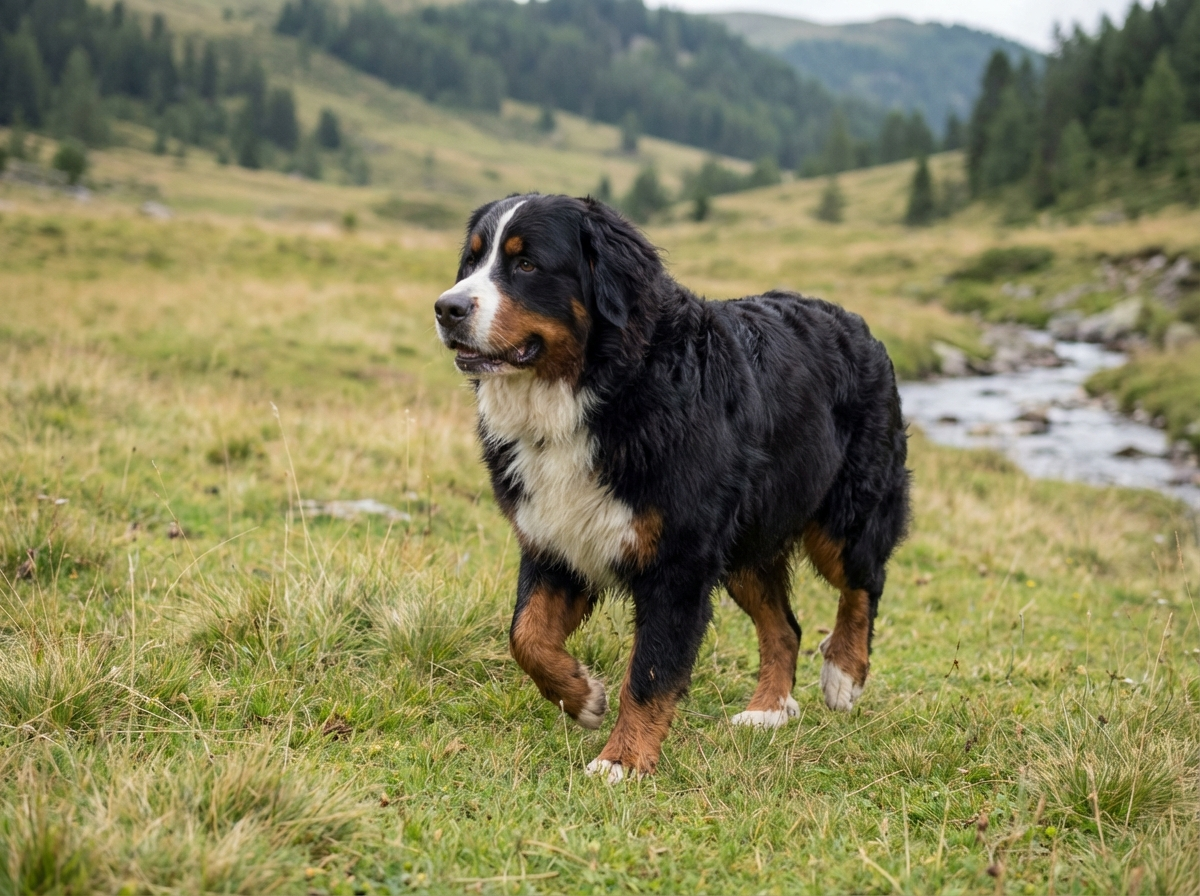
- Hip dysplasia. The dominant cause in this breed, often showing between five and twelve months as bunny-hopping, a reluctance to rise, or a shortened walk.
- Panosteitis. A self-limiting inflammation within the long bones of growing large-breed dogs, causing shifting lameness that moves from leg to leg.
- Osteochondritis dissecans. A defect in developing joint cartilage, more often in the shoulder or elbow but capable of affecting the stifle.
- Cruciate ligament injury. Less typical in a young dog than an adult, but possible after a twisting injury, and surgical in a dog this size.
- Soft tissue strain. Genuinely common, usually improving with a few days of rest, and the diagnosis of exclusion rather than the first assumption.
- Bone tumours. Uncommon in a young dog but not impossible in a large breed, and the reason persistent one-legged lameness with swelling always needs imaging.
Frequently asked questions
Can a Bernese Mountain Dog get Legg-Calve-Perthes disease?
It is not a recognised concern in this breed and is not part of standard Bernese health screening. The condition is concentrated in small breeds, typically under about twenty-five pounds. A veterinarian assessing a lame Bernese puppy would work through large-breed causes long before considering this.
Why do so many articles list it under hip problems?
Because it is a genuine hip disease and general canine health articles group conditions by body part rather than by breed. That grouping is accurate but misleading, since the breeds affected by femoral head necrosis and the breeds affected by hip dysplasia barely overlap. Always check which breeds a condition actually occurs in.
At what age would a young Bernese show hip trouble?
Hip dysplasia signs commonly appear between about five and twelve months, which is the same window in which Legg-Calve-Perthes affects small dogs. That coincidence of timing is part of why the two get confused, even though the underlying problems are completely different.
How is femoral head necrosis distinguished from hip dysplasia?
By radiographs, and the appearances are quite distinct. Necrosis of the femoral head shows collapse and irregularity of the ball itself, usually on one side only. Dysplasia shows a shallow socket and a poorly seated joint, and it is usually bilateral. A single set of hip radiographs settles the question in one visit.
My Bernese puppy limps on and off between different legs. What is that?
Shifting lameness in a growing large-breed dog is the classic description of panosteitis, an inflammation inside the long bones that comes and goes and eventually resolves on its own. It is painful and it is real, and it needs veterinary confirmation rather than self-diagnosis, but it is not a permanent joint problem.
Should I restrict exercise while a limp is investigated?
Reduce it, do not eliminate it. Short, flat, controlled lead walks are usually appropriate while waiting for an appointment. What should stop immediately is running, jumping, stairs and rough play, since a joint or bone problem in a heavy growing puppy is easy to worsen in an afternoon.
Related guides