Newfoundland Most Common Genetic Disorders: What Owners Should Know
Quick answer
What are quick facts about Newfoundland genetic disorders?
The supplied breed information highlights elbow dysplasia and dilated cardiomyopathy as concerns that may appear more frequently in purebred dogs. This is not a diagnosis for any individual Newfoundland.
A genetic risk is not a diagnosis. Knowing what to watch for helps you respond thoughtfully if your Newfoundland seems uncomfortable or unwell.
This topic is useful for prospective Newfoundland owners and families who want to understand health history, monitor changes, and know when professional veterinary advice is appropriate.
Important reminder
This guide is not medical advice. If your dog shows pain, sudden behavior change, or worsening symptoms, consult a licensed veterinarian.
Some links may be affiliate links. We may earn a commission at no extra cost to you. We only suggest products we believe are helpful for dog owners.
We research and check what we publish, but we do not warrant that any figure, date, price, or statement is accurate, complete, or current, and we accept no liability for any loss, cost, injury, or other harm arising from the use of this site. Use it as one reference among several. You remain responsible for your own decisions and for your dog's care - confirm anything that matters with a licensed veterinarian or another qualified professional before you act on it. Full disclaimer.
What this problem looks like
This page addresses inherited health concerns that Newfoundland owners may want to discuss with a veterinarian. The supplied information names elbow dysplasia and dilated cardiomyopathy as concerns that may appear more frequently in purebred dogs. A breed-level association cannot diagnose an individual dog.
Common triggers
A known health concern in a dog's family history
A new or persistent change in movement or comfort
A noticeable change in normal stamina or breathing
Questions raised during a routine veterinary visit
The supplied information notes that elbow dysplasia and dilated cardiomyopathy can appear more frequently in purebred dogs, but it does not provide prevalence data for Newfoundlands. Individual risk varies, and not every Newfoundland will develop a health condition.
Why this happens
Breed factors
Some health conditions can have an inherited component. For Newfoundlands, the supplied information specifically identifies elbow dysplasia and dilated cardiomyopathy as concerns to discuss. Genetics are only one part of a dog's health picture and do not determine an outcome for every dog.
Environment factors
A dog's day-to-day environment does not establish whether a condition is inherited. However, changes in activity, comfort, or breathing are useful observations to share with a veterinarian when evaluating a health concern.
What you can do at home (once it is not an emergency)
When to talk to your vet
Talk to a veterinarian when you notice persistent lameness, discomfort, reduced stamina, breathing changes, weakness, or any other change from your Newfoundland's usual behavior. Seek prompt care for sudden or severe signs.
At home, alongside your vet's plan
Keep a simple record of any changes in movement, comfort, energy, stamina, or breathing so you can give your veterinarian specific information.
Maintain routine veterinary care and ask questions when a new concern appears.
Avoid self-diagnosing from a breed list or using medication intended for another dog.
Follow your veterinarian's recommendations about activity and follow-up if a health concern is being evaluated.
Newfoundland Most Common Genetic Disorders: Mistakes to Avoid
Careful observation and timely veterinary input are more useful than trying to diagnose a genetic condition at home. These mistakes can make it harder to get clear answers.
Assuming a breed tendency means a diagnosis: A possible inherited risk does not mean an individual Newfoundland has a disorder. Ask a veterinarian to evaluate the dog rather than relying on breed information alone.
Waiting out changes in movement: Limping, reluctance to move, or signs of discomfort deserve veterinary guidance, especially when they persist or worsen.
Overlooking changes in stamina or breathing: A noticeable change in normal activity tolerance should be discussed with a veterinarian instead of being attributed to age or personality.
Using another dog's treatment plan: Medication, supplements, and activity changes should be selected with a veterinarian because the cause of a symptom may be different from what it appears to be.
Treating health history as a guarantee: Family or breed history can inform questions, but it cannot predict exactly what will happen with every dog.
Skipping follow-up after a concern is identified: Follow the veterinary plan and ask what changes should prompt an earlier recheck.
The timeline depends on the cause of the concern and the veterinary evaluation. It is safer to focus on timely assessment and following the plan provided for your individual dog than to expect a fixed schedule.
Success means a veterinarian has assessed the concern, you understand the recommended next steps, and your Newfoundland's comfort and daily function are being monitored appropriately.
When to Seek Prompt Veterinary Care
Contact a veterinarian promptly if your Newfoundland has sudden weakness, collapse, difficulty breathing, marked exercise intolerance, severe pain, or cannot comfortably use a limb. These signs can have many causes and need an in-person assessment.
For less urgent changes, such as a new limp, reluctance to exercise, or a gradual change in energy, arrange a veterinary appointment and note when the change began, what you have observed, and whether it is getting worse. Do not start medication or restrict activity beyond common-sense safety measures unless your veterinarian advises it.
Elbow dysplasia and dilated cardiomyopathy are listed as concerns that can occur more frequently in purebred dogs. That information is a reason to stay attentive, not a way to diagnose an individual Newfoundland.
Newfoundland Most Common Genetic Disorders: What Owners Should Know - When to Seek Prompt Veterinary Care
Using Observations to Start the Right Conversation
After noticing that her Newfoundland was less willing to continue a usual walk, an owner wrote down when the change began and whether it occurred after rest or activity. Rather than assuming a breed-related cause, she arranged a veterinary visit and shared the notes. The veterinarian could then evaluate the dog and advise on appropriate next steps.
The useful lesson was not to diagnose from a breed list, but to act on a meaningful change and seek individualized veterinary guidance.
Key takeaway: Breed information can help owners ask informed questions, but veterinary assessment is needed to understand an individual Newfoundland's health.
Frequently asked questions
What are the Newfoundland most common genetic disorders owners discuss with vets?
The available breed information identifies elbow dysplasia and dilated cardiomyopathy as concerns that may occur more frequently in purebred dogs. It does not mean that every Newfoundland will develop either condition. A veterinarian can explain what an individual dog's history and signs may mean.
Will every Newfoundland develop a genetic disorder?
No. Breed-level information describes possible concerns, not a diagnosis or prediction for every dog. Many factors can affect a dog's health, so discuss your individual Newfoundland with a licensed veterinarian.
What signs should prompt a veterinary visit?
A persistent limp, pain, reluctance to move, reduced stamina, breathing changes, weakness, or collapse are all reasons to contact a veterinarian. Sudden or severe signs need prompt attention.
How can I find out whether my Newfoundland has a health concern?
A veterinarian can assess your dog's history, physical condition, and symptoms, then recommend any appropriate next steps. Avoid trying to confirm or rule out a disorder based on online information alone.
What should I ask my veterinarian about Newfoundland health?
Share any available health history and ask which observations are important for your dog. Your veterinarian can help you make decisions based on your Newfoundland's age, condition, and needs.
How can I monitor my Newfoundland responsibly at home?
Keep notes on changes in mobility, energy, breathing, appetite, and comfort. Clear observations can help your veterinarian decide whether an examination or additional evaluation is needed.
What are quick facts about Newfoundland genetic disorders?
The supplied breed information highlights elbow dysplasia and dilated cardiomyopathy as concerns that may appear more frequently in purebred dogs. This is not a diagnosis for any individual Newfoundland.
Health
What can I do if I am concerned about my Newfoundland's health?
Record any changes in movement, stamina, breathing, or comfort and discuss persistent or concerning changes with a veterinarian.
Health
When is a Newfoundland health concern urgent?
Seek prompt veterinary care for sudden weakness, collapse, difficulty breathing, severe pain, or an inability to use a limb normally.
Related DogBreedCompass guides
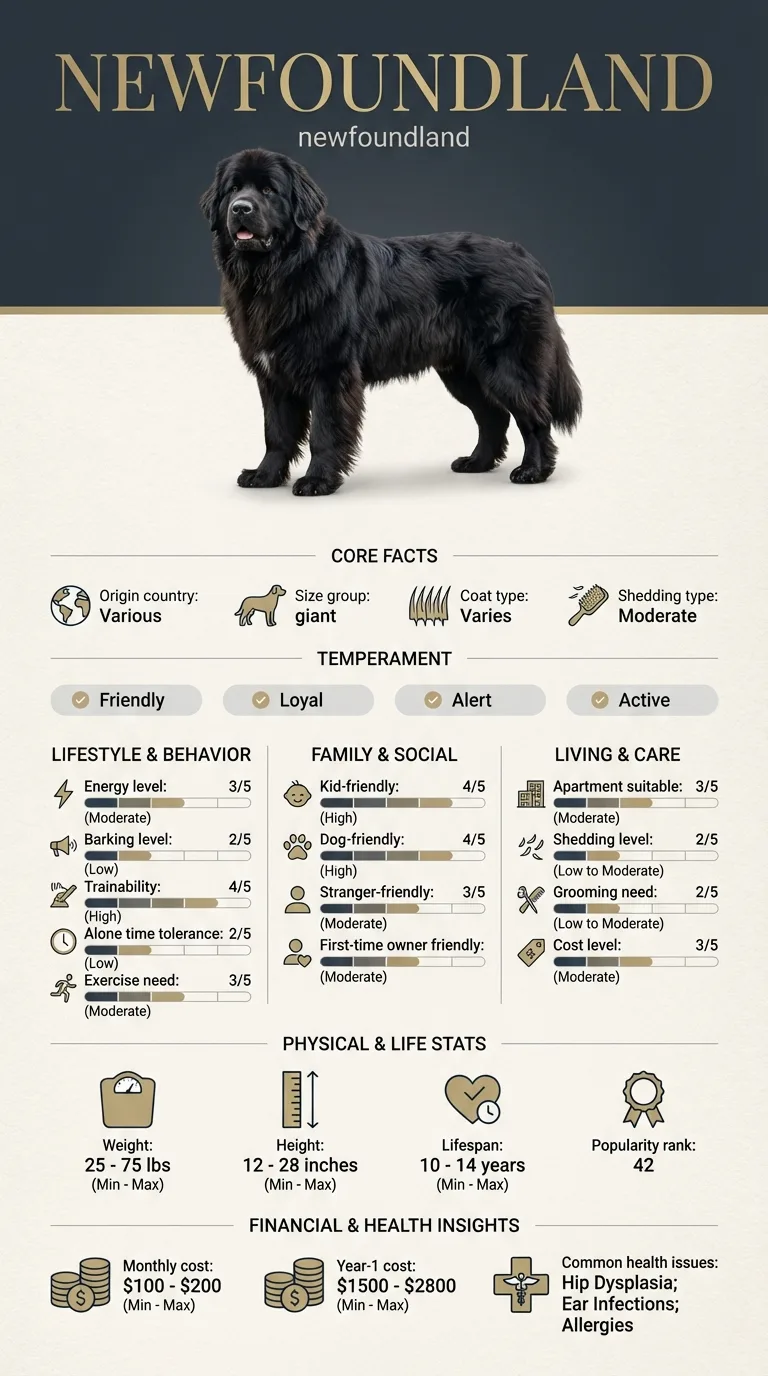
Newfoundland breed overview – See the broader Newfoundland breed overview for general care and ownership information.