Costs
What is the Pembroke Welsh Corgi first year cost?
Budget $2,100 to $4,800 for year one with a Pembroke Welsh Corgi in Baltimore.

See Pembroke Welsh Corgi price across all cities →
Quick answer
What is the Pembroke Welsh Corgi first year cost?
Budget $2,100 to $4,800 for year one with a Pembroke Welsh Corgi in Baltimore.
Curious about the Pembroke Welsh Corgi cost in Baltimore? You're looking at a range of expenses that can really add up.
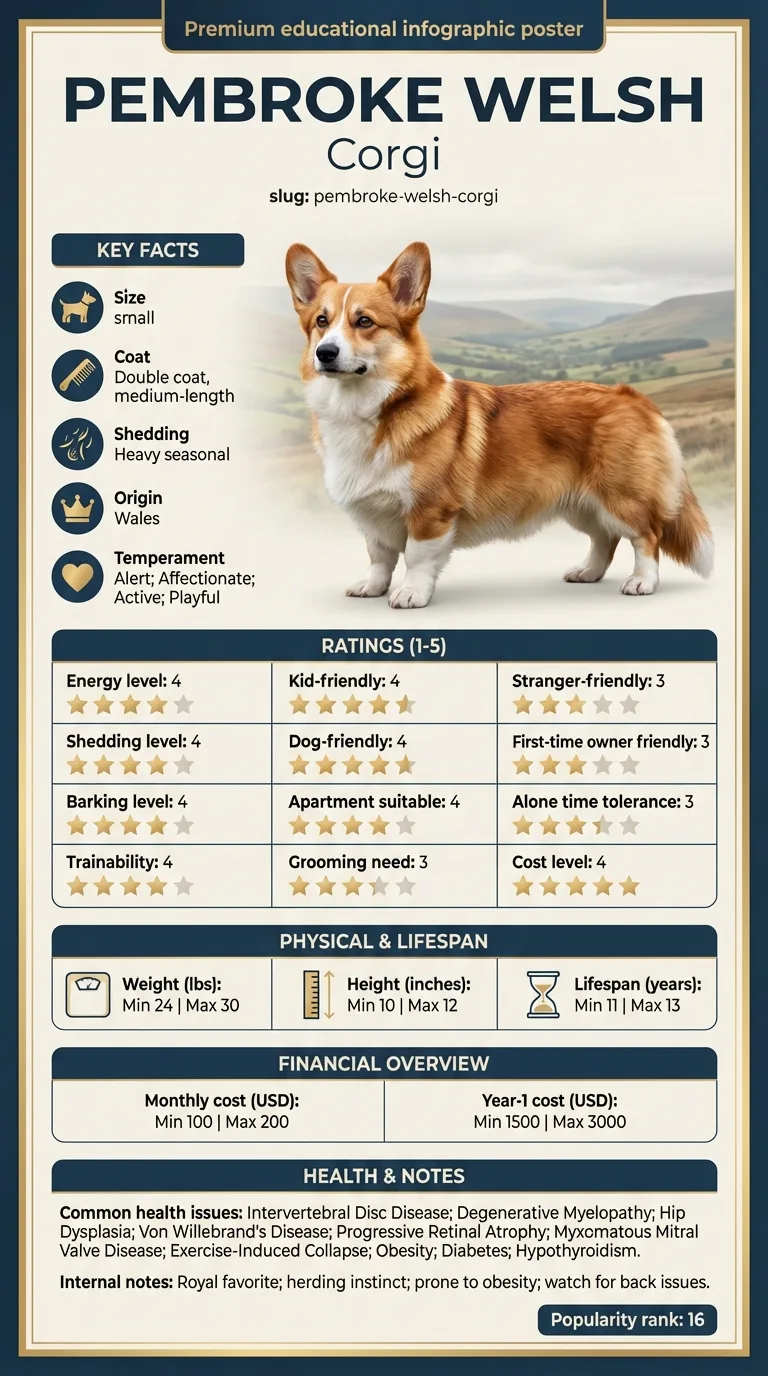
Keep in mind that expenses can spike due to emergencies or unexpected vet visits, especially considering health issues common in Corgis.
The total cost of owning a Pembroke Welsh Corgi in Baltimore varies based on factors like initial purchase, food, and healthcare.
Estimate · source: us average · confidence: medium · updated 2026-10-06 · not a quote
| Item | Cost range |
|---|---|
Initial Purchase Cost This includes the cost to adopt or buy a Pembroke Welsh Corgi from a breeder or rescue. | $500 - $1500 |
Training Classes Investing in training can help with behavioral issues and make your Corgi easier to manage. | $100 - $300 |
Miscellaneous Supplies This includes leashes, collars, toys, and bedding. | $100 - $200 |
| Item | Cost range |
|---|---|
Food Quality dog food is essential for your Corgi's health and can vary based on brand and dietary needs. | $50 - $100 |
Pet Insurance Pet insurance can offset costs for unexpected health issues, which are common in Corgis. | $30 - $60 |
Grooming Corgis have a double coat that requires regular brushing and occasional professional grooming. | $20 - $40 |
Each range starts from a national baseline for this breed's size class and is then adjusted for local cost of living and veterinary pricing. The baselines, and the source each one came from, are listed on our sources page (dataset 2026.09). Two inputs, the purchase price and the emergency reserve, have no published national figure we could verify, so we leave them to you rather than invent them.
These are planning estimates, not quotes. Your own numbers will move with the individual dog, your vet and your insurer. Build a budget with your own figures.
It can help manage unexpected medical expenses and provide peace of mind. However, it's essential to evaluate your specific situation before deciding.
Insurance is particularly beneficial if your Corgi is prone to specific health issues like hip dysplasia or intervertebral disc disease. If you live in Baltimore, where vet bills can be higher, insurance may ease the financial burden of emergency care. Additionally, if you prefer not to dip into savings for unexpected costs, insurance can be a safety net.
If you're financially stable and can comfortably cover vet expenses, insurance might not be necessary. Some owners find that they can set aside money each month for their pet's care instead. Also, if you have a healthy Corgi with no family history of serious health problems, it may be more cost-effective to pay as you go.
Owning a Pembroke Welsh Corgi in Baltimore can be costly, but there are several practical ways to save money. Here are some actionable tips to help you manage your expenses efficiently.
When budgeting for a Pembroke Welsh Corgi, it's essential to consider hidden costs that often catch owners off guard. While you might account for initial expenses, small recurring fees can add up quickly. Think about things like grooming, which can range from $30 to $90 every few months, depending on the services needed—especially for those double coats.
Unexpected vet visits are another common expense. Whether it's an upset stomach or a minor injury, these visits can cost anywhere from $50 to $200. Regular check-ups and vaccinations will also contribute to costs, averaging around $300 to $500 annually for a healthy dog.

Don’t forget about gear replacements. Collars, leashes, and toys might need replacing every few months, costing $50 to $100 over time. Plus, if your Corgi is a chewer, you may find yourself buying new toys more frequently than expected.

Lastly, consider lifestyle-driven extras. Dog daycare can also add to your monthly costs, typically costing $200 to $500 a month, depending on frequency.

When considering the Pembroke Welsh Corgi cost in Baltimore, a few local factors come into play. Additionally, the availability of veterinary care is generally good, with several clinics and specialists around, but prices can vary widely depending on the facility and services required.

Emily, a busy nurse living in Baltimore, always dreamed of having a Pembroke Welsh Corgi. However, Emily was surprised by the costs of pet insurance for her Corgi, which added an unexpected $50 to her monthly expenses. When her Corgi developed a minor ear infection, the vet visit added another $200 to her budget, reminding her that vet bills can be unpredictable. Despite these surprises, Emily learned to adjust her budget by cutting back on dining out, ensuring she could cover her furry friend's needs without too much stress. With careful planning, she found joy in her Corgi's companionship, even as she navigated the financial responsibilities of pet ownership. Emily's story shows that with a little foresight and flexibility, anyone can manage the costs of a Pembroke Welsh Corgi in Baltimore.
Key takeaway: Budgeting for a Pembroke Welsh Corgi in Baltimore can be manageable with careful planning. Expect initial costs around $2,000 and a monthly budget of $150-$200, but be prepared for surprise vet bills.
The Pembroke Welsh Corgi cost in Baltimore typically ranges from $1,500 to $3,000 for the first year. This includes initial expenses like adoption fees, vaccinations, and supplies.
Yes, Pembroke Welsh Corgis can be considered somewhat expensive.
This can vary based on coverage options and your location.
This includes routine check-ups, vaccinations, and unexpected health issues.
For your Pembroke Welsh Corgi's first year, expect to budget between $1,500 and $3,000. This covers everything from adoption fees to food, grooming, and healthcare.
Additionally, consider the costs of dog sitting or boarding when you travel.
This includes food, routine vet visits, and grooming.
In Baltimore, you can expect to spend around $300 to $700 yearly on veterinary care for a Pembroke Welsh Corgi. This includes routine check-ups, vaccinations, and preventive treatments.
Yes, living in Baltimore may involve additional costs for pet ownership, such as increased licensing fees or pet-friendly housing expenses. Additionally, urban living often means higher costs for grooming and daycare services. It's essential to factor these into your overall budget.
The first year cost of owning a Pembroke Welsh Corgi in Baltimore can range from $1,500 to $3,000. Remember, this first-year cost can be higher due to one-time purchases like crates and training classes.
This includes food, routine vet visits, grooming, and supplies. Consider setting aside extra funds for unexpected expenses, such as emergencies or special dietary needs.
Budget $2,100 to $4,800 for year one with a Pembroke Welsh Corgi in Baltimore.
Keeping a Pembroke Welsh Corgi in Baltimore costs $100 to $200 a month. Food is the biggest piece at $50 to $100.
Pet insurance for a Pembroke Welsh Corgi in Baltimore runs $30 to $60 a month, moving with the deductible and payout limit you choose.
This guide is not medical advice. If your dog shows pain, sudden behavior change, or worsening symptoms, consult a licensed veterinarian.
Some links may be affiliate links. We may earn a commission at no extra cost to you. We only suggest products we believe are helpful for dog owners.
We research and check what we publish, but we do not warrant that any figure, date, price, or statement is accurate, complete, or current, and we accept no liability for any loss, cost, injury, or other harm arising from the use of this site. Use it as one reference among several. You remain responsible for your own decisions and for your dog's care - confirm anything that matters with a licensed veterinarian or another qualified professional before you act on it. Full disclaimer.
One sheet with every line item, the emergency fund and when insurance pays off - unlocks on this page.
You get: 12-month budget sheet
No spam. One-click unsubscribe. See our privacy policy.
See a sample page before you decide.