For a first dog, an apartment, or a house full of visitors, the Pug wins clearly. The Corso is the right call only for an experienced owner who wants a large protective breed and has the space for one.
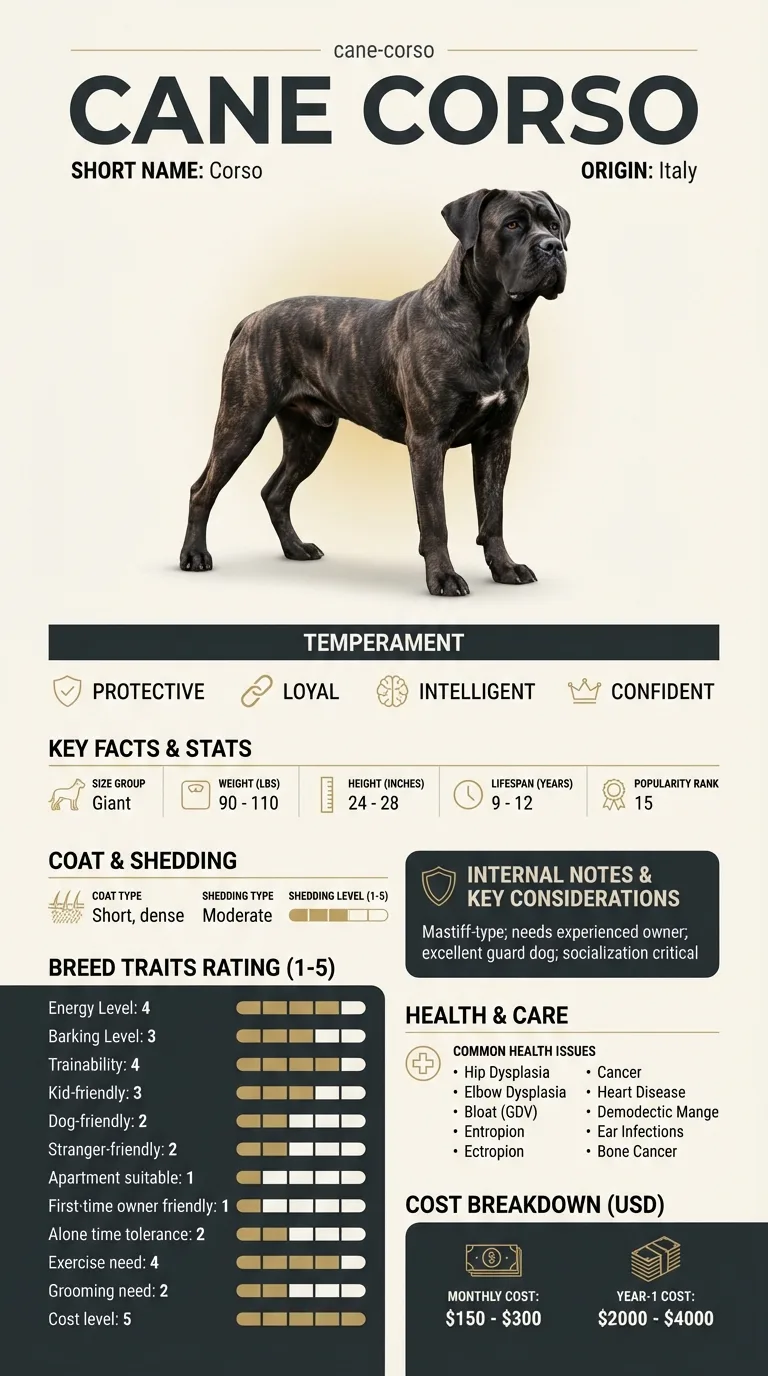
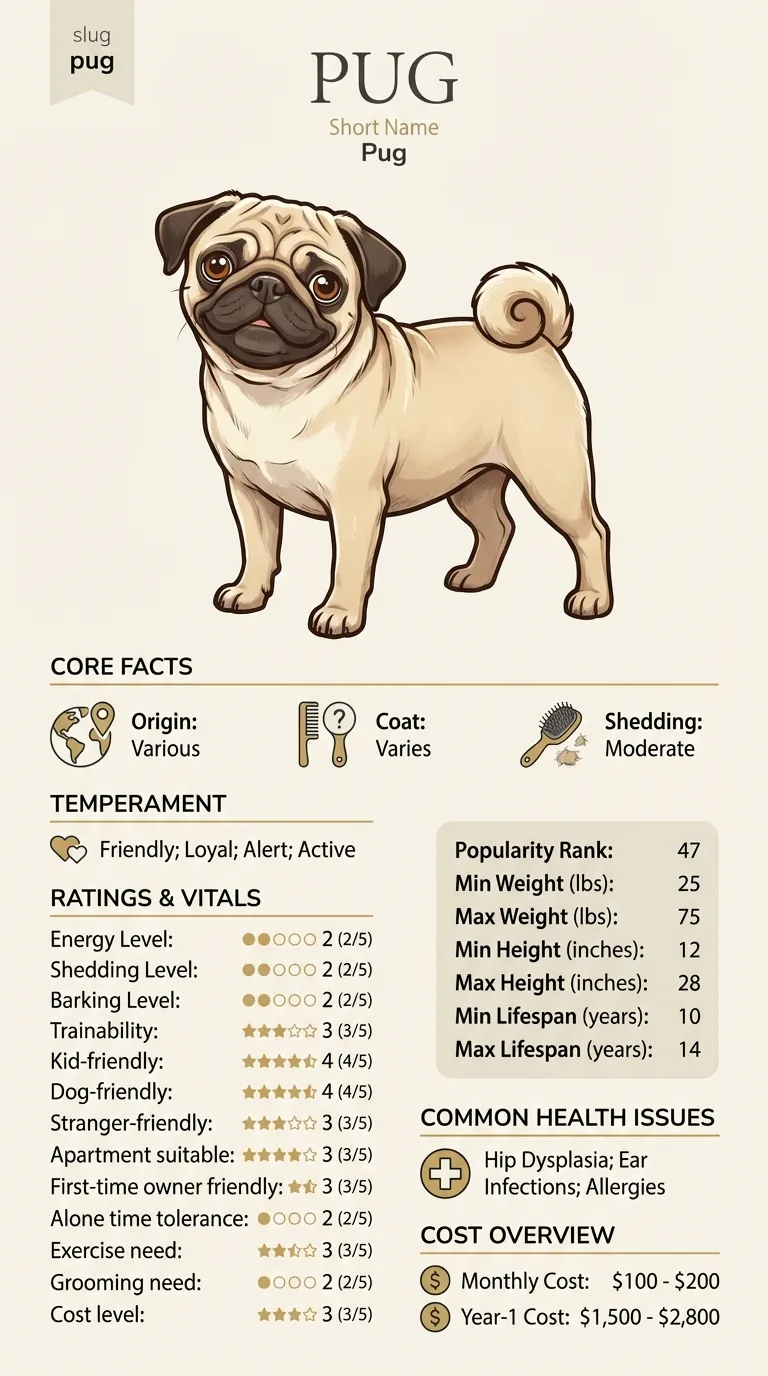
Cane Corso or Pug? On paper they differ most on apartment suitability, and on the scales Cane Corso is the heavier at 90–110 lbs. Here is how the two compare on everything that shapes an ordinary week.
This is for someone already down to Cane Corso and Pug and deciding between them. For this pair the decision usually turns on apartment suitability and good for first-time owners, so those are covered first and in most detail. Anyone choosing from a flat has a clear answer here: Pug rates 5/5 against 1/5. There is no origin story here — only what changes about your week.
Quick verdict
Between Cane Corso and Pug, apartment suitability is what separates them, and Pug is the lower-effort dog of the two to keep.
Choose cane corso if...
Choose Cane Corso if shedding is a problem in your house, you want a dog that picks up training quickly and you want a dog that can keep up with an active routine.
Choose pug if...
Choose Pug if you are in a flat or a smaller home, this is your first dog and your walking routine is modest.
Head-to-head comparison
Feature
cane corso
pug
Winner
Size class
giant
small
Equal
Weight
90–110 lbs
14–18 lbs
Equal
Height
24–28 in
10–13 in
Equal
Lifespan
9–12 years
13–15 years
pug
Exercise need
High (4/5)
Low (2/5)
pug
Grooming need
Low (2/5)
Low (2/5)
Equal
Shedding
Moderate (3/5)
High (4/5)
cane corso
Energy level
High (4/5)
Low (2/5)
Equal
Barking
Moderate (3/5)
Low (2/5)
pug
Apartment suitability
Very low (1/5)
Very high (5/5)
pug
Good for first-time owners
Very low (1/5)
Very high (5/5)
pug
Tolerates being alone
Low (2/5)
Low (2/5)
Equal
Trainability
High (4/5)
Moderate (3/5)
cane corso
Good with kids
Moderate (3/5)
Very high (5/5)
pug
Good with other dogs
Low (2/5)
High (4/5)
pug
Friendly to strangers
Low (2/5)
Very high (5/5)
pug
Cost level
Very high (5/5)
Moderate (3/5)
pug
Coat
Short, dense
Short, smooth double coat
Equal
Origin
Italy
Various
Equal
Typical monthly cost
$150–$300
$80–$150
Equal
Typical first-year cost
$2,000–$4,000
$1,100–$2,300
Equal
Deep dive
Size and build
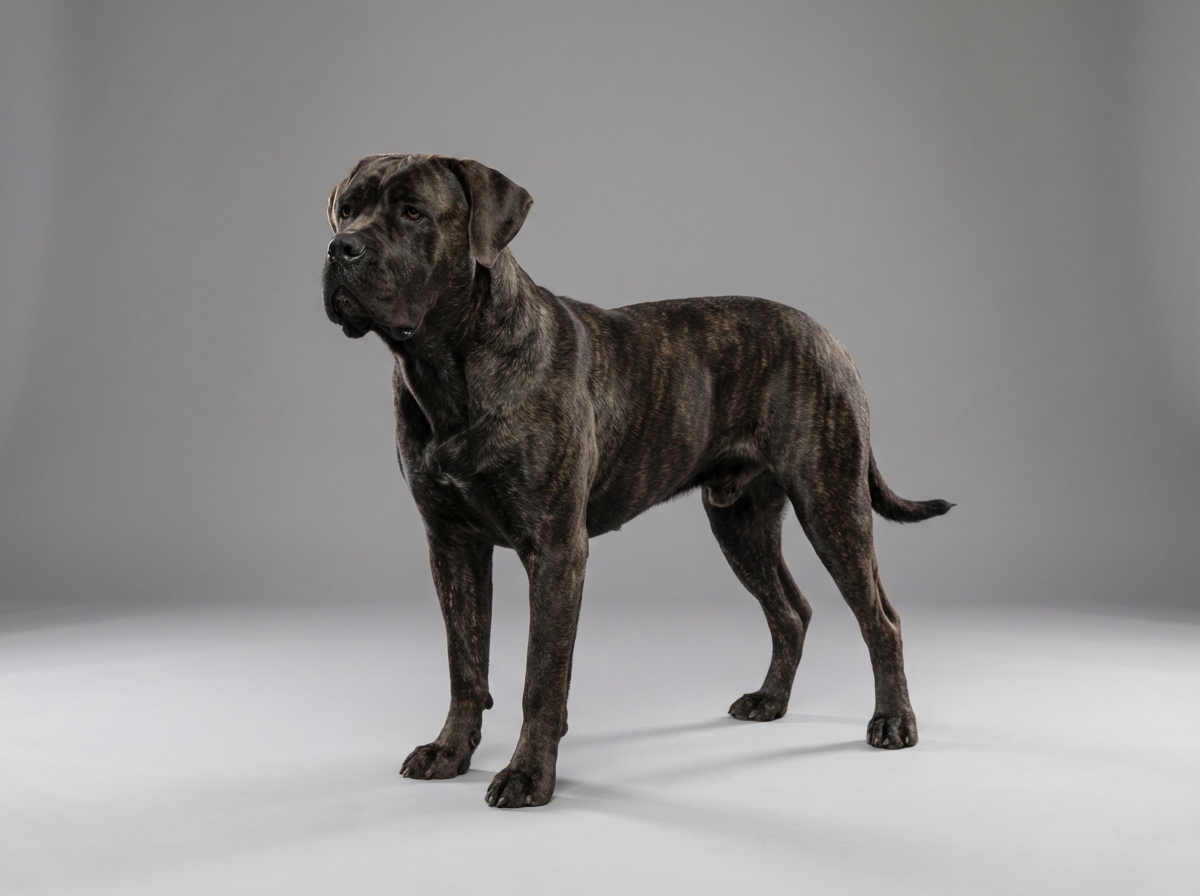
The Pug is small and compact, 14 to 18 pounds, 10 to 13 inches, while the Cane Corso is a genuine giant at 90 to 110 pounds and 24 to 28 inches. A full-grown Corso outweighs a Pug by roughly six times its own bodyweight. Beyond the number, the two breeds are built for entirely different purposes, the Corso a working guardian, the Pug a companion bred for close human contact.
Energy and exercise
The Corso rates high (4/5) for exercise need; the Pug rates low (2/5), reflecting both its smaller frame and its brachycephalic, flat-faced, build, which limits how much exertion it can safely handle, especially in heat. Energy level ties nominally at a high rating for both, but day to day the Pug's activity comes in short bursts rather than sustained exercise.
Grooming and shedding
Grooming ties at low (2/5) for both breeds, which surprises people expecting more from the Pug's wrinkled face, but the coat itself is easy to maintain. Shedding tips the other way: the Pug sheds heavily, high, 4/5, despite its short coat, while the Corso sheds only moderately (3/5). Regular brushing helps more with the Pug's shedding than with grooming demands overall.
Apartment living, noise and time alone
The Pug is rated a very high 5/5 for apartment suitability, about as good as it gets, while the Corso sits at the bottom, 1/5. Barking favors the Pug too, low, 2/5, against the Corso's moderate, 3/5. Both breeds rate low for tolerating time alone, so a Pug's apartment-friendliness doesn't extend to being left solo all day.
Training and owner experience
The Corso rates higher on raw trainability, high, 4/5, versus the Pug's moderate, 3/5, but the Pug is by far the easier first dog: very high (5/5) for first-time owners against the Corso's rock-bottom 1/5. Pugs are agreeable and food-motivated, which offsets their more moderate trainability score when it comes to actually living with one.
Kids, other dogs and visitors
The Pug rates very high with kids, 5/5, against the Corso's moderate, 3/5, high with other dogs, 4/5 versus 2/5, and very high with strangers, 5/5 versus low, 2/5. Its temperament words, charming, mischievous, affectionate, even-tempered, describe a genuinely social companion breed, a sharp contrast to the Corso's protective, more reserved nature.
Health and lifespan
The Pug's expected lifespan, 13 to 15 years, beats the Corso's 9 to 12. Their health risks barely overlap, though both carry serious breed-specific concerns: the Pug's brachycephalic build brings airway syndrome, corneal ulcers, and spinal issues like hemivertebrae, plus a real risk of obesity given its low exercise tolerance. The Corso's risks run toward giant-breed staples, hip and elbow dysplasia, bloat, and elevated cancer risk, a genuinely different set of things to watch for.
Cost to keep
The Corso costs more on every measure: very high (5/5) cost level against the Pug's moderate (3/5), $150-$300 monthly against $80-$150, and $2,000-$4,000 against $1,100-$2,300 in the first year. Worth noting on the Pug's side: brachycephalic breeds can carry higher veterinary costs than their price tag suggests, since airway and eye issues sometimes need specialist care.
Cane Corso vs Pug at a glance
Cane Corso weighs 90–110 lbs and lives 9–12 years; Pug weighs 14–18 lbs and lives 13–15 years. The two diverge most on apartment suitability, good for first-time owners and exercise need and 5 other rated axes. They are level on tolerates being alone and grooming need, so those cannot decide it. Where the table declares a winner it means less work for the owner, nothing more; descriptive rows are left as ties on purpose. The value here is in the differences between the two columns; treat any single score as approximate.
Cane Corso vs Pug: Which Suits Your Home? - Cane Corso vs Pug at a glance
Frequently asked questions
Is a Pug a good first dog?
Yes, it rates a very high 5/5 for first-time owners, one of the best scores on this site, against the Corso's 1/5.
Why does a Pug need less exercise than a Cane Corso?
Partly size, partly build, Pugs are brachycephalic, flat-faced, which limits how much exertion they can handle safely, especially in warm weather. Their exercise need rates low (2/5) against the Corso's high (4/5).
Do Pugs shed a lot?
Yes, more than you might expect from a short coat, rated high (4/5), even above the Corso's moderate (3/5) rating.
How much does a Pug cost compared to a Cane Corso?
A Pug runs $80-$150 monthly and $1,100-$2,300 in year one, against $150-$300 and $2,000-$4,000 for a Corso, though Pugs can carry higher vet bills tied to their brachycephalic build.
Do Cane Corsos and Pugs share health risks?
Not really, their lists don't overlap. The Pug's risks center on its flat-faced build, airway and eye issues; the Corso's center on giant-breed joint disease, bloat, and cancer.
Which breed lives longer?
The Pug, typically by two to four years, 13 to 15 years against the Corso's 9 to 12.
Are Pugs good with strangers?
Very, rated a full 5/5, among the friendliest scores on this site. The Corso rates low (2/5), reflecting its more protective, guarded nature.
For a first dog, an apartment, or a house full of visitors, the Pug wins clearly. The Corso is the right call only for an experienced owner who wants a large protective breed and has the space for one.
Costs
What's the monthly cost gap?
$150-$300 for the Corso versus $80-$150 for the Pug, roughly double, before factoring in the Pug's potential brachycephalic vet costs.
Training
Which breed needs more exercise?
The Corso, rated high (4/5) against the Pug's low (2/5), the Pug's flat-faced build limits how much exertion it can safely handle.
Health
Which breed lives longer?
The Pug, typically 13-15 years against the Corso's 9-12.
Related DogBreedCompass guides
Cane Corso breed guide – Readers comparing the two usually want the full profile of Cane Corso before deciding.
Pug breed guide – The same for Pug, so the comparison can be checked against the detail.
Cane Corso vs Rottweiler – Rottweiler is the closest breed to Cane Corso on the measured axes, so it is the natural next comparison.
Pug vs Boston Terrier – Boston Terrier sits closest to Pug, which makes it the alternative worth ruling out.
What Cane Corso costs to keep – Anyone weighing these two is usually also pricing them, and the cost pages carry city-level figures.
Pug health problems – The health pages set out what each breed is actually screened for.
Health information here is general and is not veterinary advice. If your dog shows pain, sudden behaviour change, or worsening symptoms, consult a licensed veterinarian.
Some links on this site are affiliate links. We may earn a commission at no extra cost to you, and we only suggest products we believe are helpful for dog owners.
We research and check what we publish, but we do not warrant that any figure, date, price, or statement is accurate, complete, or current, and we accept no liability for any loss, cost, injury, or other harm arising from the use of this site. Use it as one reference among several. You remain responsible for your own decisions and for your dog's care - confirm anything that matters with a licensed veterinarian or another qualified professional before you act on it. Full disclaimer.