Living
What are quick tips for choosing between purebred and mixed breed Poodles?
Assess your lifestyle and preferences. If you prefer predictability, a purebred may be better, but if you're open to variability, consider mixed breeds.

Quick answer
What are quick tips for choosing between purebred and mixed breed Poodles?
Assess your lifestyle and preferences. If you prefer predictability, a purebred may be better, but if you're open to variability, consider mixed breeds.
Choosing between Poodle (All Sizes) purebred and mixed breeds can be challenging. It impacts not just the dog’s behavior but also your training experience. (Poodle (All Sizes) purebred vs. mixed breeds)
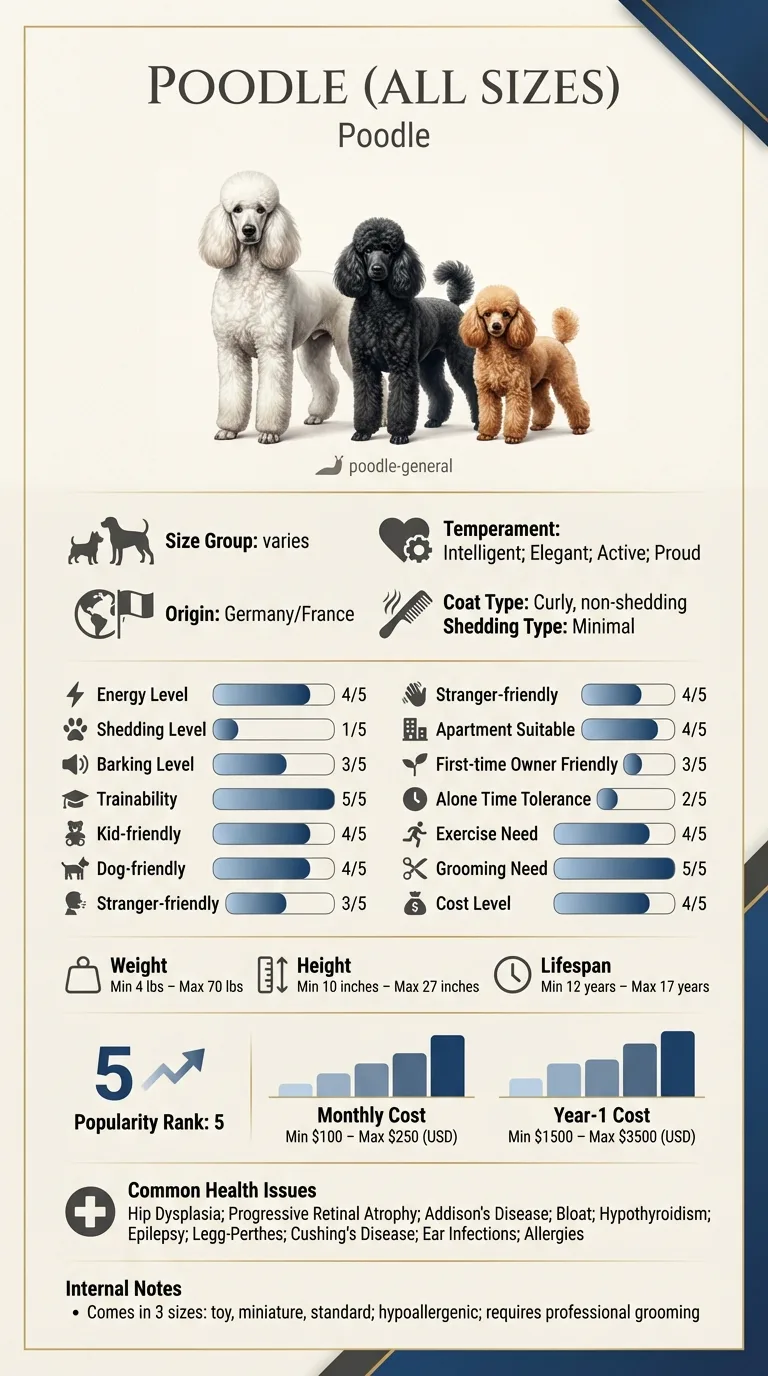
First-time dog owners, families with kids, and busy professionals often struggle with this decision. They want to ensure they bring home a dog that fits their lifestyle and minimizes potential health issues.
This guide is not medical advice. If your dog shows pain, sudden behavior change, or worsening symptoms, consult a licensed veterinarian.
Some links may be affiliate links. We may earn a commission at no extra cost to you. We only suggest products we believe are helpful for dog owners.
We research and check what we publish, but we do not warrant that any figure, date, price, or statement is accurate, complete, or current, and we accept no liability for any loss, cost, injury, or other harm arising from the use of this site. Use it as one reference among several. You remain responsible for your own decisions and for your dog's care - confirm anything that matters with a licensed veterinarian or another qualified professional before you act on it. Full disclaimer.
Check this first
Understanding when a situation with your Poodle (All Sizes) becomes an emergency is crucial. Certain signs indicate that you should call your vet immediately, while others can be monitored at home. Knowing the difference can save your dog's life and help you manage anxiety as a pet owner.
If any of these apply, call your vet or an emergency clinic now. The rest of this page is for the cases that are not an emergency.
Poodle owners may struggle with the decision between purebred and mixed-breed dogs. This choice often leads to uncertainty about health risks and temperament, especially since purebred Poodles can be more prone to certain genetic issues. Day-to-day, this dilemma can manifest as stress over potential health problems and behavioral concerns.
This issue is quite common among Poodle owners, as many are unaware that purebred dogs are statistically more likely to face certain health challenges. In fact, studies show that purebred dogs can be 1.9 times more likely to develop cancer than their mixed-breed counterparts. Understanding these risks helps owners make informed decisions.
Poodles can inherit specific genetic traits, especially if they are purebred. These traits may include health issues or behaviors that can affect their temperament and health. For instance, purebred Poodles are more prone to certain conditions like hip dysplasia and progressive retinal atrophy, which can influence their overall behavior.
The environment plays a crucial role in a Poodle's behavior, regardless of being purebred or mixed. Factors such as lack of socialization, inconsistent training, or insufficient exercise can lead to behavioral issues. A stressful home environment or changes in routine can also trigger anxiety or other problematic behaviors.
If you notice drastic changes in your Poodle's behavior, such as increased aggression or signs of severe anxiety, it's important to talk to a vet. They can rule out any underlying health issues that might be affecting your dog's behavior.
Avoiding these common mistakes can help you better manage the issues surrounding Poodle (All Sizes) purebred vs. mixed breeds. Here are some behaviors to steer clear of.
Start here: Poodle (All Sizes) Genetic Disorders: What to Screen For
See all Poodle General health problems, which breeds are prone to purebred vs mixed breeds, or the full Poodle General breed guide for temperament, exercise needs and ownership costs.
You can expect to see some improvements within a few weeks, but significant changes may take several months of consistent care under your vet's plan.
Success means your Poodle responds well to training commands, shows less anxiety in new situations, and enjoys interactions with other dogs.
If you notice any of the following symptoms, it’s time to seek immediate veterinary care: - Difficulty breathing or choking - Uncontrolled bleeding or severe injury - Sudden collapse or unconsciousness - Signs of severe pain, such as whining or hiding - Seizures or loss of coordination - Vomiting or diarrhea lasting more than 24 hours - Any signs of allergic reaction, like swelling or hives

In less severe situations, you can monitor your Poodle (All Sizes) at home. Consider the following mild cases: - Occasional sneezing or coughing - Minor digestive upset, like soft stools - Slight lethargy without other symptoms - Mild itching or skin irritation - Behavioral changes that are not drastic

Jessica, a busy nurse in Chicago, adopted Bella, a Standard Poodle mixed with a Labrador. At first, Bella struggled with anxiety and would bark excessively whenever guests arrived. After researching training methods, Jessica began using positive reinforcement techniques. She also enrolled in a puppy training class. Over time, Bella became calmer and more confident, learning to greet guests without barking frantically.
Key takeaway: Consistency in training and socialization can transform anxious behaviors into positive interactions.
Purebred Poodles have a consistent appearance and temperament, while mixed breeds can vary greatly. Mixed breeds may also have fewer genetic health issues, as they benefit from a broader gene pool. However, purebreds often have predictable traits that some owners prefer. This answer relates to Poodle (All Sizes) purebred vs. mixed breeds.
Behavior issues in Poodles can stem from genetics, lack of training, or environmental factors. Purebreds may have specific traits that can lead to challenges, like anxiety or excessive barking. Early socialization and consistent training can help mitigate these problems.
Training a Poodle requires patience and consistency. Use positive reinforcement methods and keep training sessions short and engaging. Incorporating mental stimulation, like puzzle toys, can also help keep your Poodle focused and happy.
Yes, studies show that purebred Poodles are more likely to develop certain health issues, such as hip dysplasia and progressive retinal atrophy. Regular vet check-ups and a healthy diet can help manage these risks. Mixed breeds often have a lower risk of hereditary diseases.
Consider factors like temperament, health risks, and your lifestyle. Purebreds might have specific needs and traits, while mixed breeds can offer more variability. Assess your living situation and choose a dog that fits your family's needs.
Generally, purebred Poodles can be more expensive due to their breeding and lineage. Initial costs can range from $1,500 to $3,500 in the first year, while mixed breeds might have lower upfront costs. However, ongoing care costs will depend on the dog's health and needs.
Purebred Poodles may be more prone to certain genetic health problems, such as hip dysplasia and progressive retinal atrophy. In contrast, mixed breeds often benefit from hybrid vigor, which can result in fewer inherited health issues. It's still important to monitor any dog for health concerns, regardless of their breeding.
Training a Poodle, whether purebred or mixed, requires consistency and positive reinforcement. If your Poodle shows behavioral issues, consider enrolling in a training class or seeking advice from a professional trainer. They can help tailor strategies to your dog's specific needs and background.
It's normal for mixed breed Poodles to exhibit characteristics from their various ancestry. While this can include a range of energy levels and temperaments, any concerning behaviors should be assessed. Consulting with a veterinarian or a behaviorist can provide insights tailored to your dog's unique mix.
If your purebred Poodle shows signs of anxiety, it’s important to address this promptly. Create a safe and comforting environment, and consider consulting a vet or an animal behaviorist for effective strategies. They may suggest training techniques or even therapy options suited for your Poodle.
Yes, the costs associated with owning a purebred Poodle can vary. Factors include potential health issues and grooming needs, which are generally higher for purebreds. Mixed breeds might have lower initial costs, but ongoing care should still be budgeted for both types to ensure their health and happiness.
Assess your lifestyle and preferences. If you prefer predictability, a purebred may be better, but if you're open to variability, consider mixed breeds.
Create a calm environment and establish a routine. Regular exercise and training can help alleviate anxiety in your Poodle.
Common issues include barking, separation anxiety, and chewing. Early training and socialization can help address these behaviors.
Poodles require regular professional grooming due to their curly, non-shedding coat. Plan for monthly grooming sessions to keep their coat in top shape.
A one-page prep sheet for this condition: the signs, the questions to ask, what to get priced. Unlocks here.
You get: Vet visit prep sheet
No spam. One-click unsubscribe. See our privacy policy.
See a sample page before you decide.
Early access list
The free prep sheet covers the same-day warning signs, a symptom log and the questions to ask. We are considering a fuller kit that adds a cost worksheet for the usual tests and treatments (US price ranges with their sources) and a plain-English guide to ways of covering the bill. It is not built yet; this list tells us whether it is worth building.
One email, no spam, unsubscribe anytime. Information only, not veterinary advice.