Behavior
Which breed needs less grooming?
The Weimaraner.

Quick answer
Which breed needs less grooming?
The Weimaraner.
German Wirehaired Pointer or Weimaraner? On paper they differ most on grooming need, and on the scales Weimaraner is the heavier at 55–90 lbs. Here is how the two compare on everything that shapes an ordinary week.
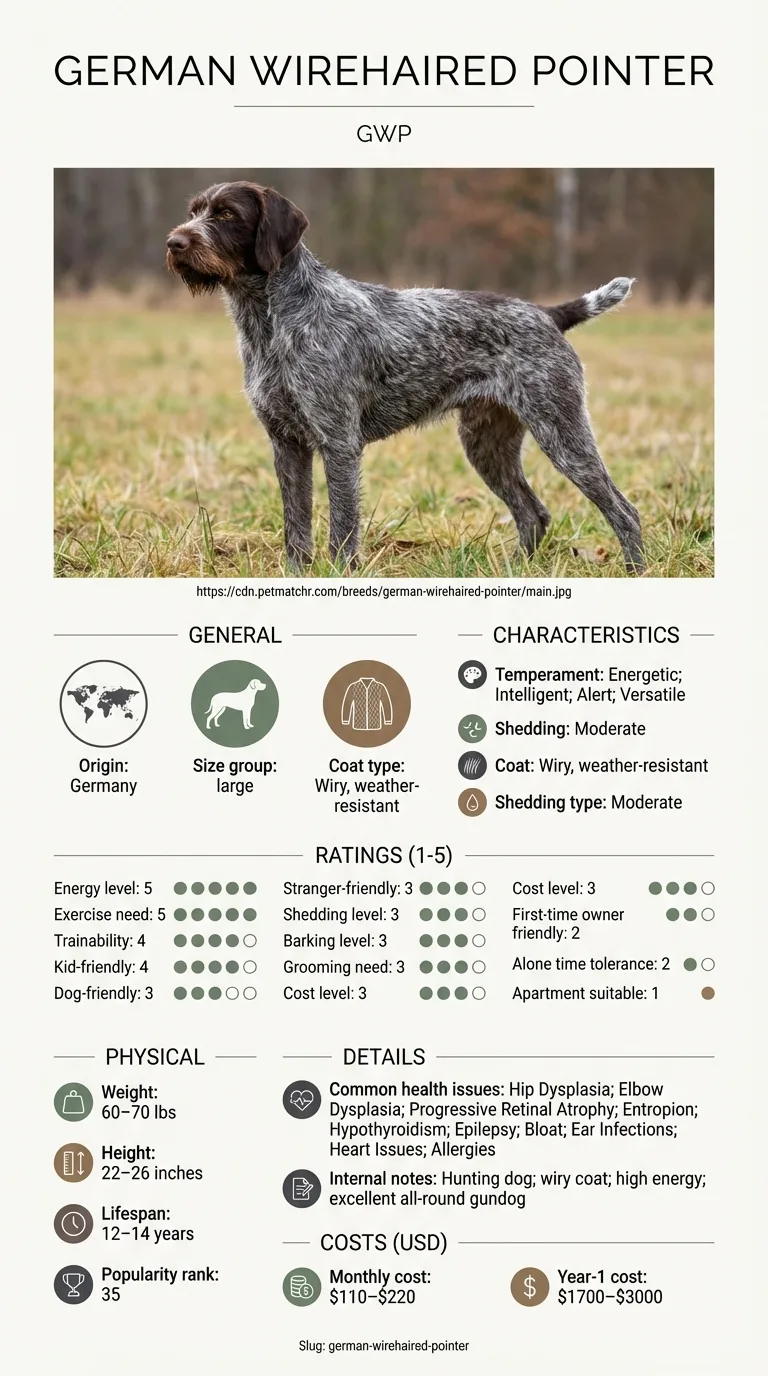
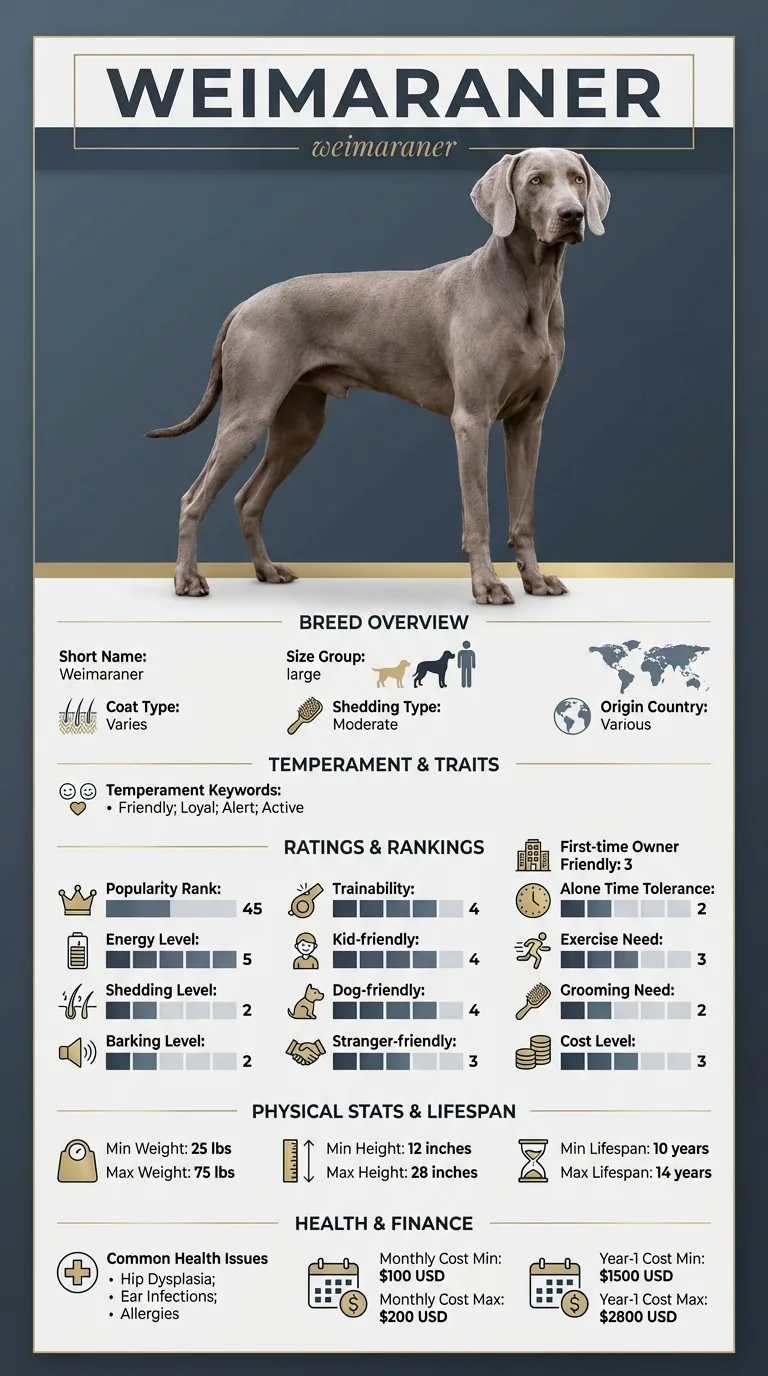
This is for someone already down to German Wirehaired Pointer and Weimaraner and deciding between them. For this pair the decision usually turns on grooming need, so those are covered first and in most detail. Both rate 1/5 for flats, so housing does not settle this one. There is no origin story here — only what changes about your week.
Between German Wirehaired Pointer and Weimaraner, grooming need is what separates them, and Weimaraner is the lower-effort dog of the two to keep.
Choose German Wirehaired Pointer if a smaller dog suits your car, your home or your back.
Choose Weimaraner if you do not want a standing grooming appointment and shedding is a problem in your house.
| Feature | german wirehaired pointer | weimaraner | Winner |
|---|---|---|---|
| Size class | large | large | Equal |
| Weight | 60–70 lbs | 55–90 lbs | Equal |
| Height | 22–26 in | 23–27 in | Equal |
| Lifespan | 12–14 years | 10–13 years | german wirehaired pointer |
| Exercise need | Very high (5/5) | Very high (5/5) | Equal |
| Grooming need | Moderate (3/5) | Very low (1/5) | weimaraner |
| Shedding | Moderate (3/5) | Low (2/5) | weimaraner |
| Energy level | Very high (5/5) | Very high (5/5) | Equal |
| Barking | Moderate (3/5) | Moderate (3/5) | Equal |
| Apartment suitability | Very low (1/5) | Very low (1/5) | Equal |
| Good for first-time owners | Low (2/5) | Low (2/5) | Equal |
| Tolerates being alone | Low (2/5) | Very low (1/5) | german wirehaired pointer |
| Trainability | High (4/5) | High (4/5) | Equal |
| Good with kids | High (4/5) | High (4/5) | Equal |
| Good with other dogs | Moderate (3/5) | Moderate (3/5) | Equal |
| Friendly to strangers | Moderate (3/5) | Moderate (3/5) | Equal |
| Cost level | Moderate (3/5) | Moderate (3/5) | Equal |
| Coat | Wiry, weather-resistant | Short and sleek | Equal |
| Origin | Germany | Various | Equal |
| Typical monthly cost | $110–$220 | $110–$240 | Equal |
| Typical first-year cost | $1,700–$3,000 | $1,700–$3,200 | Equal |
At 60-70 lbs and 22-26 inches, the German Wirehaired Pointer sits at the compact end of the large-breed spectrum, while the Weimaraner's 55-90 lb, 23-27 inch range covers more ground, since Weimaraners can run noticeably rangier depending on line. Both are athletic, deep-chested gundogs built for a full day in the field rather than a stroll around the block. Neither breed carries much extra bulk, so newcomers expecting a stocky companion should look elsewhere. Owners choosing between the two should know a well-fed Weimaraner can outweigh a GWP by close to 20 pounds despite similar height, which matters for crate sizing, vehicle space and vet-visit costs alike.
Both breeds score a full 5 out of 5 for exercise need, and that rating is not exaggerated for either dog. The GWP was bred to point, flush and retrieve across marsh and field for hours, while the Weimaraner was developed to run down boar and stag at speed, and both temperament lists include Energetic and Alert as core traits. Expect to budget 90 minutes or more of vigorous daily activity, hiking, running or structured fieldwork, for either dog. A bored GWP or Weimaraner left to its own devices tends to invent destructive hobbies. Households without a fenced yard, a hunting routine or serious runners on the roster will struggle to satisfy either breed's drive.
Coat care is where this pairing actually splits. The GWP's wiry, weather-resistant coat needs moderate work (3/5) and hand-stripping a couple of times a year to stay functional, and it sheds at a moderate 3/5 clip. The Weimaraner's short, sleek coat needs almost nothing, rating a very low 1/5 for grooming, and sheds slightly less too, at 2/5. In practical terms, a Weimaraner owner is looking at a weekly wipe-down and occasional bath, while a GWP owner has to actually learn or pay for stripping technique to keep that wiry texture from going soft and losing its water resistance. Neither breed is a heavy shedder by large-breed standards, but the Weimaraner is the lower-maintenance coat of the two.
Neither dog belongs in a high-rise. Both score a rock-bottom 1/5 for apartment suitability, and both carry moderate barking ratings, so noise isn't really the dealbreaker, space and exercise access are. Where the two diverge is time alone: the GWP tolerates solitude at a low 2/5, while the Weimaraner drops to a very low 1/5, and Weimaraner temperament data explicitly lists Separation Anxiety as a known concern alongside its Devoted, Headstrong nature. A GWP left alone for a full workday will get restless; a Weimaraner left the same amount of time is more likely to develop genuine anxiety behaviors, so this pairing favors households with someone home most of the day, and the Weimaraner needs that presence even more.
Both breeds rate High (4/5) for trainability and Low (2/5) for first-time-owner suitability, so on paper they look interchangeable, but the temperament lists hint at different flavors of stubborn. The GWP is described as Intelligent and Versatile, reflecting its multi-purpose gundog background, while the Weimaraner's Headstrong label signals a dog that questions commands rather than one that simply gets distracted. Both need an owner who has handled a strong-willed sporting breed before and who will commit to daily structured work, not just off-leash park time. Neither is a good match for a first dog or a household hoping obedience will happen passively.
Families get a nearly identical read here: both breeds rate High (4/5) with kids, Moderate (3/5) with other dogs and Moderate (3/5) with strangers. The GWP's Versatile streak makes it adaptable to a busy household with visitors coming and going, while the Weimaraner's Devoted nature can tip into velcro-dog behavior around its core people specifically. Supervision still matters with both around small children simply because of their size and exercise-driven energy, not temperament red flags. Multi-dog homes should expect a normal introduction process rather than instant harmony, since neither breed is rated a top scorer for canine sociability.
The GWP's projected 12-14 years edges out the Weimaraner's 10-13, a real difference for a large sporting breed. The GWP's health list is longer and more varied, ten conditions including Progressive Retinal Atrophy, Entropion, Epilepsy and Heart Issues alongside the shared risks of Hip Dysplasia and Bloat. The Weimaraner's shorter five-item list is narrower but not lighter: Bloat (GDV), Hip Dysplasia, Hypertrophic Osteodystrophy and Von Willebrand Disease are all serious, and Separation Anxiety rounds out the list as a behavioral-health concern tied directly to its low tolerance for being alone. Both breeds are deep-chested and need bloat precautions, slow-feed bowls and no strenuous exercise right after meals.
Monthly costs land close together, $110-220 for the GWP versus $110-240 for the Weimaraner, and first-year costs follow the same pattern at $1,700-3,000 and $1,700-3,200 respectively. Both are rated Moderate (3/5) on overall cost level, so the real budget variable isn't the sticker price of ownership but what each dog's specific health list will cost you over time. The GWP's longer roster of conditions, including epilepsy management and eye issues, can mean more diagnostic visits, while the Weimaraner's bloat and Von Willebrand Disease risks call for emergency-fund readiness given how fast GDV can turn fatal. Budget similarly for both, but earmark a vet emergency fund either way.
German Wirehaired Pointer weighs 60–70 lbs and lives 12–14 years; Weimaraner weighs 55–90 lbs and lives 10–13 years. The two diverge most on grooming need. They are level on apartment suitability, barking and cost level, so those cannot decide it. Where the table declares a winner it means less work for the owner, nothing more; descriptive rows are left as ties on purpose. The value here is in the differences between the two columns; treat any single score as approximate.

Neither — both score just 1/5 for apartment suitability and need very high daily exercise, so this pairing is really a house-with-yard comparison either way.
Yes, it's listed directly among the breed's health concerns, and its 1/5 tolerate-alone score is the lowest rating either breed shows in this comparison, so plan for company or professional dog-walking if you choose one.
The Weimaraner, at 2/5 versus the GWP's 3/5, and its short coat also needs far less grooming work, 1/5 versus 3/5.
Not really — both rate Low (2/5) for first-time owners, so this is a pairing for people who've handled a strong sporting breed before.
The GWP, with a 12-14 year lifespan compared to the Weimaraner's 10-13 years.
Yes, Bloat appears on both health lists, and given their deep chests, slow feeders and rest after meals are wise for either dog.
They're tied — both rate High (4/5) with kids, so kid-friendliness isn't a deciding factor here.
The Weimaraner.
The Weimaraner.
The German Wirehaired Pointer.
No, both rate just 1/5 for apartment suitability.
Secure checkout on Stripe. We never see your card.
7-day money-back guarantee. Instant access.
Health information here is general and is not veterinary advice. If your dog shows pain, sudden behaviour change, or worsening symptoms, consult a licensed veterinarian.
Some links on this site are affiliate links. We may earn a commission at no extra cost to you, and we only suggest products we believe are helpful for dog owners.
We research and check what we publish, but we do not warrant that any figure, date, price, or statement is accurate, complete, or current, and we accept no liability for any loss, cost, injury, or other harm arising from the use of this site. Use it as one reference among several. You remain responsible for your own decisions and for your dog's care - confirm anything that matters with a licensed veterinarian or another qualified professional before you act on it. Full disclaimer.
Match your lifestyle to the right dog.
Take quizNot sure which breed is right for you? Take our 2-minute quiz to find out.
Take the quiz