Living
Which is quieter?
The French Bulldog, 2/5 for barking against the Corgi's 4/5, tied to the Corgi's herding-dog instincts.

Quick answer
Which is quieter?
The French Bulldog, 2/5 for barking against the Corgi's 4/5, tied to the Corgi's herding-dog instincts.
Deciding between a French Bulldog and a Pembroke Welsh Corgi? Both small, affectionate breeds have unique traits that make them great companions. Let’s break down their differences to help you choose the perfect fit for your home.
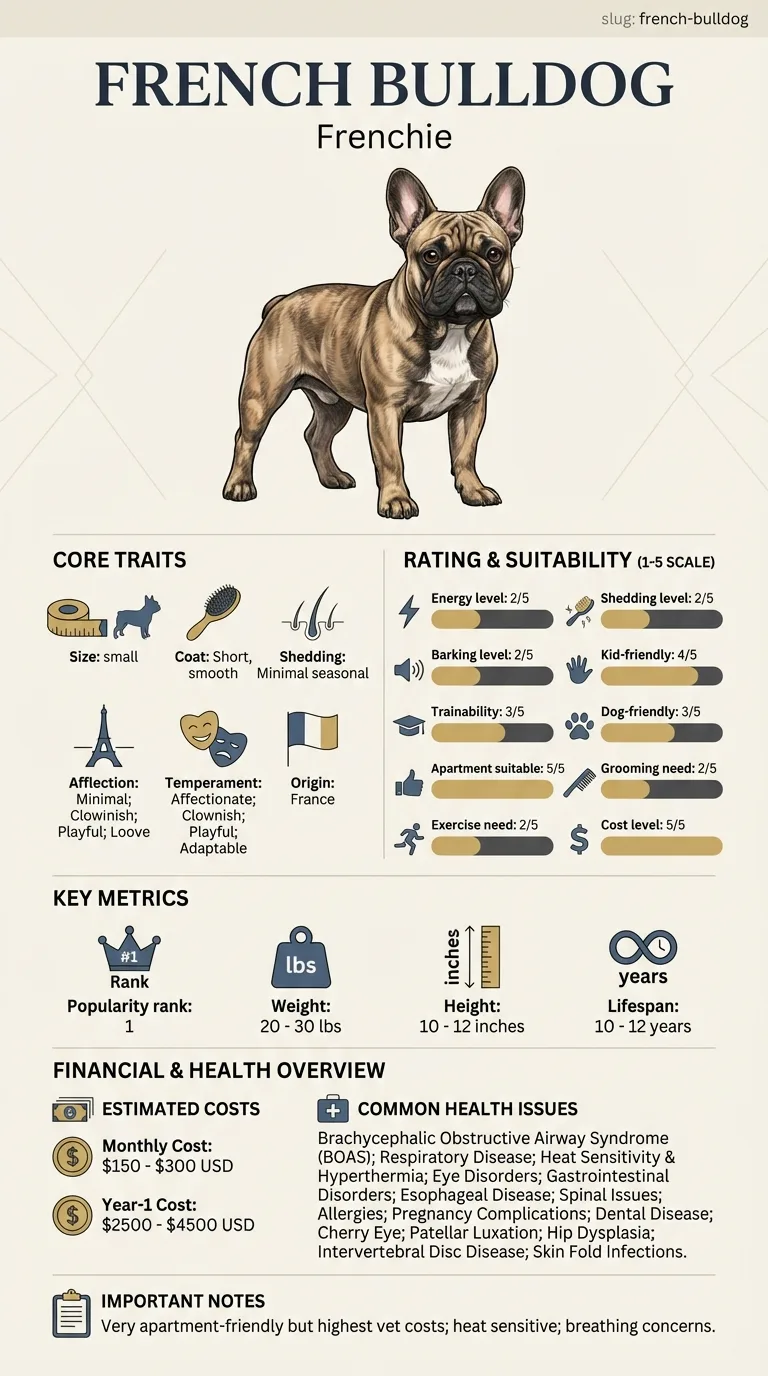
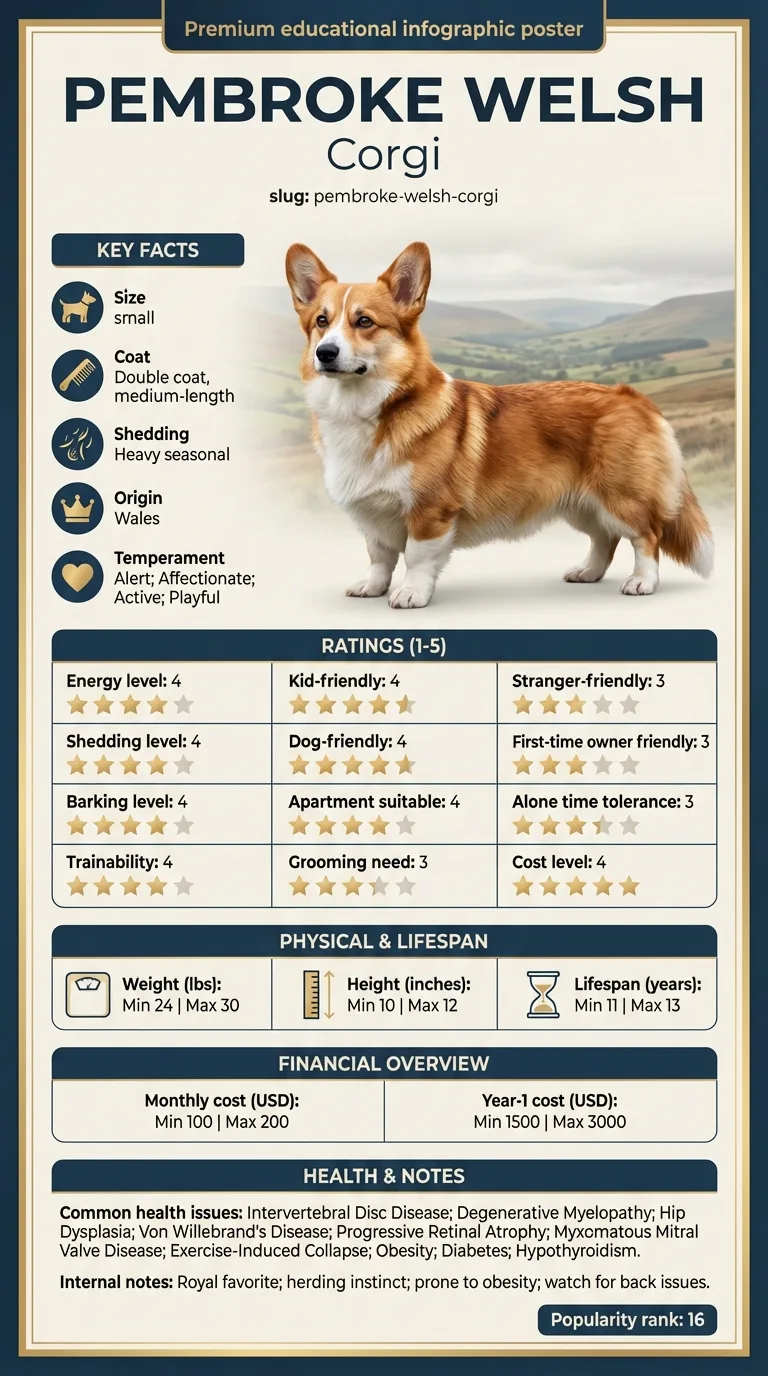
This comparison is for prospective dog owners who are considering either a French Bulldog or a Pembroke Welsh Corgi. Maybe you live in an apartment and need a breed that adapts well to smaller spaces, or perhaps you're a family looking for a kid-friendly companion. You might be curious about each breed's health costs, energy levels, and grooming needs to ensure your choice aligns with your lifestyle and budget.
If you want a laid-back companion who thrives in apartments, the French Bulldog is your best bet, while the Pembroke Welsh Corgi is ideal for active families seeking a playful and intelligent dog.
Choose the French Bulldog if you prefer a quieter, more relaxed dog that requires less exercise and is highly suited for apartment living. Their affectionate nature makes them great for first-time dog owners.
Opt for the Pembroke Welsh Corgi if you desire a lively, affectionate dog that enjoys playtime and outdoor activities. They are great with kids and can keep up with a more active lifestyle.
| Feature | french bulldog | pembroke welsh corgi | Winner |
|---|---|---|---|
| Size class | small | small | Equal |
| Weight | 20–30 lbs | 24–30 lbs | Equal |
| Height | 10–12 in | 10–12 in | Equal |
| Lifespan | 10–12 years | 11–13 years | pembroke welsh corgi |
| Exercise need | Low (2/5) | High (4/5) | french bulldog |
| Grooming need | Low (2/5) | Moderate (3/5) | french bulldog |
| Shedding | Low (2/5) | High (4/5) | french bulldog |
| Energy level | Low (2/5) | High (4/5) | Equal |
| Barking | Low (2/5) | High (4/5) | french bulldog |
| Apartment suitability | Very high (5/5) | High (4/5) | french bulldog |
| Good for first-time owners | Very high (5/5) | Moderate (3/5) | french bulldog |
| Tolerates being alone | Very high (5/5) | Moderate (3/5) | french bulldog |
| Trainability | Moderate (3/5) | High (4/5) | pembroke welsh corgi |
| Good with kids | High (4/5) | High (4/5) | Equal |
| Good with other dogs | Moderate (3/5) | High (4/5) | pembroke welsh corgi |
| Friendly to strangers | Moderate (3/5) | Moderate (3/5) | Equal |
| Cost level | Very high (5/5) | High (4/5) | pembroke welsh corgi |
| Coat | Short, smooth | Double coat, medium-length | Equal |
| Origin | France | Wales | Equal |
| Typical monthly cost | $150–$300 | $100–$200 | Equal |
| Typical first-year cost | $2,500–$4,500 | $1,500–$3,000 | Equal |
These two are closer in scale than most pairs in this batch, the Corgi's 24-30 lbs sits right against the Frenchie's 20-30, and both share the same 10-12 inch height. Don't let that similarity fool you about the rest of the comparison, though; a Corgi's long body and herding-dog build come with a very different daily energy level than the Frenchie's.
Exercise need splits clearly here: 2/5 for the Frenchie, 4/5 for the Corgi, despite the two being nearly the same size. A Pembroke Welsh Corgi was bred to herd cattle all day and carries that drive into companion life, it wants real daily activity, not just a walk around the block from a similarly sized dog.
Shedding is the sharpest gap in this category: 4/5 for the Corgi against the Frenchie's 2/5, despite the Corgi needing only moderately more grooming, 3/5 against 2/5. That double coat blows out seasonally and sheds steadily the rest of the year, a Corgi owner should expect a fair amount of hair on the floor regardless of how much brushing they keep up with.
Apartment suitability favors the Frenchie, 5/5 against the Corgi's still-solid 4/5, not a dramatic gap. Barking is a bigger difference: 2/5 for the Frenchie against a high 4/5 for the Corgi, a trait tied to its herding background. Alone-tolerance splits too, 5/5 versus 3/5, so a Corgi handles solo time reasonably well but not as easily as the Frenchie.
Trainability favors the Corgi, 4/5 against the Frenchie's 3/5, but the first-time-owner score flips that, 5/5 for the Frenchie, a more moderate 3/5 for the Corgi. A Corgi's herding instincts, including nipping at heels, can take more experienced handling to manage than its trainability score alone suggests.
Kids tie at 4/5 for both breeds, and strangers tie at 3/5 too, an unusually even match. The Corgi edges ahead with other dogs, 4/5 against the Frenchie's 3/5. Overall this is one of the more balanced household-fit comparisons in this batch, without a single lopsided category.
The Corgi's health list is longer than most in this batch and leans toward its long back: intervertebral disc disease, degenerative myelopathy, plus hip dysplasia, heart disease, and diabetes. The Frenchie's list centers on its flat face instead. Hip dysplasia is the only shared risk. Lifespan slightly favors the Corgi, 11-13 years against the Frenchie's 10-12.
Cost level rates 5/5 for the Frenchie against 4/5 for the Corgi. Monthly costs run $150-$300 versus $100-$200, and first-year costs $2,500-$4,500 against $1,500-$3,000. Given the Corgi's longer health-risk list, particularly around its spine, budgeting some room above that range for orthopedic care is reasonable.








Closer than most pairs, 20-30 lbs for the Frenchie against 24-30 for the Corgi, and both stand 10-12 inches. The difference shows up in energy, not size.
Yes, 4/5 against the Frenchie's 2/5, driven by its double coat, even though its grooming need is only moderately higher at 3/5.
A solid 4/5, double the Frenchie's 2/5, its herding-dog background means it wants real daily activity despite its short legs.
The Frenchie, 5/5 against the Corgi's 3/5, partly because Corgi herding instincts like heel-nipping can take more experienced handling.
$150-$300 for the Frenchie versus $100-$200 for the Corgi.
Only hip dysplasia. The Corgi's other risks lean toward its long back, intervertebral disc disease and degenerative myelopathy in particular.
The Corgi, slightly, 11-13 years against the Frenchie's 10-12.
The French Bulldog, 2/5 for barking against the Corgi's 4/5, tied to the Corgi's herding-dog instincts.
$150-$300 for the Frenchie versus $100-$200 for the Corgi.
A solid 4/5, real daily activity, not just a walk, despite its similar size to the low-energy Frenchie.
The Corgi, slightly, 11-13 years against the Frenchie's 10-12, though its long back brings its own spine-related risks.
Secure checkout on Stripe. We never see your card.
7-day money-back guarantee. Instant access.

This guide is not medical advice. If your dog shows pain, sudden behavior change, or worsening symptoms, consult a licensed veterinarian.
Some links may be affiliate links. We may earn a commission at no extra cost to you. We only suggest products we believe are helpful for dog owners.
We research and check what we publish, but we do not warrant that any figure, date, price, or statement is accurate, complete, or current, and we accept no liability for any loss, cost, injury, or other harm arising from the use of this site. Use it as one reference among several. You remain responsible for your own decisions and for your dog's care - confirm anything that matters with a licensed veterinarian or another qualified professional before you act on it. Full disclaimer.
Match your lifestyle to the right dog.
Take quizNot sure which breed is right for you? Take our 2-minute quiz to find out.
Take the quiz