Behavior
Bloodhound or Pug — which is the easier overall dog?
The Pug for most households — easier to train, better in small spaces, and friendlier with kids and strangers, though its brachycephalic health risks need real attention.

Quick answer
Bloodhound or Pug — which is the easier overall dog?
The Pug for most households — easier to train, better in small spaces, and friendlier with kids and strangers, though its brachycephalic health risks need real attention.
Bloodhound or Pug? On paper they differ most on apartment suitability, and on the scales Bloodhound is the heavier at 90–110 lbs. Here is how the two compare on everything that shapes an ordinary week.
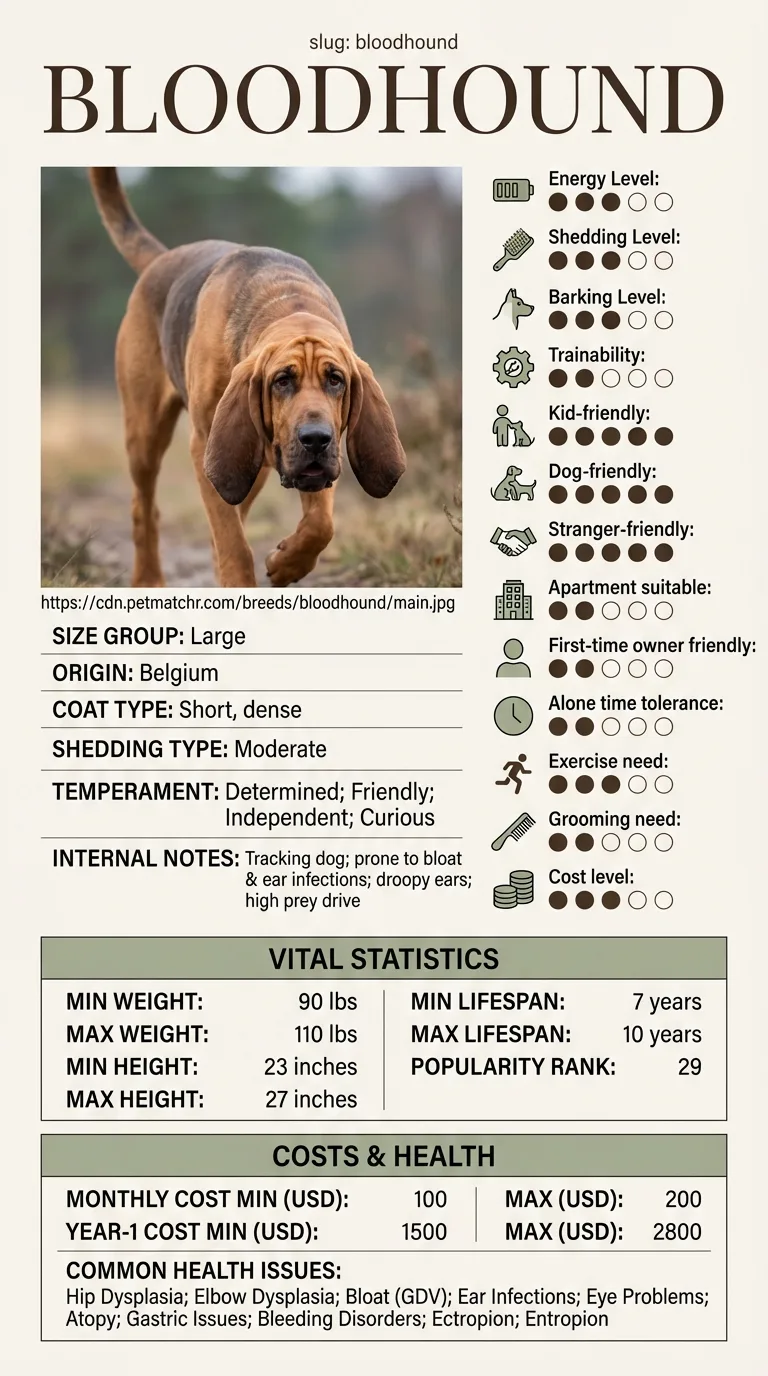
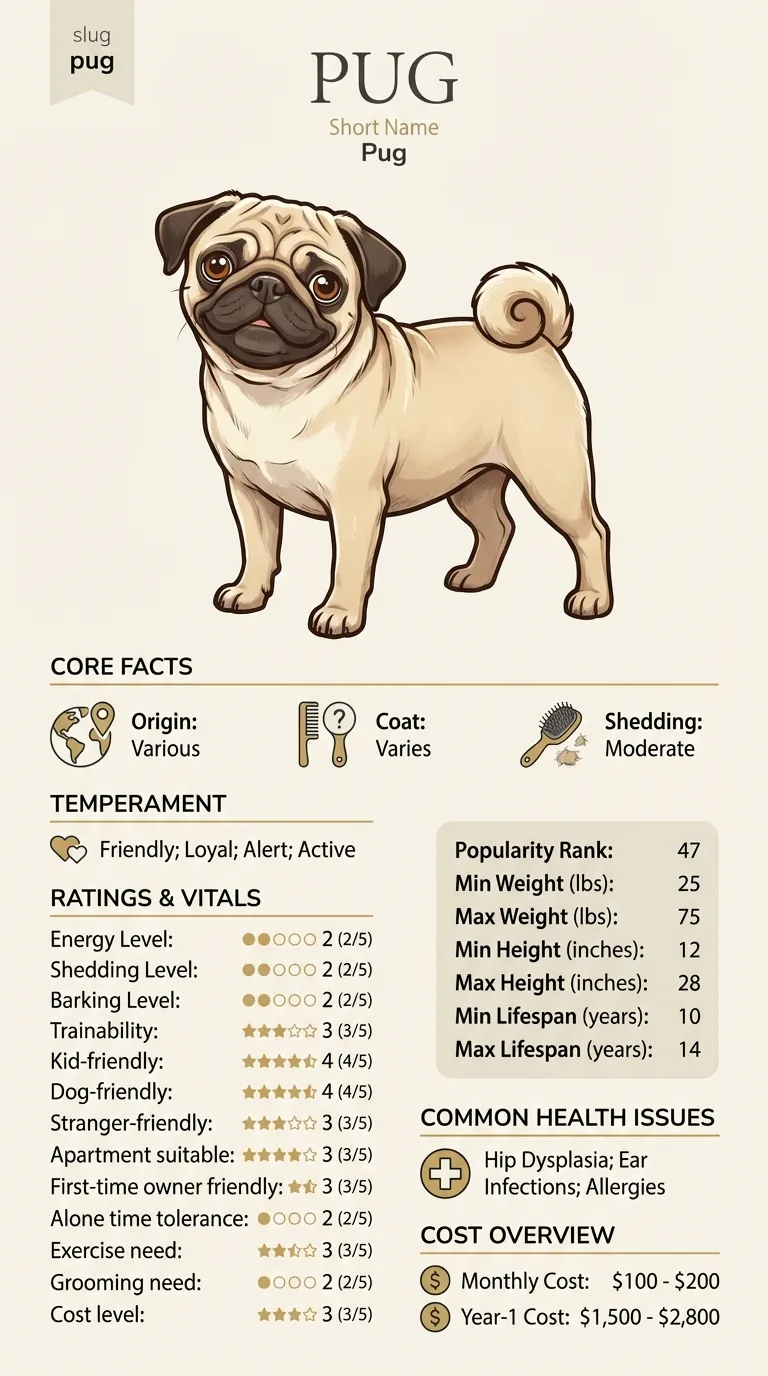
This is for someone already down to Bloodhound and Pug and deciding between them. For this pair the decision usually turns on apartment suitability and good for first-time owners, so those are covered first and in most detail. Anyone choosing from a flat has a clear answer here: Pug rates 5/5 against 2/5. There is no origin story here — only what changes about your week.
Between Bloodhound and Pug, apartment suitability is what separates them, and Pug is the lower-effort dog of the two to keep.
Choose Bloodhound if shedding is a problem in your house, you want a dog that can keep up with an active routine and you want a dog that is more watchful with visitors.
Choose Pug if you are in a flat or a smaller home, this is your first dog and your walking routine is modest.
| Feature | bloodhound | pug | Winner |
|---|---|---|---|
| Size class | large | small | Equal |
| Weight | 90–110 lbs | 14–18 lbs | Equal |
| Height | 23–27 in | 10–13 in | Equal |
| Lifespan | 7–10 years | 13–15 years | pug |
| Exercise need | Moderate (3/5) | Low (2/5) | pug |
| Grooming need | Low (2/5) | Low (2/5) | Equal |
| Shedding | Moderate (3/5) | High (4/5) | bloodhound |
| Energy level | Moderate (3/5) | Low (2/5) | Equal |
| Barking | Moderate (3/5) | Low (2/5) | pug |
| Apartment suitability | Low (2/5) | Very high (5/5) | pug |
| Good for first-time owners | Low (2/5) | Very high (5/5) | pug |
| Tolerates being alone | Low (2/5) | Low (2/5) | Equal |
| Trainability | Low (2/5) | Moderate (3/5) | pug |
| Good with kids | High (4/5) | Very high (5/5) | pug |
| Good with other dogs | High (4/5) | High (4/5) | Equal |
| Friendly to strangers | High (4/5) | Very high (5/5) | pug |
| Cost level | Moderate (3/5) | Moderate (3/5) | Equal |
| Coat | Short, dense | Short, smooth double coat | Equal |
| Origin | Belgium | Various | Equal |
| Typical monthly cost | $100–$200 | $80–$150 | Equal |
| Typical first-year cost | $1,500–$2,800 | $1,100–$2,300 | Equal |
These two sit at opposite ends of the size chart. The Bloodhound weighs 90-110 lbs and stands 23-27 inches; the Pug weighs 14-18 lbs and stands just 10-13 inches. The Pug's compact, wrinkled build and short muzzle also make it a structurally different kind of dog, not just a smaller one — its brachycephalic face changes how it breathes, sleeps and handles heat, which the Bloodhound's long muzzle never has to contend with.
The Pug needs less from you physically, low (2/5) exercise need against the Bloodhound's moderate (3/5), and both rate similarly on daily energy level. Pugs tire quickly, partly due to their flat-faced breathing limitations, and do best with short, easy walks rather than long outings. The Bloodhound's moderate needs are really about scent-trail time rather than raw physical demand.
Grooming need ties at low (2/5) for both, but the Pug sheds more, high (4/5) against the Bloodhound's moderate (3/5) — a lot of hair for such a small dog, and its wrinkled face needs regular cleaning to prevent skin infections in the folds. The Bloodhound's short coat is simpler care overall, even accounting for its slightly higher shedding rating.
The Pug is built for apartment life, very high (5/5) apartment suitability against the Bloodhound's low (2/5), and it's also quieter, low (2/5) barking versus the Bloodhound's moderate (3/5). Both tolerate being alone poorly, tied at low (2/5) — Pugs are famously attached to their people and don't do well left alone for long stretches, small size or not.
The Pug rates very high (5/5) on first-time-owner suitability and moderate (3/5) on trainability, both ahead of the Bloodhound's low (2/5) on each. Pugs are food-motivated and generally easygoing to live with, even if they're not the fastest learners in obedience class. The Bloodhound's nose-first independence makes it the tougher dog to train regardless of which breed you're measuring it against.
The Pug edges ahead with kids, very high (5/5) against the Bloodhound's high (4/5), and with strangers, very high (5/5) against high (4/5). Both are good with other dogs, tied at high (4/5). Pugs have a well-earned reputation as sociable, easygoing family dogs, and this data backs that up on every household-fit measure, though its small size still means supervising play with very young or rough-handed kids.
The Pug lives longer, 13-15 years against the Bloodhound's 7-10, but its health risks are notably breathing-related: brachycephalic airway syndrome (BOAS), corneal ulcers from its prominent eyes, and pug dog encephalitis, a breed-specific neurological condition. None of these overlap with the Bloodhound's own list of hip and elbow dysplasia, bloat, ear and eye problems and atopy. Heat sensitivity is a real practical concern for the Pug that the Bloodhound doesn't share.
Both rate moderate (3/5) on overall cost, and the dollar ranges favor the Pug: $80-150 monthly and $1,100-2,300 in year one, against $100-200 and $1,500-2,800 for the Bloodhound. That said, brachycephalic breeds like the Pug can carry higher lifetime vet costs tied to airway and eye issues that a monthly average doesn't fully capture — corneal ulcers and BOAS-related treatment in particular can mean unplanned bills a Bloodhound owner is less likely to face.
Bloodhound weighs 90–110 lbs and lives 7–10 years; Pug weighs 14–18 lbs and lives 13–15 years. The two diverge most on apartment suitability and good for first-time owners. They are level on tolerates being alone, cost level and good with other dogs, so those cannot decide it. Where the table declares a winner it means less work for the owner, nothing more; descriptive rows are left as ties on purpose. The value here is in the differences between the two columns; treat any single score as approximate.

Considerably — 14-18 lbs versus 90-110 lbs, and 10-13 inches versus 23-27 inches. The Pug's flat-faced build also makes it a functionally different kind of dog, not just a smaller version of a long-muzzled breed.
The Pug, rated high (4/5) against the Bloodhound's moderate (3/5) — a fair amount of hair for such a small dog, despite both breeds rating low (2/5) on overall grooming need.
Yes, clearly — very high (5/5) first-time-owner suitability against the Bloodhound's low (2/5). It's an easygoing, food-motivated breed that's simpler to live with day to day, even if it's not the quickest learner.
The Pug, rated very high (5/5) on apartment suitability against the Bloodhound's low (2/5). It's also the quieter dog, rated low (2/5) on barking versus the Bloodhound's moderate (3/5).
The Pug runs $80-150 a month, the Bloodhound $100-200. Keep in mind the Pug's breathing-related health risks can add unpredictable vet costs beyond that baseline average.
No overlap in the data. The Pug's risks are centered on its flat face — airway syndrome, corneal ulcers, pug dog encephalitis — while the Bloodhound's are joint, skin and eye conditions unrelated to muzzle shape.
The Pug, at 13-15 years compared to the Bloodhound's 7-10 years.
The Pug for most households — easier to train, better in small spaces, and friendlier with kids and strangers, though its brachycephalic health risks need real attention.
$80-150 for the Pug versus $100-200 for the Bloodhound, though the Pug's airway-related health risks can add unpredictable costs.
The Bloodhound, rated moderate (3/5) against the Pug's low (2/5) — the Pug's flat face limits how much exertion it can handle comfortably.
The Pug, at 13-15 years versus the Bloodhound's 7-10 years.
See every pug comparison.
Secure checkout on Stripe. We never see your card.
7-day money-back guarantee. Instant access.
Health information here is general and is not veterinary advice. If your dog shows pain, sudden behaviour change, or worsening symptoms, consult a licensed veterinarian.
Some links on this site are affiliate links. We may earn a commission at no extra cost to you, and we only suggest products we believe are helpful for dog owners.
We research and check what we publish, but we do not warrant that any figure, date, price, or statement is accurate, complete, or current, and we accept no liability for any loss, cost, injury, or other harm arising from the use of this site. Use it as one reference among several. You remain responsible for your own decisions and for your dog's care - confirm anything that matters with a licensed veterinarian or another qualified professional before you act on it. Full disclaimer.
Match your lifestyle to the right dog.
Take quizNot sure which breed is right for you? Take our 2-minute quiz to find out.
Take the quiz