Training
Which is more trainable?
The Poodle, rated Very High (5/5).

Quick answer
Which is more trainable?
The Poodle, rated Very High (5/5).
Bichon Frise or Poodle (All Sizes)? On paper they differ most on exercise need, and on the scales Poodle (All Sizes) is the heavier at 4–70 lbs. Here is how the two compare on everything that shapes an ordinary week.
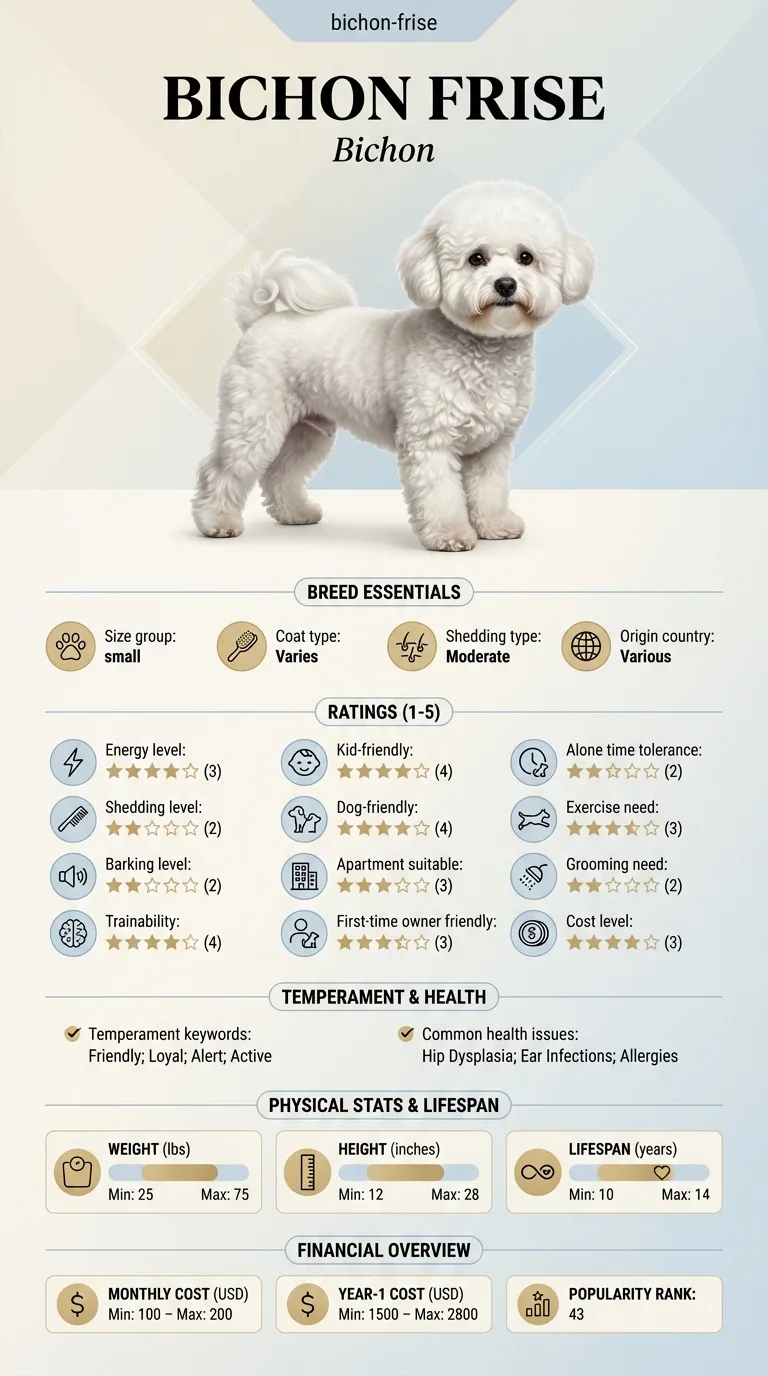
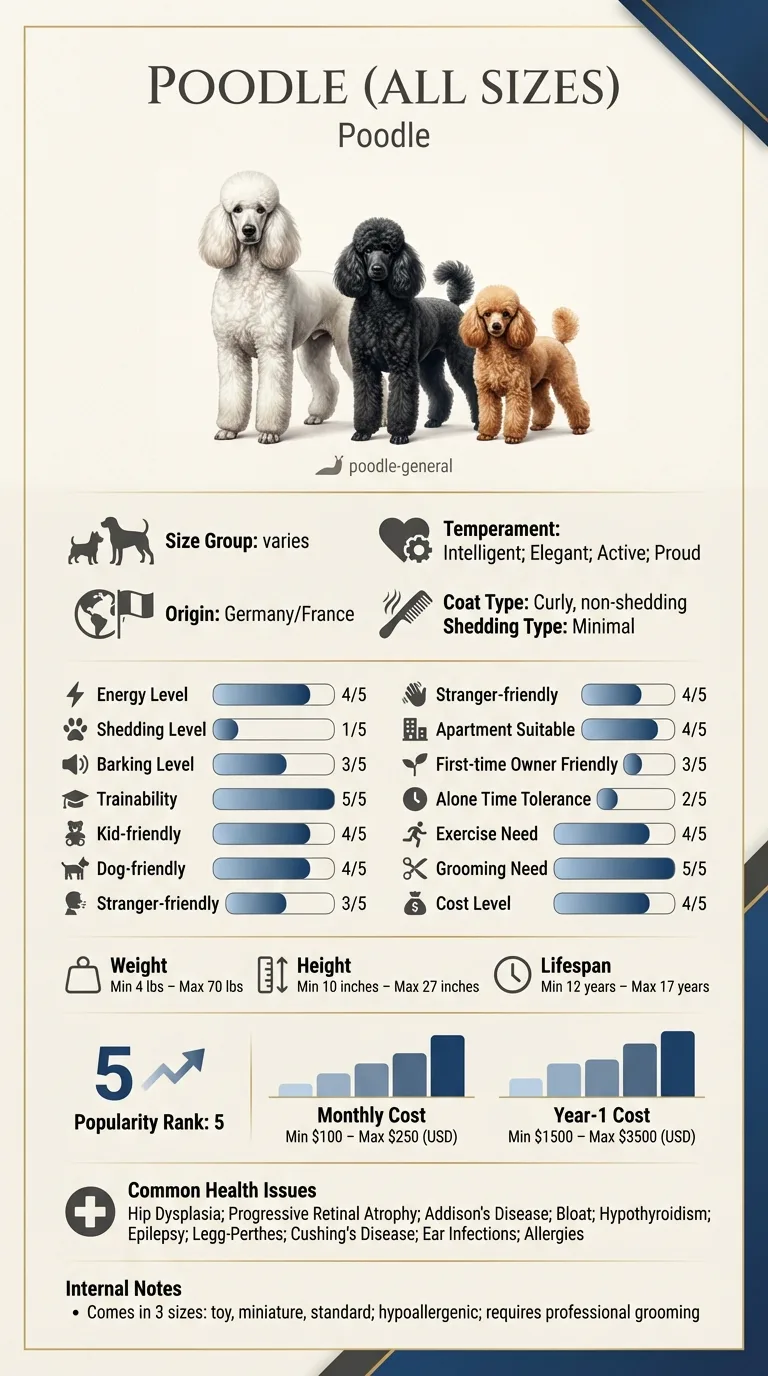
This is for someone already down to Bichon Frise and Poodle (All Sizes) and deciding between them. For this pair the decision usually turns on exercise need and trainability, so those are covered first and in most detail. Anyone choosing from a flat has a clear answer here: Bichon Frise rates 5/5 against 4/5. It is written for the decision rather than the breed history.
Between Bichon Frise and Poodle (All Sizes), exercise need is what separates them, and Bichon Frise is the lower-effort dog of the two to keep.
Choose Bichon Frise if you are in a flat or a smaller home, this is your first dog and your walking routine is modest.
Choose Poodle (All Sizes) if you want a dog that picks up training quickly, you want a dog that can keep up with an active routine and you want a dog that is more watchful with visitors.
| Feature | bichon frise | poodle general | Winner |
|---|---|---|---|
| Size class | small | varies | Equal |
| Weight | 12–18 lbs | 4–70 lbs | Equal |
| Height | 9–12 in | 10–27 in | Equal |
| Lifespan | 14–15 years | 12–17 years | Equal |
| Exercise need | Low (2/5) | High (4/5) | bichon frise |
| Grooming need | Very high (5/5) | Very high (5/5) | Equal |
| Shedding | Very low (1/5) | Very low (1/5) | Equal |
| Energy level | Moderate (3/5) | High (4/5) | Equal |
| Barking | Moderate (3/5) | Moderate (3/5) | Equal |
| Apartment suitability | Very high (5/5) | High (4/5) | bichon frise |
| Good for first-time owners | High (4/5) | Moderate (3/5) | bichon frise |
| Tolerates being alone | Low (2/5) | Low (2/5) | Equal |
| Trainability | Moderate (3/5) | Very high (5/5) | poodle general |
| Good with kids | High (4/5) | High (4/5) | Equal |
| Good with other dogs | High (4/5) | High (4/5) | Equal |
| Friendly to strangers | High (4/5) | Moderate (3/5) | bichon frise |
| Cost level | Moderate (3/5) | High (4/5) | bichon frise |
| Coat | Curly, dense double coat | Curly, non-shedding | Equal |
| Origin | Various | Germany/France | Equal |
| Typical monthly cost | $80–$150 | $100–$250 | Equal |
| Typical first-year cost | $1,100–$2,300 | $1,500–$3,500 | Equal |
The Poodle (All Sizes) entry spans 4–70 lbs and 10–27 inches, a range wide enough to include a teacup-adjacent Toy on one end and a Standard nearly as tall as a Labrador on the other — versus the Bichon Frise's tight 12–18 lb, 9–12 inch profile. That breadth is the whole point of this comparison: it treats the Poodle as a breed family rather than pinning down one variety, so the practical takeaway depends on which end of that range a household is picturing. A Toy or small Miniature Poodle compares closely to the Bichon in size; a Standard is an entirely different physical proposition.
The Poodle family rates High (4/5) on both exercise need and energy level, ahead of the Bichon Frise's Low (2/5) exercise need and Moderate (3/5) energy. That tracks with the Poodle's Active, Intelligent, Proud temperament and its history as a working water retriever — even the smallest Toy Poodles tend to carry that drive, just packaged into a smaller body. A Bichon's exercise needs can be met with a short daily walk and some indoor play, while a Poodle of any size generally benefits from more purposeful activity like fetch, swimming, or agility-style games to avoid boredom-driven behavior.
Grooming and shedding both tie exactly between these two breeds — Very High (5/5) grooming need and Very Low (1/5) shedding apiece — which is a rare full match on this site's coat-related metrics. Both the Bichon Frise's curly double coat and the Poodle's curly, non-shedding coat require brushing several times a week and professional clipping every four to six weeks to prevent matting, and both are popular choices among allergy-sensitive households for exactly that reason. The real difference owners notice is styling: Poodle coats support an enormous range of clip patterns, from practical short cuts to elaborate show trims, while Bichon grooming tends toward one consistent rounded look.
Apartment suitability favors the Bichon Frise slightly, Very High (5/5) against the Poodle's High (4/5) — a gap likely driven by the Poodle range including larger Standard-sized dogs that need more room to move. Barking ties at Moderate (3/5) for both, and alone-time tolerance also ties at Low (2/5), so neither breed is an ideal pick for an owner who's regularly out of the house for long stretches without a plan. A smaller Poodle variety would likely match the Bichon's apartment score closely, while a Standard Poodle household should weigh the extra square footage that size actually needs to stay comfortable.
The Poodle family rates Very High (5/5) on trainability, a full two points above the Bichon Frise's Moderate (3/5) — Poodles are consistently ranked among the most intelligent and biddable breeds that exist, a reputation this comparison bears out clearly. Interestingly, the Bichon still edges ahead for first-time owners, High (4/5) against the Poodle's Moderate (3/5), likely because a highly intelligent dog also needs consistent mental engagement to stay well-behaved, which can be more demanding for a beginner than a slightly less trainable but lower-maintenance Bichon. An experienced owner who wants to do real obedience or agility work will likely get more out of the Poodle's capabilities.
Kids and other dogs both tie at High (4/5), so both breed families are solid choices for a household with children or existing pets. Strangers are where the Bichon Frise pulls ahead, High (4/5) versus the Poodle's Moderate (3/5) — the Poodle's Proud temperament tag can translate into a more reserved, watchful reaction to unfamiliar visitors compared to the Bichon's openly Cheerful, Affectionate greeting style. A household that hosts often or lives somewhere with lots of casual foot traffic may find the Bichon's universal friendliness the easier day-to-day trait, while the Poodle's slightly more discerning nature can double as informal watchdog behavior.
Lifespan ranges overlap heavily, 14–15 years for the Bichon Frise against a wider 12–17 for the Poodle family — meaning a long-lived Poodle can actually outlast a Bichon at the top end, even though the average expectation is similar. The Poodle's tracked health list runs to ten conditions, though, twice the Bichon's five: hip dysplasia, progressive retinal atrophy, Addison's disease, bloat, hypothyroidism, epilepsy, Legg-Perthes, Cushing's disease, ear infections, and allergies. That breadth partly reflects the Poodle's size range — bloat and hip dysplasia skew toward larger Standards, while Legg-Perthes tends to affect smaller varieties — so a size-specific Poodle page will narrow this list down more precisely than the general profile can.
Cost level rates High (4/5) for the Poodle family against Moderate (3/5) for the Bichon Frise, with monthly ranges of $100–$250 versus $80–$150 and first-year totals of $1,500–$3,500 against $1,100–$2,300. Part of that gap comes from the Poodle range including larger, more expensive-to-feed Standard dogs, and part comes from its longer health-issue list, which can mean more diagnostic and specialist visits over a lifetime. Both breeds share the same Very High (5/5) grooming need, so coat-maintenance costs are likely comparable regardless of which Poodle size is chosen — it's food volume and veterinary risk that widen the overall cost gap here.
Bichon Frise weighs 12–18 lbs and lives 14–15 years; Poodle (All Sizes) weighs 4–70 lbs and lives 12–17 years. The two diverge most on exercise need and trainability. They are level on tolerates being alone, barking and good with other dogs, so those cannot decide it. In the table, a "winner" means easier for an ordinary household — not better. Size, coat and origin are recorded without a verdict. Because both breeds are scored the same way, the gaps are reliable even where the absolute numbers are rough.

This comparison covers all Poodle varieties together — Toy, Miniature, and Standard — rather than a single size, which is why the weight and height ranges are so wide.
The Poodle, rated Very High (5/5) versus the Bichon Frise's Moderate (3/5).
Yes, both tie at Very Low (1/5) shedding.
The Poodle, rated High (4/5) versus the Bichon Frise's Low (2/5).
The Bichon Frise, rated High (4/5) versus the Poodle's Moderate (3/5).
The Poodle, with ten tracked conditions versus the Bichon's five, including hip dysplasia, bloat, and Addison's disease.
The Poodle, rated High (4/5) cost level versus the Bichon Frise's Moderate (3/5).
The Poodle, rated Very High (5/5).
The Poodle, High (4/5) versus the Bichon Frise's Low (2/5).
Yes, both Very Low (1/5).
The Bichon Frise, rated Moderate (3/5) cost level.
Secure checkout on Stripe. We never see your card.
7-day money-back guarantee. Instant access.
Health information here is general and is not veterinary advice. If your dog shows pain, sudden behaviour change, or worsening symptoms, consult a licensed veterinarian.
Some links on this site are affiliate links. We may earn a commission at no extra cost to you, and we only suggest products we believe are helpful for dog owners.
We research and check what we publish, but we do not warrant that any figure, date, price, or statement is accurate, complete, or current, and we accept no liability for any loss, cost, injury, or other harm arising from the use of this site. Use it as one reference among several. You remain responsible for your own decisions and for your dog's care - confirm anything that matters with a licensed veterinarian or another qualified professional before you act on it. Full disclaimer.
Match your lifestyle to the right dog.
Take quizNot sure which breed is right for you? Take our 2-minute quiz to find out.
Take the quiz